







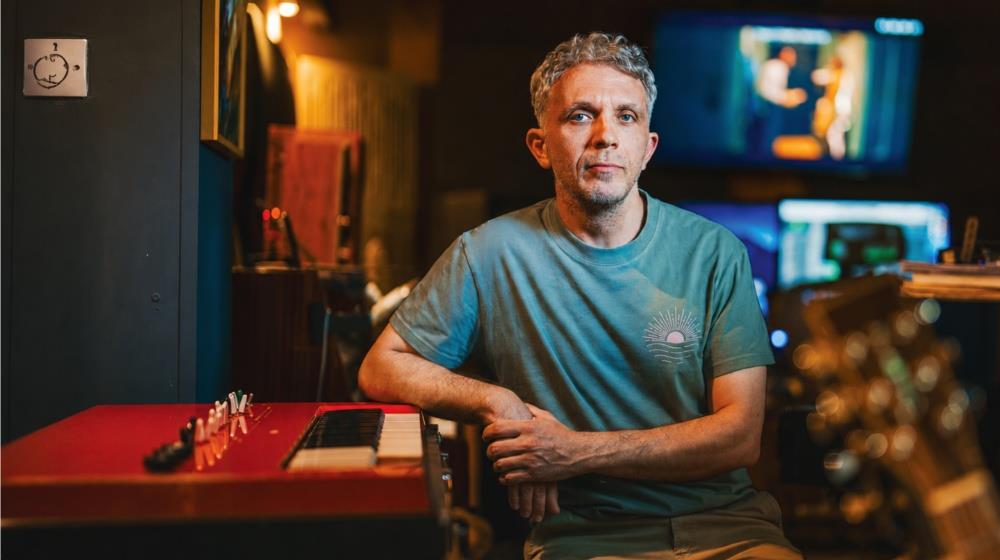
For Cypriot composer Marios Takoushis, the quiet power of music has been a lifelong fascination. From Netflix series and award-winning films to video games and international campaigns for some of the world's biggest brands, Takoushis has devoted his career to exploring the delicate relationship between sound and image.
His compositions become part of the narrative itself – an invisible presence that shapes the audience's experience within.
What first drew you to composition and what role did film music play in shaping that interest?
Music was simply the thing I was most drawn to from a very young age. Over time, it became clear that it was something I was going to pursue professionally. Cinema and film music had a particularly strong impact on me. I was fascinated by the way music could completely change the meaning of a scene without drawing attention to itself and without being "heard". That relationship between image and sound still feels magical. There wasn't a specific person who pushed me in that direction. I started out as a pianist, and improvisation was a big part of how I learned music. Creating ideas at the piano came naturally, and composing gradually became an extension of that process. Before I really thought of it as a profession, I was already spending a lot of time arranging and exploring music on my own.
You studied at Berklee College of Music and the Conservatoire National Supérieur Musique et Danse de Lyon – two very different musical environments. How did those experiences shape you, both artistically and personally?
At Berklee I understood how competitive the music world is. I was surrounded by incredibly talented musicians from all over the world, each with their own ambitions and level of dedication. It made me realise how many great musicians are out there and how much work is required if you want to find your own voice. It was both inspiring and humbling and it pushed me to work harder. Lyon offered something different. It encouraged deeper listening and a broader perspective on music and culture. It was a place where I had the opportunity to explore music in a more open way, while also deepening my appreciation for cinema and the relationship between music and image.
You have composed award-winning music for both cinema and video game productions, from Balik and The End of the Line to Need for Speed: Hot Pursuit. Which project challenged you the most creatively, and why?
It's difficult for me to single out one project because every score presents its own challenges. Some projects require a lot of music, while others require very little. Sometimes the hardest thing is knowing what to leave out. Also, I wouldn't say that larger productions are necessarily more challenging than smaller films. Some of the most rewarding experiences can come from very intimate stories where every musical decision matters. What I have learned over the years is that the real challenge lies in understanding what each story needs and finding the right musical approach for it. Whether the audience is hundreds or millions of people, that responsibility remains the same.
You've worked on Netflix productions including Love 101, Lovers Anonymous and The Museum of Innocence. Has the streaming era changed the way composers approach storytelling?
Yes and no. Streaming has created more opportunities for long-form storytelling, which means composers often spend much more time with the characters and the story than they would in a 120-minute film. In that sense, it allows music to develop more gradually and become a bigger part of the narrative. On the other hand, I don't think the essence of the job has changed. Whether it's a streaming series, a film or a television production, you're still trying to understand the story and support it through music.
You have also composed music for global brands such as Red Bull F1, Panasonic, Adidas and others. How do you preserve your artistic identity within commercial work?
In commercials, I don't really think about preserving an artistic identity! My job is to understand what the project needs and try to do it well. Commercial work is different from film or television because the focus is naturally on the product or the brand and I think it's important to respect that. The music is there to support the message, not compete with it. At the same time, that doesn't mean there is no room for creativity. There absolutely is. It's just that the main goal is to support what you're trying to communicate or sell. Once you understand that, the creative process becomes about finding the most effective musical solution for the project.
What emotion dominates your mind when you are beginning a new composition? Excitement? Apprehension? Or something else entirely?
Usually, it is a mixture of excitement and uncertainty. The beginning of a project is exciting because every story offers the opportunity to create its own musical world. One of the first things I look for is what might give the project its own musical character. Sometimes it's a long theme, sometimes it's a sound and sometimes it's something like a simple two or three-note motif. At the same time, there is always some uncertainty because there is no formula for finding the right musical voice for a story. Every project requires a different approach. I've learned to accept that uncertainty as part of the process. Once the exploration begins, creativity usually takes over and the blank page of the score becomes much less intimidating.
Are there any kinds of stories or projects that you are still dreaming of scoring?
I don't dream about a specific type of project. What matters most to me is working on good stories with people who care about what they're making. Whether a project is large or small doesn't really matter. What matters is the quality of the story, the collaboration and the opportunity to contribute something meaningful through music. As long as I continue working on interesting projects with passionate people, I'll always feel very fortunate.
(Original photo by TADOBI)
This interview first appeared in the 2026 edition of The Cyprus Journal of Wealth Management. Click here to view it.