






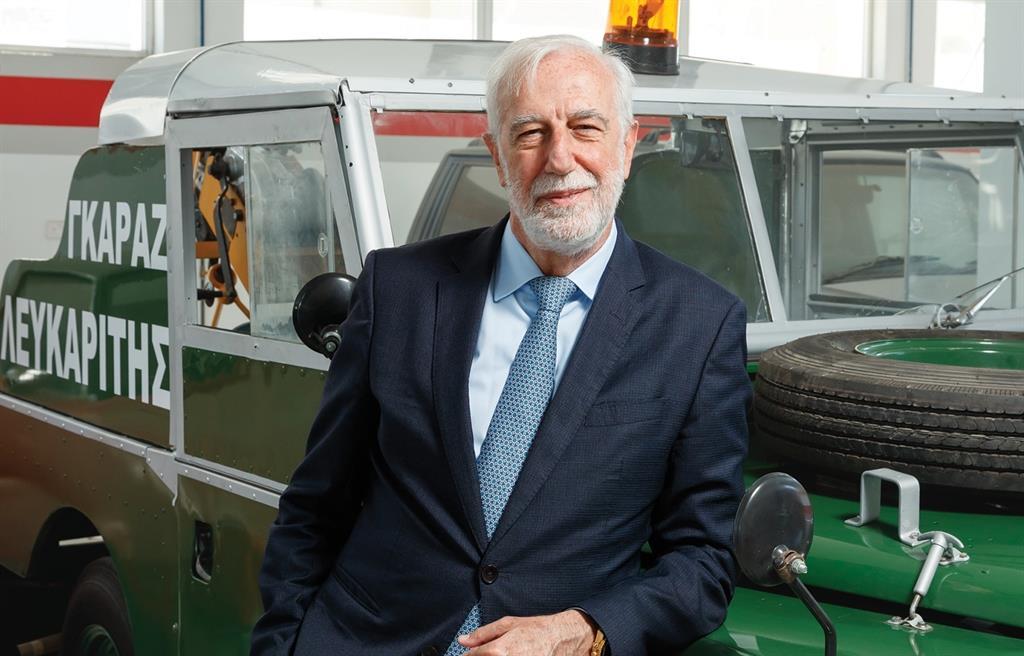
The story of Petrolina Group is inextricably linked to the business journey of the Lefkaritis family and Cyprus’ economic development. From a family business founded in 1959 by the Lefkaritis brothers -with roots dating back to 1939- it became a public company in 2000 and has since evolved into a modern energy group with a turnover of €560 million and a workforce of more than 550 people, steadily moving into a new era. Dinos Lefkaritis, CEO of Petrolina (Holdings) Public and of the Lefkaritis Group, welcomes us to the group’s headquarters in Larnaca, and in a wide-ranging interview discusses the milestones and major investments of the two historic businesses, as well as the future of energy.
What is Petrolina (Holdings) Public today? Describe its multifaceted activities for us.
Petrolina (Holdings) Public is a public oil-products company with Cypriot interests, active in the broader energy sector. It operates one of the largest fuel-station networks in Cyprus — Petrolina, Eni and Agip — alongside the affiliated Esso station network, operated by the wholly owned subsidiary eWise Cyprus Ltd. It has sales points in Greece through its subsidiary Silk Oil S.A., as well as its own fuel storage and management facilities in Cyprus (Vasiliko) and Greece (Samos, Chania). It is also active in the storage and management of LPG in Vasiliko, as well as in aircraft refuelling. In addition, it leads in electric-vehicle charging through pcharge, the largest recharging network in Cyprus. In collaboration with the Lefkaritis Group, it is strategically expanding into land development through Land of Tomorrow, focusing on the sustainable urban transformation of Larnaca. The main subsidiaries of the Petrolina Group are Med Energywise, eWise Cyprus, Silk Oil and Petrolina Bayfront, while its main affiliated companies include PPT Aviation Services, LCA Aviation Fueling System (LAFS), Hellenic Aviation Fuels Company (HAFCO) and VLPG Plant.
What do you consider to be the most important milestones in the Petrolina Group’s journey?
The relocation of Petrolina’s facilities from Larnaca’s seafront to Vasiliko is undoubtedly one of the most important projects in the company’s history and one of the largest investments ever made by a Cypriot business, amounting to approximately €80 million.
Among the other key milestones is also our most recent major achievement: the acquisition of ExxonMobil Cyprus for €45.1 million, which was completed following a process of negotiations and approvals by the Competition Commission.
At the same time, expansion into new areas, such as electromobility through pcharge, marks the transition to new forms of energy and services, while the development of the group’s land on Larnaca’s seafront through the Land of Tomorrow project represents a long-term development initiative with a broader economic and social impact on the city.
How decisive was the creation of the group’s own fuel terminal in Vasiliko for its further development?
The project was one of the group’s most important strategic investments and marked the complete transition to a new, state-of-the-art energy terminal with increased storage capacity, a high level of automation, and enhanced safety and environmental-protection standards. The significance of the investment is not limited to its operational upgrade; it extends to the overall competitiveness of Petrolina, as it ensures greater efficiency, higher levels of safety and environmental compliance, as well as the capacity for long-term development in a particularly demanding energy environment.
And what has been the greatest challenge you have had to manage as a group over all these years?
The greatest challenge remains the continuous adaptation to an energy environment that is changing rapidly, both because of geopolitical developments and market volatility, and because of technological advances and the growing demands for sustainability and the energy transition. This challenge requires agility, timely planning and continuous investment in innovation, digital transformation, network upgrading and the customer experience, with the adoption of the principles of sustainable development and ESG criteria as a core strategic priority.
Our role in the new energy era
How is the completion of the acquisition of the entire share capital of ExxonMobil Cyprus by Petrolina’s subsidiary, Med Energywise Ltd, and its renaming as eWise Cyprus Ltd, changing Cyprus’ fuel market?
The acquisition of ExxonMobil Cyprus and the creation of eWise Cyprus Ltd represent an important strategic development for our group, as they strengthen our presence in the Cypriot market and create significant synergies in terms of operations and commercial activity. These synergies enable us to operate more effectively and to continue investing in the quality of the products and services we offer.
As far as the fuel market is concerned, it is important to note that the transaction was thoroughly examined by the Commission for the Protection of Competition. The commitments undertaken under the relevant decision ensure that competition remains healthy and does not materially change following the completion of the acquisition. Our aim is to make the most of the opportunities created, so that we can continue to offer value to consumers, our partners and the Cypriot economy.
With this acquisition, Petrolina incorporated a network of more than 65 ESSO stations in Cyprus. What tangible benefits have consumers already seen?
The integration of the ESSO station network into the new eWise Cyprus Ltd was carried out with the primary aim of ensuring a smooth transition for customers, with no reduction in the quality of the products and services they had come to expect. Today, consumers enjoy the combined experience and expertise of two strong organisations through an upgraded station network that continues to invest in service, reliability and the overall customer experience.
Speaking of the energy sector, the Lefkaritis Group, closely linked to the Petrolina Group, has established its presence in the sector, with a significant footprint in electricity and renewables. What is your vision for the group’s evolution into an energy organisation?
Our strategy in the energy sector is a natural evolution of the Lefkaritis Group’s long-standing presence and responds to the changes shaping the market and the energy transition. Our goal is to evolve continuously by investing in a more modern and sustainable development model. Initiatives such as Petrolina Solar, Petrolina Electric and Petrolina Energy fall within this framework, strengthening our ability to offer comprehensive energy solutions. We aspire to play an even more substantive role in the new energy era.
Back to Petrolina, what will be the greatest challenge for energy companies in Cyprus over the coming years, and how are you preparing for the new era?
As I mentioned earlier, the energy sector is going through a period of significant change, with increased demands in terms of technology, regulation and investment in new forms of energy. At Petrolina, we seek to balance maintaining our traditional activities with the need for innovation and sustainability, investing in infrastructure and new initiatives that ensure long-term competitiveness and a steady development path. At the same time, we strive to meet the modern demands of the market by offering high-quality products and services at affordable prices, supported by advanced technology.
Strengthening Larnaca’s international image
One of the largest investments associated with the name of the Lefkaritis family is the Land of Tomorrow project on Larnaca’s seafront. How will it affect the city’s economic, tourism and investment image in the years ahead?
Land of Tomorrow is currently in the implementation phase of its first stage, which is being developed within the framework of the strategic partnership between the Petrolina Group and the Lefkaritis Group with bbf: and Foster + Partners. According to the schedule, despite bureaucratic delays, construction of the first buildings is expected to begin soon, with the aim of completing them in the 2028–2029 period.
It is an iconic development that is expected to have a tangible impact on Larnaca’s economic, tourism and investment image, contributing to the creation of a new, modern seafront destination with long-term value for the city.
As chairman of Larnaca 2030, how do you view the city’s designation as European Capital of Culture for 2030?
It represents an important opportunity for the city to strengthen its international presence, attract new partnerships and create the conditions for sustainable economic development. The experience of other European cities shows that such an institution can provide a boost to tourism, entrepreneurship and investment, provided it is accompanied by sound planning and cooperation among all stakeholders.
How, in truth, do you manage to balance tradition with continuous transformation, creating one of the largest and most modern organisations in the country?
Petrolina’s history and values form the foundation on which we build, but every era requires adaptation to new conditions. That is why we have consistently invested in our people, in innovation and in the continuous improvement of our services and activities. Our goal is to maintain the reliability and principles that have characterised the group for decades, while at the same time evolving to meet the needs of the market and society. This balance, in my view, is what has enabled us to grow consistently and with a long-term perspective.
The historic Lefkaritis Group
In the energy sector, the Lefkaritis Group is active in the installation of photovoltaic systems through Petrolina Solar, in the supply of electricity through Petrolina Electric, and, through Petrolina Energy, promotes the development of projects for the generation and storage of electricity from renewable sources. At the same time, through the Land of Tomorrow project, it is strategically expanding into land development with the aim of the sustainable urban regeneration of Larnaca’s seafront. The group’s main companies are Lefkaritis Bros, Lefkaritis Industries, Petrolina Solar, Petrolina Electric, Petrolina Energy, Linco Insurance Agent, Sub-Agent and Consultants, and Lefkaritis Bros Seas.
The history of one of Cyprus’ largest and most historic business groups begins in 1939, when the Lefkaritis brothers, Nikos and Takis, founded Lefkaritis Bros Partnership, combining the car businesses they operated in Larnaca and Limassol.
In 1946, the three younger brothers, Kallis, Kikis and Nakis, joined the business, and together they founded Lefkaritis Bros General Partnership, which was active in land transport, as well as Lefkaritis Motors, engaged in the import and sale of vehicles and spare parts.
In 1959, the Lefkaritis brothers went on to establish Petrolina Ltd, the first Cypriot company for the import, distribution and sale of petroleum products.
The company’s official opening took place in 1960.
In 1968, Lefkaritis Bros General Partnership and Lefkaritis Motors merged to create Lefkaritis Bros Ltd, the first company of the Lefkaritis Group.
Since then, the multidimensional business group has, over the years, developed a presence in the broader energy sector, as well as in land and sea transport of liquid fuels, technical and electromechanical services, insurance services, tyre trading and land development.
*Photo: Michalis Kyprianou
*From IN Business magazine, September 2026 issue.