



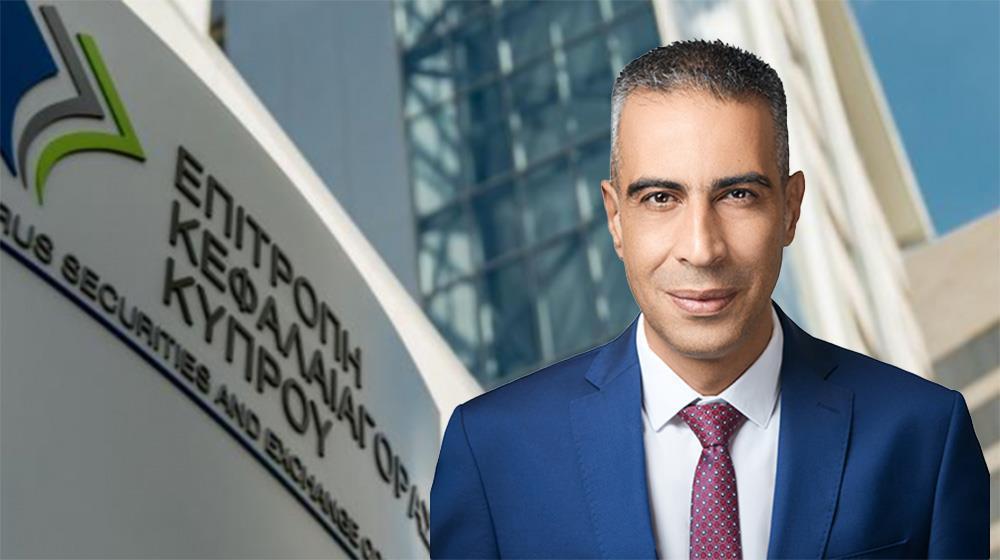
In his first exclusive interview with InBusinessNews and CBN since taking office as Chairman of the Cyprus Securities and Exchange Commission (CySEC), George Karatzias sets out his vision for the Commission’s future, placing the modernisation of its structures, more proactive and effective supervision, and the use of technology at the centre of his agenda.
He discusses the challenges posed by artificial intelligence and crypto-assets, the new risks facing investors, and the prospects for the development of Cyprus’s capital market, stressing that competitiveness and investor protection are not conflicting objectives, but two essential conditions for a market seeking to grow with credibility and an international outlook.
You are taking over the chairmanship of CySEC, having previously served as Vice-Chairman of the Commission and then as an Executive Member of the Central Bank of Cyprus’s Board of Directors. What is your first impression today of the Cypriot capital market, and what do you consider to be the biggest challenge you will have to address?
We are going through a period of significant change in international markets and, by extension, in the Cypriot capital market. The Cypriot capital market comprises several sectors, each at a different stage of its life cycle. For example, the collective investment funds sector is in its growth stage, while the investment firms sector has entered maturity.
Regardless of the stage each sector has reached, the Cypriot capital market as a whole has shown remarkable resilience in recent years, despite operating in an environment of heightened uncertainty and ongoing challenges.
The regulated companies operating in Cyprus must adapt to a constantly changing international environment shaped by geopolitical developments, economic fluctuations, digital transformation, and emerging technological and investment challenges. At the same time, investors’ demands and their expectations of high levels of transparency, accountability and protection are growing steadily.
I believe the biggest challenge before us is to preserve the competitiveness and growth momentum of the Cypriot capital market while ensuring a stronger and more effective supervisory framework. This requires the continuous upgrading and strengthening of our supervisory tools through the use of technology, as well as further improvements to our organisational structures and the skills of CySEC’s staff.
You have described taking over the chairmanship as both a great honour and a significant responsibility. What is your personal challenge for CySEC, and what would you like to have changed by the end of your term?
For me, chairing CySEC is not simply a position of responsibility. It is an opportunity to contribute actively to shaping the organisation’s future.
My personal challenge is, together with the new Vice-Chairman and the staff, to see CySEC evolve into a modern, agile and effective organisation, further strengthening the institutional credibility and standing for which it is known.
My long experience in the sector, along with my service first at CySEC and then at the Central Bank, has given me direct knowledge of the challenges and demands of supervisory work. I therefore know first-hand that achieving this goal requires bold but carefully planned changes.
That is why my key priority is to reorganise and modernise the organisational structure so that it meets today’s needs and tomorrow’s challenges. I want a CySEC that makes the most of its human capital, operates with greater speed and efficiency, plays an active and substantive role in the international institutions in which it participates, and adapts dynamically to a constantly changing environment. My vision is that, by the end of my term, I will hand over an organisation that is strong, agile and ready to meet whatever future challenges arise.
You have spoken about effective and modern supervision. What does that mean in practice? Where do you believe the way CySEC exercises supervision needs to change or be strengthened?
In recent years, the supervisory approach has focused to a large extent on assessing each company individually. This was a deliberate choice, reflecting the circumstances and priorities of that period. That dimension remains important, but I believe current conditions now require us to take the next step towards more proactive and more in-depth supervision.
Greater emphasis is needed on thematic reviews that cut across the market, so that systemic weaknesses, recurring instances of non-compliance and new challenges can be identified early. At the same time, the quality and depth of supervisory assessment must be strengthened through greater use of data, analytical tools and available technological capabilities. Supervision should be more demanding where heightened challenges are identified, and more targeted in how it allocates its resources.
Moreover, for supervision to be meaningful, it must demonstrate in practice that non-compliance carries the appropriate consequences. However, for a supervisor, imposing administrative measures is not an end in itself, but a means of protecting the sector and all regulated entities — those that invest in corporate governance, regulatory compliance and client protection.
It is our duty to ensure that the Securities and Exchange Commission remains consistently one step ahead of developments, exercising supervision with consistency, expertise and strategic foresight, for the benefit of the credibility and competitiveness of the Cypriot capital market.
Cyprus has established itself as a significant financial centre with a strong presence of investment firms, investment funds and cross-border activities. How can CySEC further support the market’s growth without weakening supervisory standards and investor protection?
Effective supervision and growth are not conflicting concepts. On the contrary, effective supervision is a fundamental prerequisite for the sustainable growth of a modern and competitive capital market. International experience shows that financial centres that grow and endure over time are those built on strong institutional credibility.
Cyprus has built a significant financial centre with a strong European and international presence of investment services firms and investment funds. To maintain and strengthen this momentum, an environment of trust, transparency and market integrity must be continuously cultivated and reinforced. Investor confidence is the foundation of every successful capital market and a key factor in attracting investment of real value.
CySEC can continue to contribute decisively in this direction through a modern, effective and proportionate supervisory approach, making full use of the technology and supervisory tools at its disposal. At the same time, regulatory clarity, consistency and predictability in the application of the regulatory framework, together with timely adaptation to European and international developments, strengthen legal certainty and create the conditions for healthy business growth.
CySEC’s mission is to ensure that the market’s growth rests on solid foundations of credibility, integrity and trust. Through this approach, the Cypriot capital market can further strengthen its international position and develop in a sustainable, resilient way that benefits investors, the market and the economy as a whole.
CySEC is required to supervise an increasingly digital market. How will artificial intelligence, automation and the use of data affect supervision in the years ahead? Is CySEC itself sufficiently prepared technologically?
These are challenges facing supervisors around the world. Artificial intelligence, automation and the use of large volumes of data are continuously transforming supervisory work, enhancing the ability to identify risks and challenges early, and enabling the effective processing and analysis of information, resulting in targeted and efficient supervisory interventions.
As the Securities and Exchange Commission, we follow a technology-neutral approach: we do not supervise technology as such, but the risks and consequences arising from its use. We monitor these developments closely and are in a process of continuous technological upgrading. We are systematically investing in modern systems and digital tools, while also strengthening our internal capabilities and the expertise of our staff.
Our aim is to ensure that CySEC has the appropriate tools to respond effectively to technological developments and to the new demands of an increasingly digital market.
The MiCA Regulation has changed the landscape for crypto-assets in the European Union. What is your current assessment of the market in Cyprus, and what do you consider to be the biggest challenges for CySEC in implementing the new framework?
For many years, the crypto-assets market operated outside a supervisory framework, with the first steps towards regulation taken through the EU’s Fifth Anti-Money Laundering Directive (AMLD5). The implementation of the MiCA Regulation is a milestone for Europe’s digital asset market, as it creates, for the first time, a single and harmonised supervisory framework across the entire European Union.
Crypto-asset service providers are now required to operate under requirements comparable to those applying in other regulated financial sectors, in areas such as governance, capital adequacy, operational resilience and client protection.
In Cyprus, the sector has attracted major companies with an international presence and is showing strong growth. I believe the coming years will be decisive for the market’s maturation, as innovative companies currently at an early stage evolve into institutionally robust organisations, with greater emphasis on corporate governance.
It is likely that we will see greater participation by institutional investors, higher levels of transparency, and a market increasingly concentrated around companies with strong compliance structures and sustainable business models. I expect the new framework to favour organisations with these characteristics.
For CySEC, the biggest challenge is to implement this new and highly demanding regulatory framework effectively in a sector that is evolving at an exceptionally fast pace. This requires specialised expertise, continuous monitoring of technological developments, and close cooperation both with the Central Bank of Cyprus, which is the designated competent supervisory authority for this legislation in Cyprus, and with the other European supervisory authorities, to ensure consistent application of the framework across the European Union.
At the same time, we must strike the right balance between two equally important objectives: protecting investors and maintaining an environment that allows innovation and the healthy development of the sector. Although MiCA does not eliminate all the risks associated with crypto-asset markets, I believe it provides the essential tools to achieve this balance, strengthening confidence in the market and creating new opportunities for Cyprus as a regional centre of technological and financial innovation.
In recent years, Cyprus has significantly strengthened its investment funds sector. What is the next step? Is there potential for Cyprus to attract larger and more complex investment capital, and what obstacles need to be addressed?
It is true that, over the past decade, Cyprus has made significant progress in the investment funds sector, strengthening its regulatory framework in this direction. However, this is a highly competitive sector at European level, and there is no room for complacency.
The next step is to reassess the European environment and adapt the legislative and regulatory framework to new international developments and market needs, so that Cyprus can maintain and strengthen its position as a competitive and sustainable destination internationally.
Equally important is the involvement of all stakeholders in the sector in these efforts towards modernisation and promotion. The potential to attract larger and more complex investment capital remains. What matters, however, is not only the size of the capital attracted, but also preserving and strengthening Cyprus’s competitiveness as a credible, modern and attractive investment destination.
A major European challenge is the Savings and Investments Union. What does this development mean for a smaller market such as Cyprus, and how can Cyprus benefit from the European integration of capital markets rather than face greater competition from major financial centres?
The Savings and Investments Union is a particularly important development for Europe as a whole, as its aim is to channel savings that are currently lying idle more effectively into the real economy, and to broaden the investment options available to businesses and individual investors.
Cyprus has already established itself as an international centre for cross-border financial activities. Within a more integrated European capital markets ecosystem, it can leverage its comparative advantages, attract new investment linked to innovation and technology, and further strengthen its role as a regional investment hub.
At the same time, the European integration of capital markets can significantly broaden Cypriot businesses’ access to investment capital. Small and medium-sized enterprises, innovative companies and growing sectors of the economy will find it easier to raise funding from a much wider European investor base, reducing their reliance on traditional bank lending.
There is no doubt that integration will increase competition, as investors will have even more options and major financial centres will seek to attract a larger share of European capital. For Cyprus, it is important that the European framework takes into account the particularities of smaller member states and ensures a level playing field and equal opportunities for participation for all.
Investor protection lies at the heart of CySEC’s mission. What are the biggest risks facing Cypriot investors today? Have they changed in recent years and, if so, in what direction?
The risks have evolved significantly in recent years, mainly as a result of the digitalisation of financial services and the speed at which information now circulates. Today, access to investments is easier than ever, but so too is investors’ exposure to misleading practices, unlicensed platforms and online scams.
Particular caution is needed regarding investment “opportunities” promoted through social media. So-called finfluencers and various self-proclaimed financial “gurus” now wield considerable influence, particularly among younger people, without always having the necessary expertise or being subject to supervision. At the same time, the development of artificial intelligence makes it easier to create content that appears entirely credible and professional, but is not necessarily true or reliable.
As a result, today’s investor must not only assess whether an investment is suitable for their profile and objectives. They must first determine whether the information on which they are basing their decision is reliable.
That is why, as the Securities and Exchange Commission, we insist on a number of fundamental principles: do not make hasty investment decisions; fully understand the product and the risks associated with it; and always check whether the company offering the relevant services is licensed by a competent supervisory authority. And, of course, any promise of easy, quick or guaranteed returns without risk should be treated as a warning sign, not as an incentive to invest. This is a rule that remains relevant regardless of how much technology or the markets evolve.
On the occasion of World Investor Week, in which you participated, tell us about the importance of financial literacy in protecting investors and the public from financial scams, particularly online.
Financial literacy is today one of the most important lines of defence against financial scams and misleading investment practices. In an environment where false information or a purported investment “opportunity” can spread through the internet and social media to thousands of people within minutes, investors’ own knowledge and critical thinking become decisive.
It is no coincidence that financial literacy now ranks highly among the priorities of all national supervisory authorities, as well as European and international organisations such as the European Securities and Markets Authority, the International Organization of Securities Commissions, the Organisation for Economic Co-operation and Development and the European Commission. Improving citizens’ knowledge and skills helps create better-informed investors who can assess risks more effectively, identify suspicious practices and make conscious, responsible decisions.
Financial literacy does not replace supervision or the regulatory framework. It complements them. No matter how strong supervision is, no mechanism can fully replace an informed and vigilant citizen who knows when to be cautious and what questions to ask before investing.
One of the key messages of World Investor Week is precisely this: before making any investment decision, we need to pause, examine the information before us, verify its source, and confirm that the company or individual promoting the investment is licensed and reliable.
Financial literacy is not only for those who invest. It concerns us all. It is an essential life skill that should be cultivated from an early age and continually developed, so that it keeps pace with technological developments, changing markets and the new forms of challenge emerging in the digital age.
Finally, what message would you like to send today to investors, investment firms and the international organisations following the Cypriot capital market? What kind of Cyprus do you want them to see through the way CySEC operates?
The message I want to send to investors, regulated entities and international organisations is that the Cyprus Securities and Exchange Commission remains committed to its mission of ensuring the orderly functioning and healthy development of the market through effective supervision, always with investor protection at its core.
As the new Chairman of CySEC, I believe that effective supervision must go hand in hand with modernisation, transparency and ongoing communication with the market. Our priority is to further strengthen our operational readiness and supervisory capabilities, so that we can respond promptly and effectively to developments in the European and international environment.
At the same time, our approach remains clear: consistent application of the regulatory framework, firm and proportionate supervision where required, and constructive dialogue with regulated entities. A healthy and credible market requires clear rules, accountability and trust from all participants.
Through CySEC’s work, I want a Cyprus to emerge that is credible, consistent and committed to preserving confidence in the market — a country that effectively applies European standards and provides a stable and transparent operating framework for investors and regulated entities. Our goal is to further strengthen a market that grows in a healthy and sustainable way, for the benefit of the economy and society as a whole. This is the direction in which I will serve as Chairman of CySEC.