






Back in Cyprus 20 years after her first visit, this time as Ambassador of Italy, Antonella Cavallari sits down with GOLD magazine to discuss the future of business relations between the two countries as well as many of the common issues facing them.
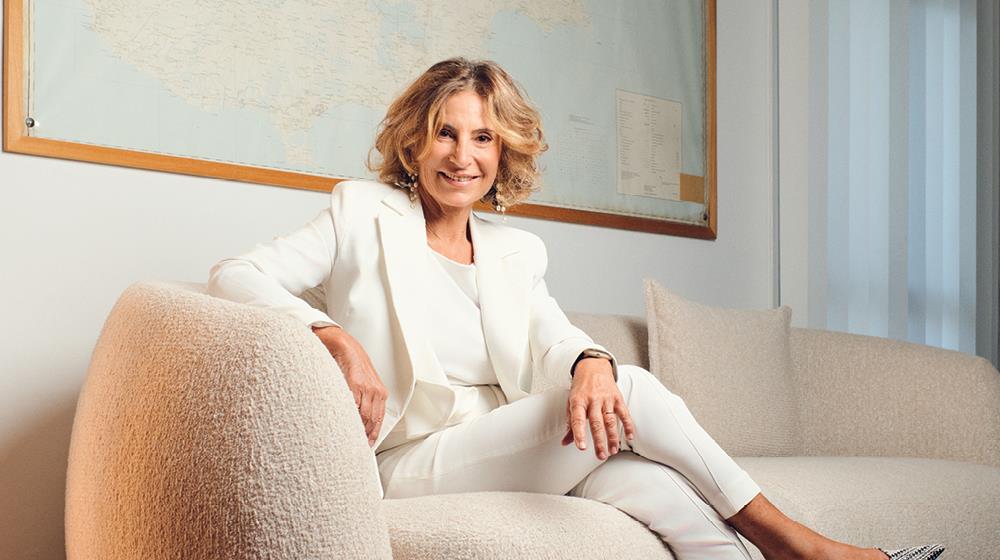
Stepping into her office, I immediately take in its Italian elegance, as Ambassador Antonella Cavallari greets me with a warm smile and a firm handshake, and invites me to sit down on the fluid crescent-shaped couch to begin our discussion. She quickly offers an espresso, as she doubtless would have done had this been Rome, and we start by delving into the relationship between Cyprus and Italy, two countries that have always been excellent partners and, in recent years, have become closer allies, facing the same all too familiar European issues and a changing international landscape.
Returning to Cyprus 20 years after her first stay in another capacity, Ambassador Cavallari has been impressed by the way in which the country has changed.
“I see how the country has grown without losing its spirit, and that’s very important – a country can grow and lose its character. The Cypriots are still the same good-hearted, hospitable people that I met 20 years ago, but now they are also much more aware of the world around them,” she notes, comparing her experiences of the island.
Building bridges through business and diplomacy
Surrounded by the warm Italian hospitality, which can soften even the most rigid, Ambassador Cavallari starts developing on the already strong relationship between the two countries, insisting that now, “we need structure and continuity,” and not just to further deepen the relationship.
Italy and Cyprus already cooperate well in all the traditional sectors, the best-known being energy with ENI’s involvement in Block 6 of Cyprus’ Exclusive Economic Zone (EEZ). Ambassador Cavallari notes, “We want to sign a memorandum or plan of action to create a structure where we can place all the different initiatives we want to realise, and also ensure continuity, so it’s not just something done on the spot and then nothing for months,” she emphasises, pointing to the fact that both countries have sectors where cooperation could be expanded. She notes that society nowadays has different needs and the economy has changed, meaning that if the relationship is to evolve, it should not always be based on the same sectors. Looking deeper into where cooperation can be expanded, she draws attention to AI and digitalisation. “AI, digitalisation and the use of AI in business are very important,” she says, revealing that an Italian company had recently reached out, wanting to examine the setting up of a joint venture with its Cypriot counterpart. “It is choosing only a few countries, and one of them is Cyprus, because this is an interesting environment in which to develop technological skills and capabilities among workers.” Continuing, she notes that employees require different training now, including the efficient use of new tools like AI. “There is a lot to be done and plenty of room to work together, especially through joint ventures, where each party invests capital and shares objectives and profits,” she mentions. She is especially keen on such joint ventures, describing them as “a particularly interesting field to explore: putting Cypriot and Italian capital together to create something new.”
Another area that Ambassador Cavallari is passionate about concerns space and satellite monitoring, a sector she knows well. She notes that, “Italy is quite strong in this field and has a lot to share, and Cyprus is starting in a good way,” before revealing that she is in close contact with the Eratosthenes Centre of Excellence and plans to co-organise Italy-Cyprus Space Days next year. “Satellite monitoring affects many sectors of our daily life, from agriculture to cultural heritage to infrastructure security,” she says. “My idea is to put my network of contacts in this sector at the disposal of the relationship, to deepen our cooperation and do something together that is meaningful, helpful and win-win.”
One of the best-known sectors of the Italian economy is the luxury goods market. Italian brands have become the staples across many sectors, from fashion to home furnishings, and they represent a sizeable part of the trade between the two countries – around 7.5% of the total $1.12 billion in Cypriot imports from Italy. Expanding on the topic of luxury goods, Ambassador Cavallari says that, “It’s not simply about selling expensive items but is rather about a way of life.” She sees the value of cooperation between Cyprus and Italy, noting that as the island continues to market and expand its tourism product – and wants to attract high-end visitors – there exists the potential for synergies. “Luxury properties need to be decorated, furnished and sold as such, and this fits perfectly with the Italian concept of lifestyle,” she notes. Even at the other end of the scale – handicrafts – she tells GOLD that a Cypriot-Italian joint venture could work very well, by “adopting traditional techniques and new designs.”
Migration, Europe and Cyprus’ future
The conversation moves to the EU and the common problems facing Italy and Cyprus as frontline states for migration, and its impact on the economy. The Italian Ambassador praises Cyprus’ recent EU Presidency for “placing the Mediterranean at the centre of the European agenda because the Mediterranean is structurally important to the EU.” On the migration issue, she would like to see countries move from crisis management to what she calls “migration governance.” Noting that the EU is still “very much in crisis-response mode – look at what’s happening in Ceuta, for example,” she concedes that the European response has been “quite effective,” thanks to the pact on Asylum and Migration, which was launched here in Cyprus in June and combines responsibility and solidarity.
Leaning forward on the plush couch, she notes that, “Not all member states are exposed to migration in the same way. Migration is a problem but it is also an opportunity. Many European societies are getting older, their demographic structures are unbalanced and there is a need to find workers in specialised areas, which Cypriots, Italians and many other Europeans are unfamiliar with. We must therefore govern migration – manage legal pathways. We must know who is entering and why,” she says.
As for why people wish to move to Europe, she believes that each reason must be addressed with a different strategy. On the specific area of economic migration, she notes that, “Most people do not want to leave their country; they are looking for better living conditions. If we help them to have decent work and prospects in their own countries, they won’t be forced to migrate,” Ambassador Cavallari says.
This sounds idyllic, but can it work? Her answer is a definite “yes” and she points out that Italy has launched a large plan of public and private investments to help African countries build infrastructure, develop their economies, and create a labour market that can absorb their workforce, so that people are not forced to migrate to Europe. The Ambassador notes that more European countries are following this kind of approach “because it is effective and can produce results in the long run.”
Italy also has about five million volunteers – a huge number – who work to help migrants integrate, to act as cultural mediaries and, more generally, to help people in need, whether or not they are migrants. She makes particular mention of such organisations in Cyprus such as Italy’s Sant’Egidio and the Catholic charity Caritas, which work with migrants here. “I went with Sant’Egidio to see their work with migrants in the Pournara camp here in Cyprus, and I also received a visit from the director of Caritas, who explained what they’re doing,” she says, indicating that these organisations not only have a strong presence but are important to the integration process of migrants.
Finally, I feel obliged to ask Ambassador Cavallari about the unresolved Cyprus Problem, which seems to be once again making some slow progress but has nonetheless remained largely unchanged since her previous time on the island. How does she view the current situation?
“It’s very hard to say, because there is a strong sense of pessimism due to previous failed attempts [in 2004 and 2017],” she says. “People are losing hope and that is the saddest part.”
Is anything different now from what she saw in 2006?
“Yes. The Eastern Mediterranean is not what it was in 2017. What worries me – but, at the same time, gives me hope – is that this new context requires some kind of settlement. If it is not found, I’m not sure that the alternative will simply be the status quo, because the regional context is very unstable – we see wars everywhere. We do not need another source of tension,” she says.
On a more hopeful note, she says, “The potential of a united Cyprus is enormous – especially for the Cypriots, who will be able to live in peace, use their resources in the best possible way, and be a model for the region. We are in urgent need of an example of successful diplomacy and I hope that wisdom and flexibility will prevail to find a solution consistent with the UN framework, and provide a win-win settlement for both communities.”
As our conversation draws to a close, the Ambassador returns to the subject of how Cyprus has developed since she last spent time in the country. She sees its political importance growing: “Energy, investment, connectivity, the launch of the India–Middle East–Europe Economic Corridor (IMEC), and new international formats like Med9 and Med5 – Cyprus is, in a sense, at the centre of many of these initiatives.”
Does this make her job easier or more difficult?
“Being a diplomat here nowadays is demanding – you have to follow all these developments – but it is also very rewarding,” she says with a smile.
Photo by TASPHO
This interview first appeared in the September edition of GOLD magazine. Click here to view it.