







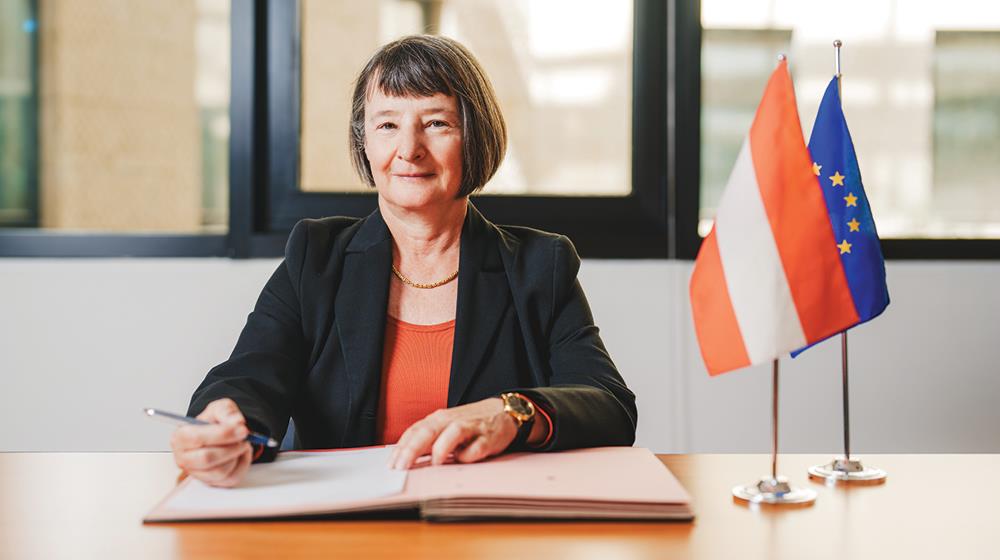
“There is great potential to further deepen our business cooperation. The Cypriot economy remains dynamic, while Austrian expertise enjoys a very strong reputation. Through the “Best Practice Austria” initiative, Austrian know-how has been transferred into concrete projects with Cypriot partners. Several Austrian companies are already active in Cyprus in areas ranging from insurance and certification to energy and water management. The foreign trade organisation Advantage Austria plays an important role in supporting Austrian companies seeking market access to Cyprus and in facilitating the establishment of business contacts between companies in Austria, Greece and Cyprus,” suggests Dr Susanne Bachfischer, Ambassador of Austria to Cyprus.
In an interview with GOLD magazine, she talks about how Cyprus-Austria business relations can be expanded, recent cooperation in education and the people-to-people contact which, she believes, can help foster peace on this long-divided island.
How would you describe the current state of relations between Cyprus and Austria and where do you see the most untapped potential?
Austrian-Cypriot relations are truly special because they are built on a foundation of trust and friendship – at both the political level and through the many personal ties that connect our people. Austrians love the Cyprus sun and hospitality, while Cypriots admire Austrian culture and the landscape. As two of the EU’s smaller member states, we share similar values and views on regional and security issues. Austria has also contributed to UNFICYP since 1964 and more than 16,000 Austrian peacekeepers have served in this mission over the years, reinforcing mutual bonds.
In the economic sphere, cooperation is growing not only in terms of tourism but also in trade and foreign direct investment (FDI) with more than €1 billion. We have witnessed this in recent years with a growing number of projects such as intergovernmental digital innovation, where local authorities work with Austrian expertise on smart cities. Institutional partnerships have also flourished, for instance between the Cyprus Biobank and the University of Graz or between the Ars-Electronica Festival and CYENS CoE. Participation in economic fora and other related events is strong and there is, of course, cultural diplomacy, which creates opportunities for people to come together and for genuine exchange.
I see potential in the green energy transition and in digital transformation. Austria has real expertise to offer in e-governance, as well as in attracting further FDI on innovation. Both countries are home to outstanding educational institutions and strengthening academic ties through research partnerships, joint ventures and significantly expanded student exchanges is something I feel very strongly about.
Are there any bilateral initiatives in the pipeline regarding expanding business relations? What Austrian companies or investments are already present in Cyprus and are more planned in the future?
There is great potential to further deepen our business cooperation. The Cypriot economy remains dynamic, while Austrian expertise enjoys a very strong reputation. Through the “Best Practice Austria” initiative, Austrian know-how has been transferred into concrete projects with Cypriot partners. Several Austrian companies are already active in Cyprus in areas ranging from insurance and certification to energy and water management. The foreign trade organisation Advantage Austria plays an important role in supporting Austrian companies seeking market access to Cyprus and in facilitating the establishment of business contacts between companies in Austria, Greece and Cyprus. Another important actor is the Cyprus-Austria Business Association, which in my view plays a key role in trade relations between Cyprus and Austria.
Austria’s participation in various business-related events further highlights our strong ambition to strengthen these relations with Cyprus. A planned Austrian business mission to Cyprus in 2027 will bring together companies from key sectors – construction, waste management, renewable energy and tourism. I see this initiative as an important opportunity to foster partnerships and support future projects in Cyprus. Given Cyprus’ attractive business environment and strategic location, there is certainly potential for more Austrian investments and for Austrian companies to expand their presence here.
Austria is seen as a leader in sustainability, so what lessons can Cyprus draw from your country’s green transition?
I am convinced that, in the light of global issues like the climate crisis, both Austria and Cyprus can benefit tremendously from even closer cooperation. Both countries will gain by exchanging knowledge of developing renewable energy systems, including energy storage technologies. Through its expansion of renewable energy production, Austria has demonstrated how natural resources can be used in a sustainable way to address climate change. We are already focusing strongly on the expansion of energy storage systems with a view to building a future-proof energy infrastructure and meeting the growing need for grid flexibility. Cyprus is making notable progress in this area, too, particularly by expanding its renewable energy capacity. At the same time, the growing amount of solar energy highlights the need for greater investment in smart grids and storage to fully utilise this potential. It is a significant step that Cyprus has enabled solar park operators to add battery storage systems alongside their existing plants since January 2026.
Given the crises in Cyprus’ broader neighbourhood that are affecting global markets and supply chains, what appears to be the best path forward for the EU?
The multiple crises in Cyprus’ neighbourhood are a reminder that the EU cannot afford to be reactive. The way forward is to strengthen Europe’s strategic autonomy, while staying open to the world. Tensions in the Middle East serve as a reminder of Europe’s continued dependence on imported oil and gas. Any escalation in this region affects global energy prices and that has direct consequences for households, businesses and, ultimately, Europe’s competitiveness. In this context, Austria supports a comprehensive approach to energy security: stronger coordination on oil and gas alongside increased domestic energy production and renewables expansion. In general, we need a greater balance and diversification backed up by stronger partnerships. Energy security remains a core part of Europe’s strategy. Investing in renewables is about both climate goals and security. This is why the energy transition needs to accelerate with investments in cross-border interconnectors to increase resilience, especially for island nations like Cyprus.
Recent high-level visits have focused on expanding cooperation in education. How can Austria’s strong higher education and vocational training system be leveraged in cooperation with Cyprus? How does Austria support innovation and do you see opportunities for cross-border collaboration?
Education has become a dynamic area in Austria-Cyprus relations and was a topic of recent high-level visits by Foreign Minister Beate Meinl-Reisinger in June last year and by Chancellor Christian Stocker in August. The 2024 MoU on student mobility and the modernisation of educational systems between our Ministries of Education demonstrates a genuine commitment to collaboration. Austria’s top-tier educational model is internationally recognised and our expertise can assist Cyprus in further developing its Post-Secondary Institutes of Vocational Education and Training (MIEEK) through apprenticeship programmes aligned with labour market demands. I would really love to see more vocational exchange programmes between our countries. The same logic applies to our cooperation in higher education. It has the potential for collaboration among students, researchers and academic institutions, as well as for joint research projects and student mobility. Currently, Austrian universities offer more than 300 courses taught in English. Let’s not forget the human aspect: having the opportunity to study abroad and exchange ideas creates invaluable experiences.
I am particularly excited about Austria’s role in supporting Cyprus in the fields of innovation and digitalisation. Several government-to-government projects aimed at improving public services – ranging from the labour market to social security applications – have kicked off since we signed the MoU on digital transformation. Our cooperation in innovation is supported by longstanding ties between the Research and Innovation Foundation (RIF) and Austria’s national R&D funding agency (FFG). Austria intends to improve links between innovation systems and joint research and development initiatives, particularly within the framework EU funding programmes.
You mentioned that Austria has actively supported UNFICYP missions in Cyprus since 1964. How do you think the Cyprus problem can best be solved? What more should be done by both sides to bridge communities and promote peace?
Austria supports the unity, sovereignty and territorial integrity of Cyprus in line with the relevant United Nations Security Council resolutions. We remain fully committed to supporting a solution to the Cyprus issue that brings the island’s division to an end. Yes, Austria has maintained a presence in Cyprus since 1964. Through the deployment of peacekeeping forces, we have demonstrated our solidarity with the Cypriot people and our commitment to peace and stability on the island. I believe that peace is possible if there is mutual trust and genuine willingness from all sides. Even when progress seems slow, persistence is paramount. The EU stands as a living example of how cooperation can overcome painful divisions. Relationships that are formed today are those that will carry this process forward for future generations. In this sense, Austria supports various bicommunal initiatives that create trust between the communities. Investing in opportunities for young people – particularly in areas that benefit everyone, such as sustainability, cultural heritage and entrepreneurship – can build organic foundations for peace.
Finally, how has your time in Cyprus been so far?
My time in Cyprus has been truly enriching, both professionally and personally. The Cyprus EU Presidency has been particularly interesting for me. I continue to be impressed by the excellent cooperation with our many institutional and cultural partners as well as the diplomatic corps. This genuine spirit of collaboration and dialogue makes working here especially rewarding. I truly appreciate the warm Cypriot hospitality that I experience every day. The country’s nature and cultural diversity contribute significantly to a high quality of life. Culturally, I find
Cyprus truly fascinating, shaped by its complex history at the crossroads of Europe, the Middle East and North Africa. I adore Cypriot cuisine, its fresh local ingredients and traditional dishes. Being posted to such a welcoming environment is an honour and I look forward to strengthening the relationship between Cypriots and Austrians even further.
This interview first appeared in the July edition of GOLD magazine. Click here to view it.
