








The land development and construction sector is one of the most important pillars of the Cypriot economy, contributing significantly to employment, infrastructure development and the overall competitiveness of the country.
At the same time, changes in urban planning policy, housing issues, licensing procedures and the investment environment are shaping a new reality for the real estate market and construction.
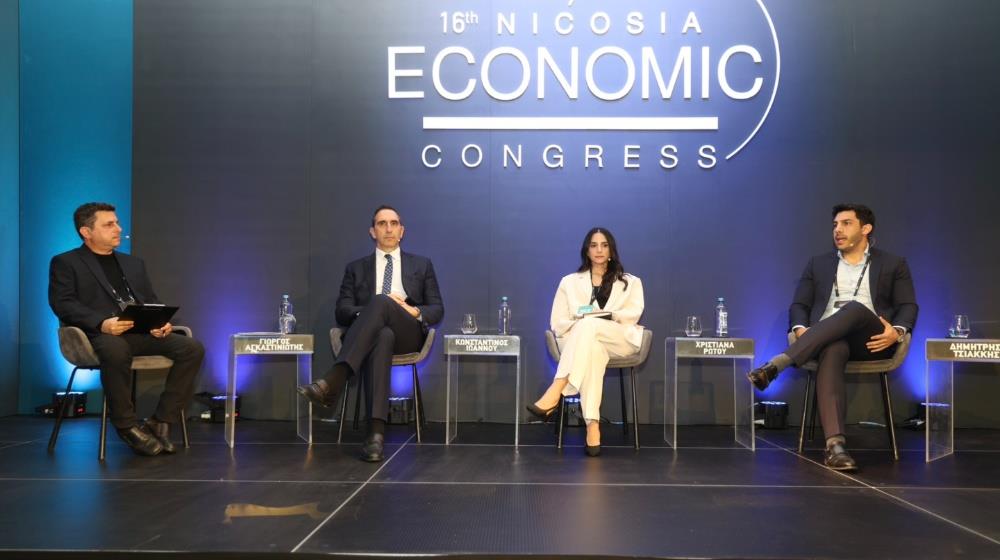
These issues were at the center of discussion held within the framework of the 16th Nicosia Economic Congress.
During the discussion, the government's vision for the modernisation of the sector, the effectiveness of the reforms being promoted, such as faster licensing procedures and changes in spatial planning, as well as investment prospects in housing, tourism developments, infrastructure and new types of projects were examined.
At the same time, the challenges that businesses in the sector continue to face were raised, as well as the impact of geopolitical instability on real estate investments.
The development of the real estate market is the result of public-private sector cooperation
Constantinos Ioannou, Minister of Interior of the Republic of Cyprus, Christiana Rotou, Director of Operations, ROTOS GROUP, and Demetris Tsiakkis, Head of Real Estate Business Development and Strategy, Themis Portfolio Management Limited particiapted in the panel discission.
Constantinos Ioannou clarified that attracting investment in the sector does not depend exclusively on the government, but also requires cooperation from the private sector.
"It is not up to the government alone to attract investors. It is also up to the private sector to take its own actions," he said, emphasising that the development of the real estate market is the result of public and private sector cooperation.
The Minister noted that attracting foreign companies to Cyprus in recent years has been a significant success, as it has contributed not only to the development of the real estate sector but also to other sectors of the economy, such as education. As he stated, the presence of international companies in the country has strengthened economic activity and is also reflected in the growth of GDP in recent years.
Referring to infrastructure, Ioannou admitted that in several cases development precedes the necessary infrastructure, which is largely related to the way projects are tendered.
At the same time, he presented the reforms promoted by the Ministry of Interior to modernise the sector. As he mentioned, a major reform effort is underway at the Ministry that began last summer and is expected to be completed in 2027.
The central axis of this effort is the revision of urban plans, with the aim of modernising development zones and accelerating licensing procedures.
The aim is to implement reforms that will facilitate business activity and strengthen the investment environment in the land development and construction sectors.
"Tackling" for project implementation
From the market perspective, Christiana Rotou noted that Cyprus has significant growth prospects both before and after the geopolitical crises affecting the region.
As she mentioned, a key challenge is the need for proper development planning, so that major projects do not proceed without the necessary infrastructure in place.
"What we are doing is developing projects without having the appropriate infrastructure and then we go back and try to 'patch up' to be able to implement these projects," Rotou said.
According to the expert, the development of a city or region must be based on a comprehensive plan, which includes not only residential areas but also offices, transportation infrastructure and public transportation.
"Residence, offices, public transportation, all of this needs to be included in the plan. Right now we are lagging behind," she estimated.
Return of demand after the de-escalation
On his part, Demetris Tsiakkis stated that demand for real estate will return dynamically once the geopolitical tension in the region de-escalates.
He underlined the fact that Cyprus has specific advantages that make it an attractive investment destination, such as its geographical location and the fact that it is a member state of the European Union.
According to Tsiakkis, history has shown that during periods of crisis in the wider region, Cyprus often attracts investment interest.
However, he stressed that this growth is also accompanied by significant risks, particularly in relation to citizens' purchasing power and the cost of living.
"We want great opportunities, but we need to see how we can protect people's purchasing power and living standards," he noted.
Tsiakkis expressed the position that the development of the real estate market must be accompanied by cooperation between the state and the private sector, in order to ensure a balance between investment opportunities and the protection of local communities.
"We want to see how we can work together, individuals and the state. At the same time, we must also protect the locals, whose economic circumstances are different," he concluded.
The discussion was moderated by George Angastiniotis, Chief Editor, IN Business News Portal.
(Source: InBusinessNews)
