








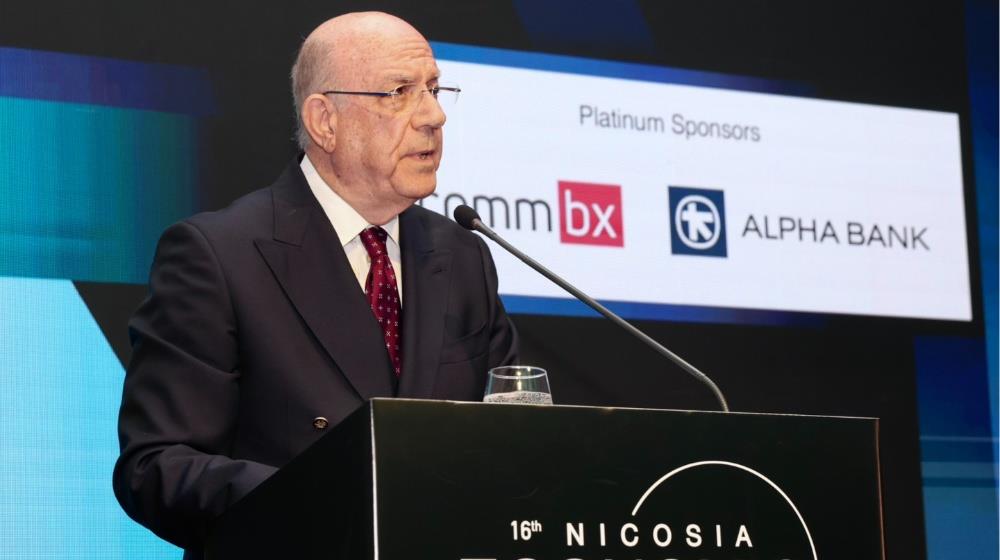
The next steps in economic policy, with an emphasis on strengthening the competitiveness of the Cypriot economy, supporting households against the increased cost of living and designing a new development program after 2026, were at the centre of the statements by the Minister of Finance Makis Keravnos in the context of the 16th Nicosia Economic Congress.
In his speech, the Minister of Finance stated that the government's main priority in the coming period is to address the increased cost of living, through policies that will improve the equitable distribution of produced wealth and will particularly support the middle class and vulnerable households.
At the same time, he noted that the design of a new short-term development programme is underway, which will ensure the continuity of the economic growth momentum, as the Recovery and Resilience Plan, which currently covers most of the development actions, is completed in August 2026.
Keravnos also stressed that strengthening the competitiveness of the Cypriot economy is a strategic priority for the government, with interventions that include the digital transition of businesses, improving human resource skills, accelerating reforms in public administration and reducing bureaucracy.
He also placed particular emphasis on the energy transition, noting that reducing energy costs is a decisive factor for the competitiveness of businesses, through the diversification of the energy mix and the strengthening of renewable energy sources.
The Minister, in addition, referred to the need to strengthen the attraction of quality foreign investments, pointing out that for small economies such as Cyprus, these investments can contribute decisively to increasing productivity, creating new jobs and transferring know-how and innovation.
In this context, he noted that the establishment of international technology companies in Cyprus in recent years has already strengthened local capabilities, improving productivity and enhancing research and innovation.
The Minister of Finance also referred to the need to create conditions for sustainable development in key sectors of the economy, pointing out that issues such as water scarcity affect both the agricultural sector and tourism.
Referring to international developments, he emphasised that the global economy is in a period of profound transformation, with geopolitical tensions, energy challenges and market volatility creating a particularly unstable environment.
As he noted, the current phase of globalisation is characterised by significant disruptions, such as the pandemic, the war in Ukraine, the conflict in Gaza and the recent tension between the US, Israel and Iran, which directly affect the global economic balance.
According to the Minister, these developments are intensifying pressures on energy markets, increasing inflation and slowing global growth, creating a fragile economic environment.
Keravnos noted that the impact of the conflict in Iran on the Cypriot economy will depend on the intensity and duration of the conflicts, as tourism, transport and energy costs may be affected.
For this reason, as he stated, the government announced timely support measures of approximately €200 million to address the effects of the energy crisis and international developments.
He stressed that the ability to take these measures is based on the fiscal stability that has been achieved in recent years, with high growth rates, a significant fiscal surplus and reduced public debt.
According to the data he presented, the Cypriot economy recorded a growth rate of 3.8% in 2025, significantly higher than the European Union average, while the country experienced low inflation and conditions of almost full employment.
At the same time, public debt is expected to decrease to close to 50% of GDP by the end of the year, recording one of the largest reductions in the European Union.
The Minister of Finance also underlined that for the first time since 2011, all major international rating agencies have restored Cyprus to investment grade A, which, he said, reflects the government's overall reform effort.
In this context, he also spoke about the tax reform being promoted, which aims at a fairer redistribution of the tax burden, strengthening the middle class, supporting businesses, encouraging the green and digital transition, as well as addressing challenges such as housing and the low birth rate.
Concluding his intervention, Keravnos noted that Cyprus has gone through a difficult path in recent years, moving from a period of crisis to a period of stability and reliability.
As he emphasised, the goal of economic policy is a strong, extroverted and sustainable economy with a human-centered character, which will be able to innovate, adapt and compete with confidence at the European and international level.
(Source: InBusinessNews)
