







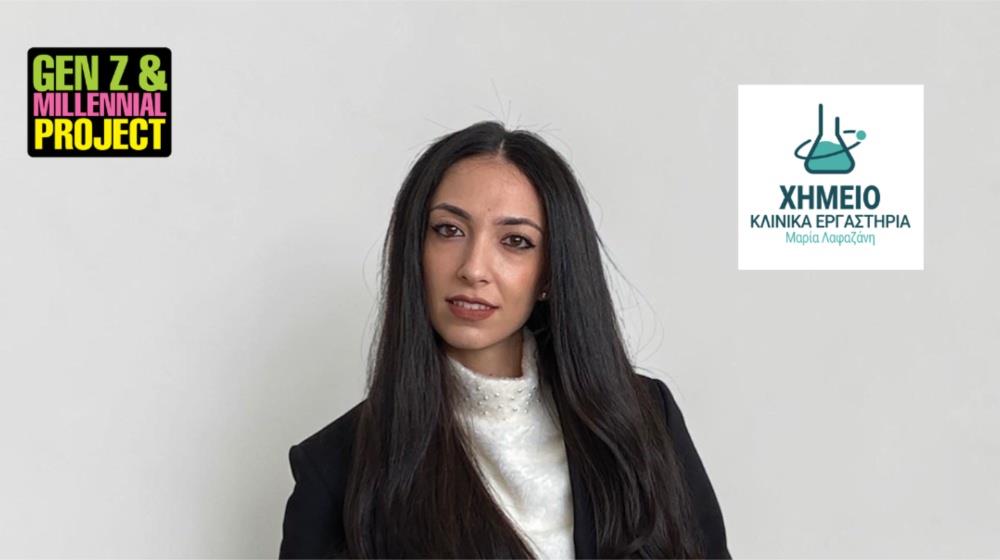
There are journeys that unfold gradually while others seem, in retrospect, almost preordained – quietly guided by an early fascination that refuses to fade. For Maria Lafazani, the question was never if she would take the path into clinical science but how far it might take her. “My vision to establish a clinical laboratory began with my love of this field at a young age,” the 32-year-old scientist reflects.
What followed was a degree in Biology at the University of Essex, postgraduate studies in Molecular Biology and Virology at Imperial College London, and then a period of deep professional immersion at Attikon University Hospital in Athens. There, over four years of specialised training, she worked across immunology, haematology, biochemistry and microbiology – disciplines that would later converge in her own practice.
By November 2020, her long-held vision took tangible form. On returning to Cyprus, she established her own clinical laboratory in Larnaca, alongside three blood collection centres in Livadia, Oroklini and the city centre. It was not simply a business venture but the realisation of a carefully constructed ambition. Today, the Maria Lafazani Clinical Laboratory is contracted with Cyprus’ national health system (GeSY) and is certified to the internationally recognised ISO15189 standard.
Yet for Lafazani, the essence of her work extends far beyond certifications. It is rooted in people – in the daily, human exchanges that define healthcare at its most immediate level. Her very location has played a quiet but decisive role in shaping that experience: “Larnaca has significantly influenced my journey through my direct connection with the local community,” she says. “The city’s professional environment, although demanding, remains human-centred and supportive, providing the foundation for a stable and responsible path,” she adds. In such a setting, trust is not an abstract concept but a daily practice, built patiently over time. In her field, she notes, “Trust is fundamental and it is cultivated daily through consistency, responsibility and meaningful personal interaction.”
The demands of the profession are unrelenting. Science evolves, technologies advance, and knowledge must be constantly renewed. “Our field requires continuous scientific education and constant adaptation to new data and technologies,” she explains. Yet rather than viewing this as a burden, she sees it as an essential discipline – one that deepens her sense of responsibility towards those who entrust her with their health.
Beyond her own laboratory, Lafazani’s gaze turns increasingly towards the city around her which, she believes, is a place in motion. “Larnaca appears to be evolving rapidly, which is very encouraging for its residents,” she observes, while noting that the journey is far from complete. There remains, in her view, significant scope to strengthen innovation. Not only through infrastructure, but through a broader culture of collaboration.
“Through targeted efforts and a collective approach, our city can evolve into an environment that not only supports but also inspires the new generation to move forward with confidence,” she says. It is here that her perspective takes on a distinctly generational tone. As a millennial, she is acutely aware of both the opportunities and the gaps that define today’s landscape.
“As a millennial, I would like to see more opportunities for young scientists, enabling them to create without obstacles and contribute meaningfully to the local community as well as to the country in general,” she concludes.
Ultimately, Maria Lafazani’s story is one of return and purposeful continuity – a journey that comes full circle without ever standing still. It is the story of someone who came home, not only to practise her craft but to root it within a community and to elevate its standards.
This article first appeared in the April edition of GOLD. Click here to view it. To view the full edition, click here.
- The Millennial and Gen Z Project is implemented with the support of European University Cyprus, Bank of Cyprus, PwC and Cablenet, with Toyota as Mobility Partner, the support of the European Commission Representation in Cyprus, and IMR as Supporter.
