







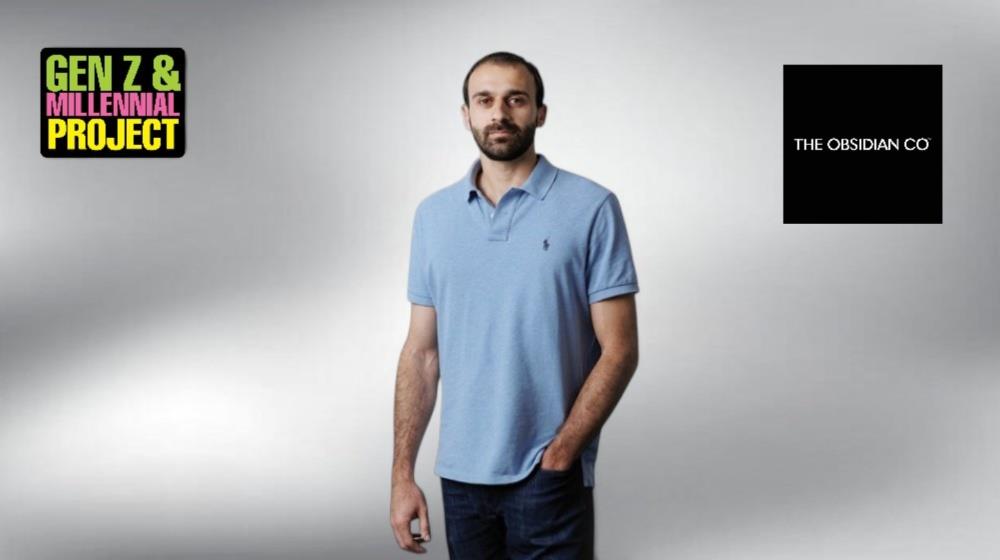
After completing his MSc in Marketing and spending several years in the UK, Christos I. Loizou’s mind was set on what he wanted to do: to build an agency where marketing is directly tied to revenue and measurable business outcomes. In 2021, with co-founder, Michalis Nikolaou, he established The Obsidian Co., with a clear focus on performance-driven digital marketing. Today, at 29, he speaks with the measured clarity of someone who has seen beyond the horizon and returned to his home city, Larnaca, not just to settle but to build.
Over the past five years, Obsidian has grown into a multi-award-winning performance agency, its reach stretching far beyond the island to Greece, the UK and the US. It moves fluently between eCommerce, real estate, SaaS and B2B, not as a service provider but as what Loizou calls a “digital growth partner,” with success measured not in impressions or abstractions but in tangible results: revenue, return on advertising spend and real commercial impact.
Yet beneath the metrics lies something more instinctive. A way of thinking shaped, in part, by Larnaca itself, which, he reflects, has quietly influenced the way the business was built. “The city is clearly growing, with more development, more activity and more opportunities starting to come through compared to a few years ago,” he says. There is a sense of momentum in Larnaca, a hum of becoming, though not yet the full symphony.
But growth in a smaller market comes with its own discipline. “You can’t rely on volume,” he says, “so you focus on quality, positioning and building something that can compete beyond the local market.” It is a constraint that becomes a kind of creative pressure – one that pushed Obsidian outwards earlier than expected, forcing it to think internationally from the outset.
There are, inevitably, gaps. Access to highly specialised talent remains limited and the broader ecosystem is still finding its depth. But Loizou does not dwell on what is missing; instead, he traces the upward curve. “The trajectory is positive and improving year by year,” he enthuses.
In his telling, Larnaca is not yet a fully-fledged hub of innovation but it is stirring in that direction, its foundations forming in infrastructure, in growing business interest, in the quiet accumulation of ambition. To move from potential to presence, he believes, the city needs density: more support for startups, more spaces for collaboration, stronger ties between education and enterprise. “Funding and talent development will also play a big role,” he notes.
His vision, however, extends beyond systems and structures into something more cultural, almost atmospheric. “I’d like to see a more active environment overall. More events, a greater exchange of ideas and a stronger culture around building and scaling businesses.”
It is, in essence, a call for energy, for a city that does not simply grow but engages; one that attracts not only capital but people, ideas and movement. The future of Larnaca, in his view, will depend as much on the conversations it hosts as the companies it houses.
So, Loizou continues to build in that in-between space. He is a founder shaped by a city that is still becoming and, in turn, he is shaping it back.
This article first appeared in the April edition of GOLD. Click here to view it. To view the full edition, click here.
- The Millennial and Gen Z Project is implemented with the support of European University Cyprus, Bank of Cyprus, PwC and Cablenet, with Toyota as Mobility Partner, the support of the European Commission Representation in Cyprus, and IMR as Supporter.
