







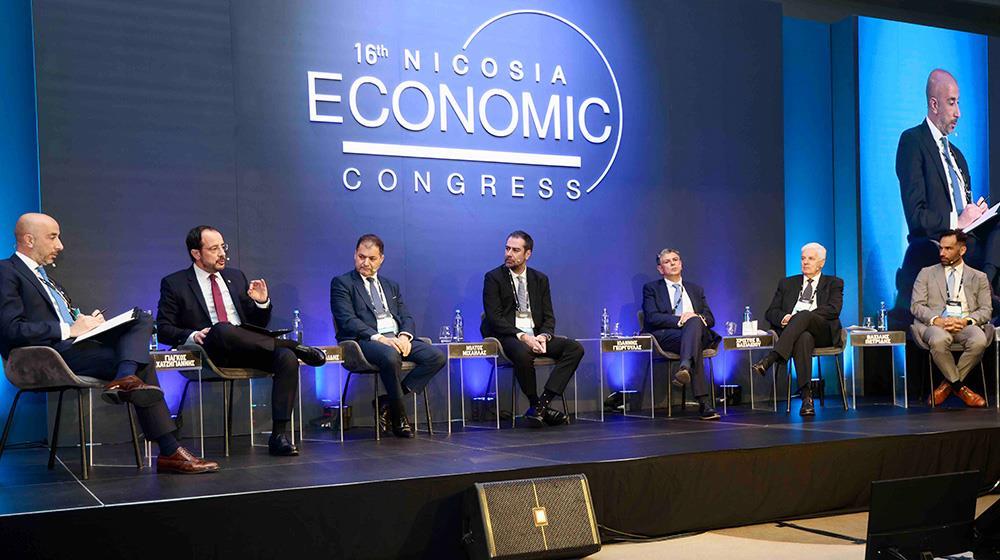
The need to strengthen the competitiveness of the Cypriot economy in an environment of geopolitical turmoil, as well as the government's particular interest in the development of the defence industry as a new productive sector, were at the centre of the discussion within the framework of the 16th Nicosia Economic Congress, where the President of the Republic, Nikos Christodoulides, addressed business leaders.
During his intervention, the President of the Republic placed particular emphasis on the issue of defence, noting that strengthening the defence sector does not only concern security issues but can also contribute to expanding the productive base of the economy. As he mentioned, Cyprus can develop capabilities even at the level of exports in the defence equipment sector, which, as he said, is being examined as part of a broader strategy to strengthen the economy.
At the same time, the President appeared highly critical of practices that, as he said, are observed in the House of Representatives, expressing concern about the legislative process. In a stern tone, he noted that it is not a sign of seriousness to massively approve dozens of bills in the last session of the House.
As he stated characteristically, he often gets the impression that proposals are submitted even when they have constitutional issues, simply to present to society that the Parliament is "protecting" citizens, while the government is then asked not to sign them. "What message are we sending about the country?" he wondered, adding that the elections concern the future of the country.
The course of the Cypriot economy, the prospects for strengthening business activity and the country's role in a changing geopolitical environment were the subject of discussion, with the President of the Republic speaking with business leaders about the key challenges of the economy.
The discussion raised issues related to strengthening business innovation in Cyprus, increasing the productivity and size of businesses, as well as creating opportunities for young people to develop professional activity in the country.
The discussion included Miltos Michaelas, Managing Director, Alpha Bank Cyprus, John Georgoulas, Independent Non-Executive Director, ECOMMBX, Christos V. Vasiliou, CEO, KPMG Limited, Vasilis Petrides, CEO, Laiko Cosmos Trading Ltd, and Panagiotis Polydoros, Country Manager for Greece, Cyprus and Malta, Mastercard.
Referring initially to developments in the Middle East and their impact on the international economy, President Christodoulides spoke of an "anarchic international system", in which, as he noted, businesses demand stability, predictability and security from the state.
He stressed that a government must have a clear plan and make decisions based on a specific ideological and political framework. As he said, the government operates on the basis of social liberalism and all decisions in the Council of Ministers are made within this framework.
The President also noted that the country's governance over the last three years has been carried out under conditions of successive crises, pointing out that the government does not react in an opportunistic manner but operates with a plan and perspective for the country's future.
Referring to the economy, he stressed that Cyprus is recording one of the highest growth rates in Europe, while for the first time since 2011 the country is in the A category by all international rating agencies. At the same time, he noted that unemployment is around 5%, a level that constitutes full employment, while public debt has been significantly reduced.
According to the President, the country's strong economic performance allows the state to support society in times of crisis, as happened with the fires in Limassol or with housing support programs.
Energy costs, as he said, are currently the most important problem for the government. In this context, he announced that plans for energy storage will soon be presented, while the goal is also to utilise natural gas, with developments that, as he said, are expected before the end of April.
The President also referred to the need to strengthen the country's workforce and to link education with the labor market, noting that Cyprus has an extremely dynamic business community.
Regarding the extroversion of the economy, he referred to upcoming international contacts, including a visit to India, as well as missions to Kazakhstan and the United States, noting that there is growing interest in Cyprus.
On his part, Miltos Michaelas noted that the banking system of Cyprus has been significantly strengthened in recent years, following the reforms of the last decade, with the result that banks today have strong balance sheets. As he stated, properly servicing investors coming to Cyprus is a critical issue, while he noted that significant steps have been taken in the modernisation of the banking sector.
John Georgoulas said that Cyprus has managed in recent years to create solid foundations for entrepreneurship, expressing confidence in the government's stance towards investments. However, he expressed concern about the cooperation between the government and Parliament in the future, noting that populist phenomena may create political risk for businesses.
At the same time, he suggested the development of a coordinated national strategy for the fintech sector and electronic payment institutions, with the participation of the government and supervisory authorities.
Christos V. Vasiliou referred to the progress of the professional services sector, noting that it has proven to be resilient, flexible and dynamic. As he stated, the sector actively contributes to the formulation of economic policies and the promotion of Cyprus as an investment destination, while underlining that in recent years significant specialisation has developed that allows Cyprus to export knowledge and know-how.
Vasilis Petrides noted that the Cypriot economy has significant prospects, however, noting that businesses face increasing operating costs and inflationary pressures. He also stressed that finding human resources is a critical issue for improving productivity, while he also referred to the new regulatory requirements arising from European policies, such as green taxation.
Panagiotis Polydoros said that the global economy is now highly interconnected and underlined the importance of strategic partnerships. As he noted, in Cyprus over 40% of transactions are carried out using cards, while proposing to strengthen incentives for the use of electronic payments.
The discussion was moderated by Yangos Hadjiyannis, CEO, CIM-Cyprus Business School & Vice Chairman Invest Cyprus.
(Source: InBusinessNews)
