






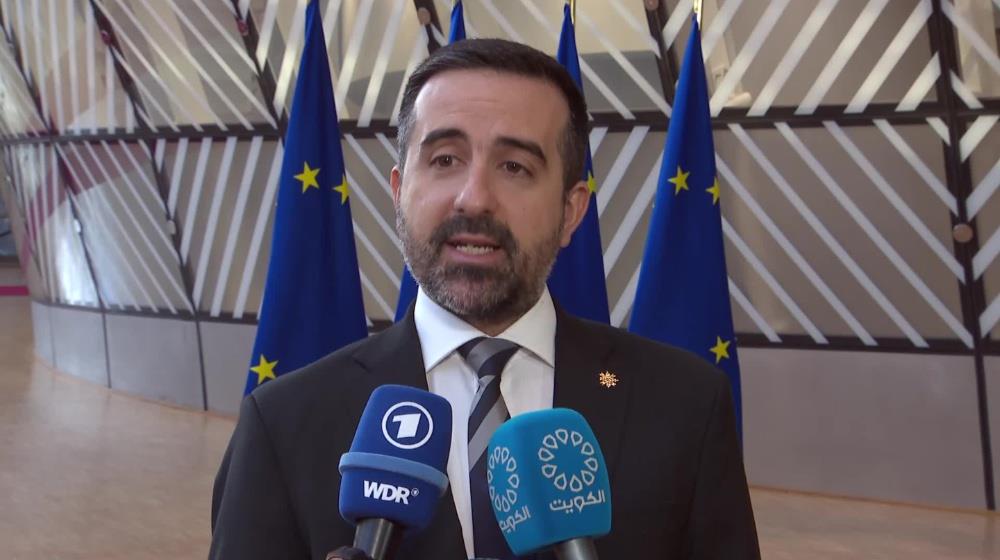
Returns of migrants, the EU’s internal security in light of developments in the Middle East and the implementation of the European Pact on Migration and Asylum will be at the centre of the agenda of the Justice and Home Affairs Council, according to Cyprus’ Deputy Minister for Migration, Nicholas Ioannides.
He was making statements to the press on the morning of Thursday, 5 March upon his arrival at the meeting in Brussels. It is important to monitor developments and remain vigilant, he said regarding regional developments.
“Within the context of the Schengen Council today we will discuss returns,” Ioannides said, describing migrant returns as a crucial issue for European migration policy. “Returns is a crucial matter, and that is why the Cyprus Presidency will work hard in order to move forward with the negotiations on the Returns Regulation. This regulation is indispensable for an effective European migration policy.”
At the same time, he referred to the importance of interoperability between European IT systems for the management of external borders. “We will also address the need to achieve interoperability between IT systems. This will help us to improve external border management.”
The Deputy Minister noted that over lunch ministers will discuss the impact of developments in Syria and Iran on the European Union’s internal security. “It is important to monitor the developments and remain vigilant. We will also debate the future of Europol in light of the forthcoming revision of the pertinent regulation.”
EU relations with Libya and Lebanon
The Deputy Minister also placed particular emphasis on the external dimension of migration, referring to EU relations with Libya and Lebanon. “We will discuss how collaboration with these two countries may contribute to the reduction of irregular flows,” while at the end of his remarks he added that “bearing in mind that June is getting closer, we will hold a discussion on the implementation of the EU Pact on Migration and Asylum.”
Responding to journalists’ questions regarding possible security threats due to the situation in Iran, the Deputy Minister said that “at the moment there is no threat for Europe. Of course we remain vigilant, as I mentioned. It is something that we should not take lightly.”
He also said that Cyprus, as a frontline member state geographically close to the region, is taking the necessary measures. “As you know, we are a front-line member state. We are very close to the region. That is why we have been taking all necessary measures in order to avert any security risks,” he said.
Cyprus is not involved in the conflict
The Deputy Minister also noted that Cyprus is not participating in military operations in the region. “No, Cyprus is not involved in the conflict. The President of Cyprus has already mentioned that. It's not involved and will not be involved in the ongoing crisis,” he said. Referring to preventive security measures, he added that “there was no disruption in daily life. There were some pre-emptive measures, no serious risk. Just taking some measures in order to be ready. I mean, daily life in Cyprus, and the fact that I'm here shows that the airspace is open, so it's business as usual.”
Asked about possible migration flows from Lebanon due to the ongoing crisis, Ioannides said that “we haven't had any departures from Lebanon. In our previous experience, when there is a crisis, especially in southern Lebanon, there is only internal displacement. So we haven't noticed any departures from Lebanon.”
Ready to access any developments
Regarding the possibility of refugee flows from Iran to the EU, the Deputy Minister said it is still too early for conclusions. “Well, just in the first days of the crisis, as I mentioned, we haven't noticed any flows from the region. And as you can tell, there is a distance between Iran and the EU, Cyprus for instance, and Greece. So I think it is early to say that. But it is something we bear in mind and we should be ready to address any developments in this field.”
Asked whether the EU is better prepared to deal with a migration crisis compared to 2016, Ioannides replied that “taking into account that the pact on migration and asylum is entering into application in June, I would say that things have already been improved compared to the past,” while adding that the EU “has improved our infrastructure, our procedures, and our legislation and the means in order to address this kind of crisis.”
(Source: CNA)