








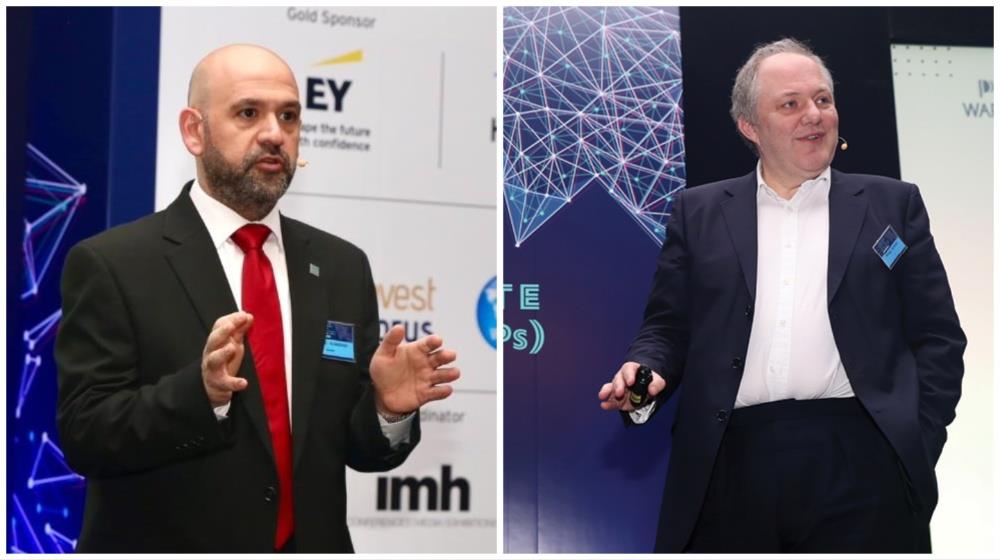
During the Unlocking Investment Through PPPs Summit, the discussion on project identification brought a pragmatic tone and a dose of hard-earned experience.
A publication edition containing an overview of what was discussed during the summit, is now available online. You can find it here.
Michael McVeigh and Nayef S. Alhaddad, seasoned PPP professionals, tackled one of the sector’s enduring dilemmas: how to move from policy ambition to viable, investable projects.
Michael McVeigh, Director of Government and Infrastructure at EY (pictured above right), opened with a personal anecdote from the early days of the UK’s Private Finance Initiative (PFI). The terminology may have changed since the 1990s, but one question, he said, remains constant: “How do we get good projects done well?” Only three outcomes are possible, McVeigh warned: good projects that are procured well end in success; good projects that are procured poorly end in failure; and bad projects, however they are procured, are an inevitable failure. It’s a sharp framework and one that reinforces a core principle – project identification is everything. If the project doesn’t make strategic and policy sense at the outset, no amount of sophisticated procurement can rescue it. “The market will ask: who’s driving this?” McVeigh said. “If the Government doesn’t believe in it, no investor will.”
Policy first, feasibility second
Nayef S. Alhaddad, Manager of Research and Strategic Planning at the Kuwait Authority for Partnership Projects (KAPP) and Chairman, Middle East and North Africa Chapter at WAPPP (pictured above left), brought the view from inside government. Line ministries often have clear sectoral needs – new power plants, improved postal logistics, better roads and so on – but may lack the technical or financial capacity to run feasibility studies. That’s where central PPP units step in, validating proposals, clustering demand and coordinating market engagement. “You need someone in the middle – a champion – who understands both the cabinet and the market,” he explained. “A Strategic Investments Office is the kind of institutional structure we need.” But not every idea is a PPP. Many don’t survive pre-feasibility. That’s a good thing, said Alhaddad. “Sometimes the conventional method is faster, cheaper or more appropriate.” A matrix approach helps: prioritise high-capex, high-readiness projects that meet urgent national needs. And don’t underestimate timing. “Even good projects fail if they miss their moment,” he warned.
Realism and risk allocation
The dialogue turned repeatedly to realism. McVeigh stressed that the private sector will only come to the table if the risk allocation makes sense. PPPs are not about pushing risk onto investors – they’re about assigning risk to the party best positioned to manage it. “If the risk transfer doesn’t align with capability, the project fails. Or worse, it proceeds and fails later,” he cautioned. Alhaddad echoed the point. Too often, he said, governments treat PPPs like a “free lunch.” But in service-based PPPs, someone pays – either the user or the state. Financial structuring must reflect that. Blended finance, equity injections, guarantees and viability gap funding all play a role.
Credibility and community
For McVeigh, credibility matters at every level: legal framework, procurement process, contract terms. But perhaps most critically, it matters to communities. “A PPP gives a private operator privileged access to a captive user base. That trust must not be abused,” he highlighted. Revenue structures must also be fair, while policy flexibility must be maintained. And the project must fit within a clear national strategy. “If it looks like an outlier, the market will hesitate,” he noted. Alhaddad applied this directly to energy. Drawing on examples from Qatar and Cyprus, he pointed to opportunities for cross-border electricity trading and renewables investment. But success, he said, hinges on vision, planning and timing. “If you build in phases, you lose economies of scale,” he said, referring to how some power plants are being built. “There’s a long queue for turbines, financing windows are tight, and investors want clarity.”
The non-negotiables
In a moment of reflection, McVeigh said what many in the audience were likely thinking: “Just give me a checklist.” What’s the project? Who pays? Who benefits? Why do it? What are the risks? He urged governments to be honest with themselves. “Don’t ask a question you don’t know the answer to. And don’t expect the market to solve your internal dilemmas. They’ll solve the problem in their own way, which may not align with your objective,” he said. Solid pre-feasibility, clear procurement planning and legal preparedness are non-negotiables. So is a Gantt chart. “Everyone loves a Gantt chart!” he quipped.
Alhaddad closed with a warning from experience. Too many projects go to market before sites are ready, permits are secured or infrastructure is in place. “Preparation matters,” he said. “You can’t just toss challenges to the private sector and hope for the best.”
Read more about PPPs in the online edition here.
