







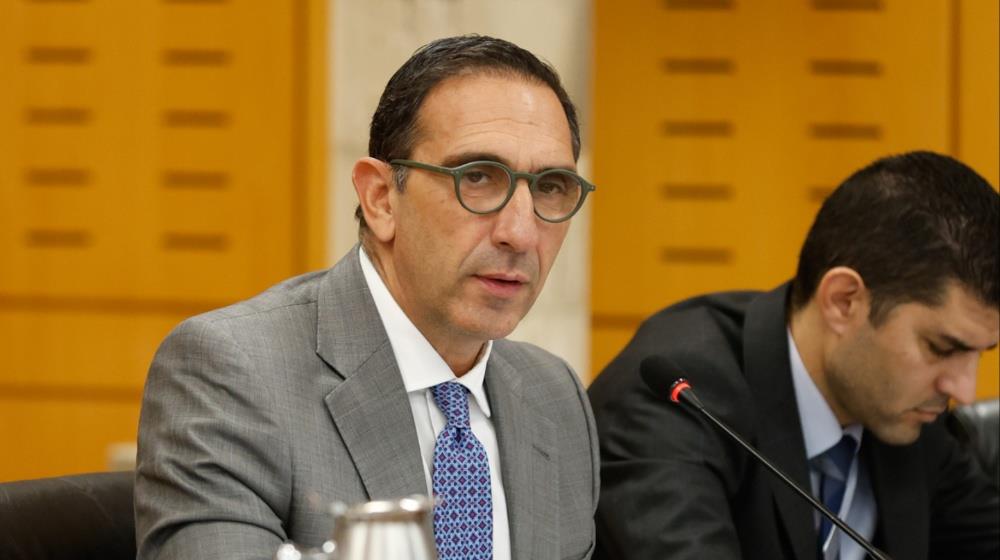
Regions should be considered as strategic partners and have a voice in the new Multiannual Financial Framework (MFF), said the Minister of Interior, Constantinos Ioannou, in statements to the Press after his meeting with Filip Reinhag, President of the Conference of Peripheral Maritime Regions (CPMR), ahead of the CPMR’s meeting in Nicosia on Thursday, 19 February.
“The future of Europe lies not only in capital cities and institutions, but also within the regions. Therefore, the voice of the regions is essential for European cohesion, for our competitiveness, for the future of Europe,” Ioannou said, adding that “regions should be considered as strategic partners and have a voice in the new MFF.”
In his statements, Reinhag said that the very high ambitions of the Cypriot Presidency of the Council of the EU “align very well with the priorities of the CPMR in getting the regions more to the centre of the policy debate.”
As he noted, “everyone lives in a region, and we know firsthand that it's the regions that can also deliver prosperity, security and connectivity to its citizens.”
The CPMR meeting focused on connectivity, competitiveness and resilience of the European Transport Network, discussed how to make the next MFF deliver more for regions and deliberated strategies for island and coastal communities.
In his address to the CPMR’s Political Bureau Meeting, Ioannou said that European Union is entering a decisive phase of reflection and negotiation on its future priorities and financial architecture, notably the next Multiannual Financial Framework. “The discussions ahead will shape the Union’s capacity to deliver on competitiveness, climate neutrality, digital transformation, security and social cohesion,” he said.
In this context, he added, regions must be recognised as strategic partners. “Policies developed without a territorial lens risk deepening disparities rather than reducing them, while investments that overlook regional specificities may fall short of their intended impact,” he stressed.
Ioannou continued noting that peripheral and maritime regions are often laboratories of innovation and resilience. “They are at the forefront of managing climate adaptation in coastal zones, sustainable maritime transport, offshore renewable energy and circular economy practices. They are also on the front line of migration management and border protection in several parts of Europe,” he said.
Therefore, he pointed out that a strong, well-funded and territorially sensitive cohesion policy remains essential.
He highlighted that the Cyprus Presidency of the Council of the EU comes at a time when reinforcing this message is both timely and necessary. “Cyprus is committed to working constructively with all member regions to strengthen CPMR’s voice in the European debate," the Interior Minister assured.
Our aim, he noted, "is to contribute to a forward-looking agenda that safeguards adequate and predictable funding for regions in the next financial framework, reinforces multilevel governance and meaningful regional involvement in national reform and investment plans, promotes sustainable blue growth and climate resilience in maritime territories, enhances connectivity for peripheral regions and ensures that the green and digital transitions are fair and inclusive."
He added that for Cyprus, these issues are not theoretical. As an island member state located at the south-eastern edge of the European Union, "we experience first-hand the challenges of insularity, remoteness and limited connectivity. Transport and energy interconnections, exposure to climate impacts, migration pressures at the EU’s external border, and the need to diversify and modernise our economy are daily realities,” he noted.
“The Cyprus Presidency is committed to acting as an honest broker and bridge between European ambition and local reality. We believe in a Europe that listens more closely to its regions, respects their diversity, and builds on their collective strength,” he continued.
Ioannou highlighted that Europe needs policies shaped from the ground up, with the active involvement of those who best understand local and regional realities. “This approach lies at the heart of CPMR’s work,” he said, adding that the Cyprus Presidency is guided by a clear vision: to promote a more autonomous, resilient, competitive and outward-looking European Union, but equally, a Union closer to its people and grounded in its fundamental values.
Strengthening social and territorial cohesion, promoting sustainable and balanced development, advancing the green and digital transition, and deepening democratic participation and values are strategic priorities of the Cyprus Presidency, closely aligned with the CPMR’s long‑standing mission, he said, noting that Cyprus places particular emphasis on the sustainable development and resilience of islands and coastal communities, especially in view of the forthcoming Strategies announced by the European Commission.
The President of CPMR and Regional Councilor, Filip Reinhag, many of the priorities of the Cyprus Presidency align with those of the CPMR.
He described CPMR’s vision as “a European Union that leaves no one behind,” noting that empowering citizens and fostering thriving environments in which they can live, work, and prosper is at heart of its actions.
A truly autonomous Europe can only be built on strong social and territorial cohesion, where no region and no citizen is left behind, he added.
“As President of the CPMR, I see it as our collective responsibility to ensure that this principle is translated into concrete political and financial decisions at the European level.”
Referring to today’s discussion, he said that it will focus on three key issues for regions. He mentioned the EU transport policy. “Military mobility has made transport an even greater strategic priority for Europe. However, connectivity is also essential for our regions. Cohesion and accessibility must not be sidelined by other priorities but must advance hand in hand with them,” he said, noting that in the upcoming discussions on the next CEF and military mobility instruments, CPMR’s message is that security and dual-use investments must strengthen civilian connectivity and territorial cohesion, not weaken them.
Secondly, CPMR discussed the future of cohesion policy in the new European budget. “Negotiations are at a pivotal stage, and our reflections and proposals over the past two years give us a real opportunity to defend a stronger territorial vision in the next MFF,” he said, noting that their goal is to ensure that “we are heard by the institution, to prevent any dilution of cohesion policy, and to secure a strong place-based approach in the next MFF.”
He stressed that they will not accept a future budget that weakens regional capacity to invest, to innovate, and to deliver for our citizens.
Thirdly, the meeting focused on two new strategies, the EU Strategy for Coastal Communities and the EU Strategy for Islands. As he said, both are essential for the regions.
(Source: CNA)
