







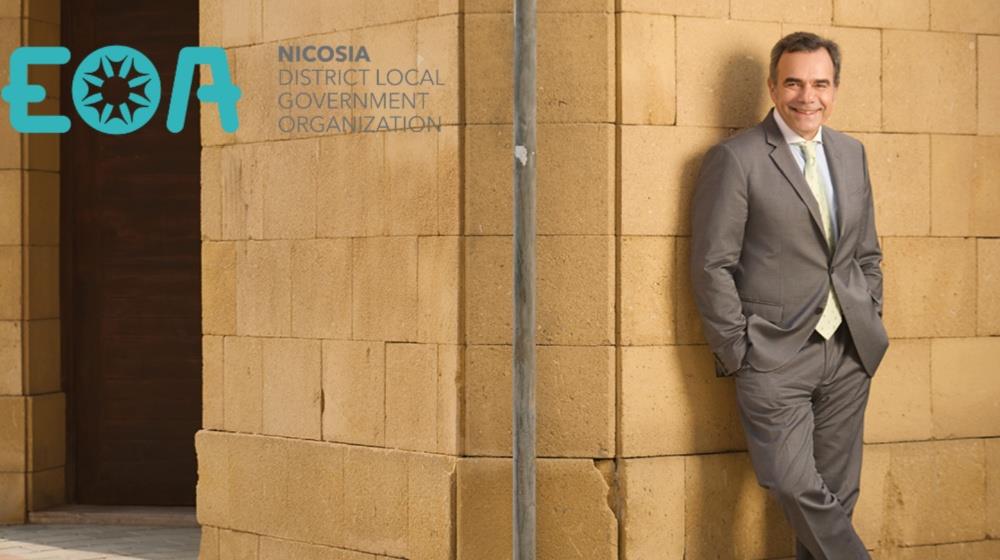
Constantinos Yiorkadjis, Chairman of the Nicosia District Local Government Organisation (NDLGO), discusses managing growing pains and water works, while reflecting on the capital’s transformation over the years and sharing his vision for its future.
Nicosia has seen a strong population influx in recent years and construction has followed suit. How active is the development scene right now and what kinds of projects are shaping the city’s skyline?
Indeed, despite the challenges such as the de facto division, development momentum in Nicosia remains strong. Since the establishment of the NDLGO in July 2024, a total of 5,891 planning and 8,509 building applications have been submitted, of which 5,689 and 8,458 respectively have already been issued. Residential developments constitute the majority of planning permission applications, followed by mixed-use (retail and office) spaces, educational and healthcare facilities, as well as new investments in renewable energy.
Can you give us an overview of the NDLGO’s planned infrastructure projects and their timelines?
The NDLGO is planning to implement a targeted infrastructure programme on water, sewage and solid waste management, all focusing on the Organisation’s green transition and a circular economy model.
Major projects, currently at the tendering stage, include the design and construction of the 1st phase of the Dhali Municipality sewage system (approx. 200km) with a budget of €75 million, the design and construction of the Pyrgos Tyllirias sewage system (approx. 20km) and the associated wastewater treatment plant with a budget of €10 million, and the replacement of the main sewer running in the buffer zone to the Mia Milia treatment plant (3.2km) with a budget of €5 million. This project is coordinated by UNDP-LIF. Our 2026 budget includes €1 million for upgrading 25% of our existing sewage pumping stations with new technology and more efficient pumps. We are also in the process of evaluating alternative solutions for solid waste management for green energy and compost production. Regarding stormwater management, we are currently preparing tender documents for the upgrade of the main anti-flood system under Dighenis Akritas Avenue (budget €2.5 million) and have budgeted €1 million in 2026 for replacing damaged and inefficient stormwater drainage systems across Nicosia.
Furthermore, we are in the process of commissioning studies for the implementation of additional anti-flood works, such as the stormwater retention lakes in Engomi and Latsia, as well as the replacement of main stormwater sewers in areas with frequent flooding. At the same time, we are systematically working to modernise our water supply network, aiming at the sustainable use of valuable water resources. This involves upgrading infrastructure, such as replacing old pipes and installing new Glass Lined Steel (GLS) tanks, to improve efficiency, reduce water loss and ensure water quality. Key aspects also include implementing advanced technology like smart water meters and advanced leak detection systems for better monitoring and management.
The installation of 72,000 smart water meters is a major project. What’s the roadmap for this and what other smart infrastructure plans are next on your list?
This initiative lays the foundation for our broader smart infrastructure strategy, fostering efficiency, innovation and sustainability. Over the last two years, we have been conducting a pilot scheme in the old city of Nicosia (with 3,636 meters) to test two different operating/communication technologies. We have now narrowed down which one we will use and are proceeding with the installation of the 72,000 smart meters. It’s important to note that this represents only the first phase. Half of them (36,000) are expected to be installed in 2026 and the rest in 2027. That said, our aim is for all 150,000 households in Nicosia to be equipped with smart devices for real-time water monitoring by 2029. Communities joining our water supply network will also benefit from advanced leak detection systems, monitoring water usage in real-time, pinpointing leaks more accurately and quickly and minimising response time and water loss.
It’s now over a year since the establishment of the Local Government Organisations. Are you still experiencing growing pains and, if so, how are these affecting your operations and your ability to implement your mandate?
The reform naturally brought transitional challenges and adjustments. Our urban planning department was understaffed and the online platform for planning applications faced various operational glitches, which complicated the task at hand. We were called upon to merge twelve different licensing authorities, allocate workspaces to personnel from different services and build a common workplace culture of consistency and collaboration. Sixteen months down the road, we are already seeing improvements (e.g., in the rate of issuing permits), although I should point out that more time is needed to fully stabilise operations and complete new staff hirings. I feel optimistic because the Organisation is staffed by highly capable and hardworking individuals and there is a culture of team responsibility and collective effort among the employees and members of the Board.
You are a former Mayor of Nicosia and you’ve been a permanent fixture in the capital’s sociopolitical landscape for decades. How have you experienced the city’s transformation into a magnet for international companies? And how would you describe the capital’s standing today?
Back in 2012, Nicosia had some key qualities and elements of potential as the administrative, political, economic, financial and cultural heart of Cyprus but it lacked the growth that other cities were enjoying. As the newly elected Municipal Authority, we felt it was our responsibility to shape the environment and create the necessary conditions to enable growth and attract existing and new private investors. In the twelve years that followed, we rolled out a multi-level intervention strategy. We developed the Strategic Area Scheme for central Nicosia, which included several planning policy incentives ensuring transparency in the urban development planning system. At the same time, we invested heavily in infrastructure improvement. All these projects were designed to complement one another in the designated area of the city centre, with the vision that their completion would create a multiplier effect and transform the centre into a greener, friendlier and more appealing destination for residents, visitors and businesses. Examples include the city’s central square designed by Zaha Hadid, the new GSP park, the city’s commercial centre, significant upgrades in the historical old city, street networks that encourage walking, cycling and public transport use in an effort to reduce car dependency, etc. We introduced smart city systems, restored and transformed existing building stock into a Centre of Excellence for research and innovation, tertiary education institutions, student residences, cultural centres, etc., and implemented soft measures such as urban planning and financial incentives to attract new residents and businesses. I am extremely pleased that the Municipality’s investment in the regeneration of the city timed perfectly with the Government’s strategy and tax incentives for attracting international businesses.
Looking ahead, what kind of city do you want Nicosia to become?
I truly believe that, today, Nicosia is a rewarding destination of promise and opportunity. It combines a rich historical past with the fast-growing pace of a modern European capital at the crossroads of three continents. It boasts an ever-increasing number of higher education institutions, medical schools, research and innovation centres of excellence, and is home to the largest academic, student and startup communities on the island. Since 2016, the city has been considered a top European city of the future for human capital and lifestyle, particularly among small cities, as recognised by fDi Intelligence’s “European Cities and Regions of the Future”. These distinctions are a validation of our efforts to create the environment and the infrastructure that allows future generations to flourish and reshape Nicosia into a modern, forward-looking and diverse European capital.
This interview is part of the “Nicosia Goes Global” cover story in the November issue of GOLD magazine. Click here to view it.
