







In 2025, Cyprus and Kazakhstan finally opened embassies in each other’s country.
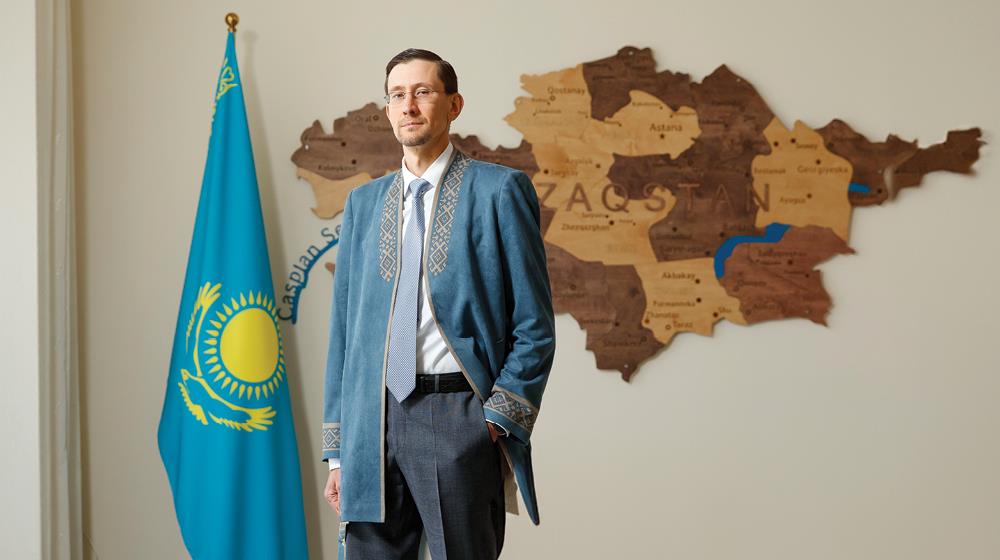
In a recent interview with GOLD magazine, Kazakh Ambassador Nikolay Zhumakanov explains why Nicosia and Astana took the decision to deepen relations and expand their cooperation.
Cyprus and Kazakhstan have recently established embassies in each other’s country. How would you describe the current state of bilateral relations following this move?
The establishment of embassies in Astana and Nicosia has truly opened a new chapter in Kazakhstan-Cyprus relations. Our engagement has become much more dynamic and comprehensive, as we now have direct, high-level channels to discuss collaboration, we can react more quickly to our partner’s initiatives, build a structured dialogue and launch new joint projects. I would describe the current relations as excellent, steadily deepening and marked by mutual respect, trust and a shared commitment to expanding cooperation.
Over the past 20 years, Kazakhstan invested $1.4 billion in the Cypriot market. In which sectors has this money been invested and where do you see opportunities for further investment?
A significant share of Kazakhstan’s investment in Cyprus has traditionally been linked to financial and corporate services, as the island has long served as an international business hub. We’ve also seen investment in real estate and hospitality.
Today, however, the structure of interest is gradually evolving, opening new avenues for cooperation. IT and fintech is one promising domain – a number of Kazakhstan’s fintech firms (one notable example being a Kazakh-founded brokerage with a Cyprus EU licence) have already established a presence and more tech collaborations could follow.
We also see considerable potential in logistics and shipping, given the island’s strategic location. In summary, our investments so far have mirrored Cyprus’ strengths in finance, real estate and services; going forward we are eager to broaden into high-tech, the green economy and other innovative sectors that benefit both sides.
Could you elaborate on Kazakhstan’s strategy for attracting Foreign Direct Investment (FDI) and how Cyprus might fit into that?
Kazakhstan has a very proactive strategy when it comes to attracting FDI. Broadly speaking, we have focused on improving the business climate through policy reforms and providing robust investor support. This includes streamlining regulations, offering tax incentives and special economic zones, and ensuring the rule of law and contract enforcement. For instance, the Astana International Financial Centre (AIFC) operates under English common law with its own court, giving foreign investors additional confidence.
Our Government has launched initiatives to modernise the economy and reduce bureaucracy – essentially creating a one-stop service for investors (“Kazakh Invest”) to guide and assist foreign businesses in setting up operations. Our strategy is also sector-focused: we encourage FDI in diversification priorities such as renewable energy, agribusiness, mining value-add, infrastructure, digital technology and manufacturing.
Now, within this big picture, Cyprus fits very neatly. It may be a smaller economy but it is an important source of investment and expertise, especially as a member of the EU. We consider Cyprus not only as an investor country but also as a bridge to European markets. Cypriot companies and financial institutions have a long history of international investment and Kazakhstan offers them a dynamic growth market in the Eurasian Economic Union and Central Asia. By attracting Cypriot investors, we also indirectly tap into the wider EU investor community, since Cypriot firms often collaborate with partners across Europe. Furthermore, Cyprus’ strengths – such as in shipping, tourism and financial services – align with opportunities in Kazakhstan. The end goal is clear – to create a mutually beneficial environment where Kazakh and Cypriot investors can flourish in each other’s economies.
From 2004-2024, Cyprus invested $4.6 billion in the Kazakh market. What are the key advantages and sectors of interest for Cypriot investors?
Cypriot investments reflect a high level of confidence in Kazakhstan as a stable and forward-looking economy. Investors are attracted by the country’s strategic location between Europe and Asia, its access to the Eurasian Economic Union market, macroeconomic stability and its consistent commitment to economic modernisation.
Cypriot companies show strong interest in energy and renewable sources, logistics and transport projects, manufacturing, digital technologies, fintech, hospitality and tourism. Kazakhstan provides opportunities for both major infrastructure initiatives and more specialised business projects.
Kazakhstan has shifted from being a loosely regulated crypto-mining hub to become a highly regulated environment. How has this influenced foreign investment and the digital economy?
Kazakhstan has indeed transitioned from a period of rapid, loosely regulated growth in crypto-mining to a more structured and transparent regulatory environment. Earlier, the surge of mining activity created pressure on the national power grid and offered limited fiscal return. In response, the Government introduced a comprehensive legal framework that established licensing requirements, taxation, mandatory registration of equipment and mining pools, as well as rules for the sale of a portion of mined digital assets through licensed exchanges.
This helped bring transparency and predictability to the sector. Unregulated operators have exited the market, while serious international investors have maintained or expanded their presence, including in the development of data centres and blockchain-related services. The clearer rules have also encouraged interest in projects linking mining with renewable energy, which supports broader national priorities. This regulatory shift has strengthened investor confidence and helped Kazakhstan move from a narrowly focused mining hub to a more diversified digital economy, with growth in fintech, blockchain development and other technology-driven sectors.
How do you see the potential for increased leisure and business travel between Kazakhstan and Cyprus?
There is significant untapped potential. Although our countries are geographically distant, they complement each other very well. Cyprus offers Kazakhstani visitors Mediterranean beaches, a rich historical heritage and a safe, welcoming environment. Cyprus, in turn, will find in Kazakhstan a completely different type of destination. Our mountain ranges, steppe landscapes, Silk Road heritage and cities like Almaty and Turkestan offer opportunities for adventure and cultural tourism that are still new to many European travellers.
The hospitality sector in Kazakhstan is developing quickly and visitors consistently remark on the warm reception they receive. Business travel is also set to expand as our economic ties deepen. More delegations, forums and joint projects mean more professionals moving between our countries. The presence of the embassies greatly facilitates this process by simplifying visas and providing direct support. I am confident that with improved connectivity and active promotion, tourism flows between Kazakhstan and Cyprus will grow steadily in the coming years.
Given Kazakhstan’s expanding international engagement and its constructive relations with both Cyprus and Turkey, how compatible do you consider the further development of these partnerships?
Kazakhstan follows a multi-vector and balanced foreign policy that allows us to maintain constructive relations with a wide range of partners, regardless of the complexity of their interactions with one another. Our cooperation with Cyprus is built on a strong foundation of friendship, trust and mutual benefit and is not directed against any third party. We also enjoy an excellent partnership with Turkey, which is based on historical, cultural, and economic ties. Turkey is a fraternal nation to us and one of the key partners in the Turkic world.
We view these relationships as independent tracks that can coexist without contradiction. This reflects Kazakhstan’s broader commitment to supporting international dialogue and fostering an environment where cooperation can develop on the basis of mutual respect.
Kazakhstan supports a peaceful resolution of the Cyprus issue in accordance with the relevant UN Security Council resolutions, and we continue to hope that negotiations will lead to a sustainable settlement acceptable to both communities on the island.
On a personal note, how has your time in Cyprus been so far? Have you adjusted easily to life here?
My time in Cyprus has been wonderful! For a diplomat, moving to a new country is always a big transition but I must say that the warmth of the Cypriot people and the beautiful environment of the island have made it easy to adjust. What has struck me most is how familiar Cyprus feels in certain ways. Kazakhstan and Cyprus are both countries that have been shaped by their location at the crossroads of civilisations, where diverse cultures, traditions, and histories have long interacted. It is easy to connect with people when you recognise similar values, hospitality and respect for heritage.
Professionally, being the Ambassador during this exciting period – opening the embassy and launching new initiatives – is very rewarding. My engagements with officials, businesses, cultural institutions and the Kazakh community here constantly reveal new facets of Cypriot life and confirm the inclusive atmosphere of this country. I have also started learning Greek and I am very determined to reach a solid level of proficiency! It is an honour to represent Kazakhstan in a country that offers such hospitality and has such a strong affinity for cooperation with us. I look forward to continuing to strengthen the bridges between our two nations.
(Photo by Michael Kyprianou)
This interview first appeared in the December 2025 edition of GOLD magazine. Click here to view it.
