







Leadership, at its most powerful, does not shout. It listens, observes and acts with intention. Marilena Shakalli Maroudia, founder of M-Brace, a company dedicated to offering top-tier leadership training, coaching and coaching supervision, reflects on leadership as a lifelong practice, where clarity, courage and the human connection remain the ultimate differentiators.
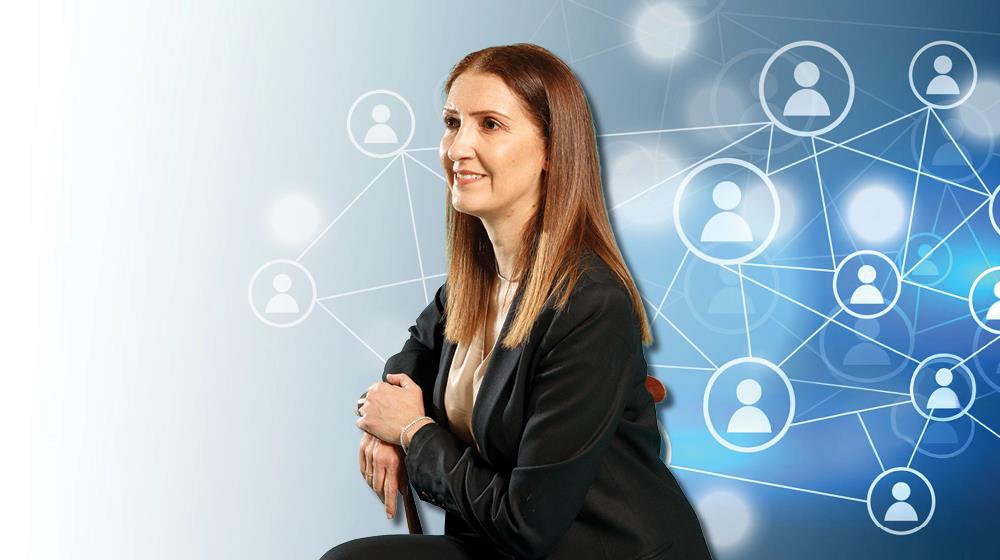
Seated across from me, Marilena Shakalli Maroudia is elegant and composed, with a presence that is immediately apparent. There is a quiet authority about her – confidence worn lightly rather than asserted.
“Detail matters,” she says, not as a slogan but as a principle reflected in how she listens and chooses her words. Shakalli Maroudia is the Director and Founder of M-Brace, a leadership and coaching practice devoted to helping individuals and organisations grow. After more than 25 years in senior corporate roles across the UK and Cyprus, she felt that her journey as an employee had come full circle. She was ready for the next chapter – one shaped by autonomy, purpose and alignment. It was time, quite simply, to march to her own rhythm.
At the heart of that rhythm lies a deep belief in lifelong learning. For Shakalli Maroudia, leadership is not a destination but a continuous practice. “My leadership philosophy is rooted in leading by example,” she tells me. “Credibility is built through consistency; leaders cannot expect behaviours that they do not demonstrate themselves. I believe effective leaders influence positively, communicate with impact, remain approachable and fair, show gratitude and, most importantly, make decisions. Indecision is often more damaging than the wrong decision, as learning comes from action.” That philosophy, she explains, lives and breathes inside M-Brace, through meticulous preparation, evidence-based content and high energy delivery.
During her career, she admits that she has worked alongside leaders who inspired her and others who taught her, just as powerfully, what leadership should never be. Those experiences sharpened her conviction that leadership is about responsibility and example.
“Leadership is not only about authority; it’s about inspiration. While some leadership qualities come naturally, many critical skills can be learned: communication, negotiation, presentation skills and emotional intelligence.”
As she notes, her background as a chartered accountant gives her a rare fluency. She speaks the language of budgets, KPIs and performance with ease, fully attuned to the commercial realities that leaders face. Yet her coaching expertise allows her to listen beyond what is said – to notice what lingers between the lines. Combined with years of global facilitation and exposure to diverse cultures, this dual lens enables her to design programmes that are practical, tailored and deeply human. “The market offers many open seminars – thousands to be exact,” she tells me with a smile. “Far fewer truly bespoke solutions, though. M-Brace fills that gap by designing programmes aligned to each organisation’s real challenges and supporting implementation. In my coaching and supervision work, I create a safe space for reflection, self-awareness and growth, supporting clients in unlocking their potential and sustaining behavioural change.”
For her, impact always begins with clarity. “In coaching engagements, clients set their objectives at the outset and progress is reviewed throughout the journey, which typically lasts six to nine months. Success is reflected in increased confidence, clearer decision-making, behavioural change and the client’s ability to stand firmly on their own feet and be responsible and accountable for their actions. In training programmes, learning objectives are agreed in advance. One of the most rewarding indicators of impact is when participants reconnect months or even years later, referencing specific learning points they still apply. Or when organisations invite me back to work with additional teams or facilitate new seminars. Sustainable change is the ultimate measure.”
When asked about one of the greatest challenges in her line of work, she is unabashedly vocal: “When clients have blind spots. They think they’re good at what they do but they don’t see what others see. These blind spots can be about behaviour, leadership style or the way they approach things. Often, they’re very rigid in how they operate. I usually pick this up through conversations and my biggest challenge is getting them to recognise their needs and what they can do differently.”
Shakalli Maroudia’s career has spanned finance, technical training, leadership development and coaching across boardrooms, continents and cultures. These experiences have broadened her horizons and deepened her understanding of human potential. And across all those differences, one truth remained constant. “Organisations often invest heavily in systems and technology, yet human potential flourishes when people feel valued and seen. This truth is universal” she tells me, holding my gaze with conviction.
As technology accelerates and AI coaching tools become more commonplace, Marilena Shakalli Maroudia is clear-eyed about what machines can and can’t do. “Technology cannot replace human connection. What differentiates human coaches is emotional intelligence – the ability to listen deeply, read non-verbal cues and exercise judgment with empathy.” With remote work and technological advancement on the rise, coaching, she believes, has become more important than ever, helping leaders foster connection in spite of distance, time zones and cultural divides. AI can assist but it cannot sense hesitation in a voice or notice when body language contradicts words.
Beyond her commercial work, for the third year now, she offers pro bono supervision to coaches working with Médecins Sans Frontières. The stories she hears are often harrowing: coaches supporting doctors and aid workers in war zones, surrounded by trauma, loss and unimaginable pressure. Sessions take place virtually, bringing together voices from across Africa, Europe and beyond. “It’s the least I can do, really. I am proud to be the first and only accredited coach supervisor in Cyprus,” she tells me. The accreditation, she clarifies, comes from the European Mentoring and Coaching Council (EMCC).
“M-Brace has reached its second year,” I tell her as we wrap the conversation. “What does the future hold?”
“Less is more,” she says. “My goal is to work with a select group of organisations where there is mutual respect and trust. I want to partner with them over the long term, designing leadership programmes, strengthening executive presence and presentation skills, as well as coaching leaders to maximise both performance and potential. Ultimately, I aim to be their trusted learning advisor and an integral part of their leadership journey.”
Marilena Shakalli Maroudia does not promise shortcuts or miracles. What she offers instead is clarity, courage and a commitment to growth – reminding leaders that meaningful change often begins within.
This interview first appeared in the February edition of GOLD magazine. Click here to view it.
