





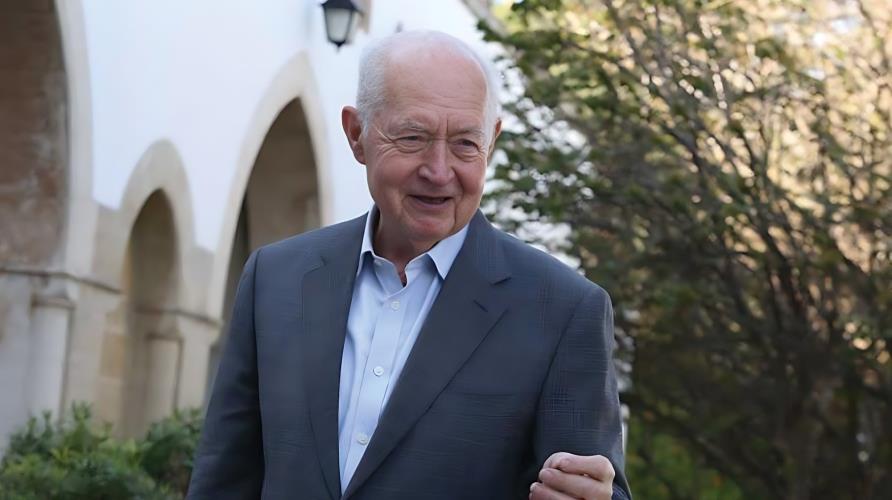
Regardless of political beliefs and party affiliations, the five-year government of George Vassiliou (1988-1993), who passed away on 14 January at the age of 94, is considered in retrospect by many to have been one of the most successful in the history of the Republic of Cyprus.
It can be said that the transition to a new era of political culture was marked during the time of this Presidency, with the primary point of reference being the sealing of Cyprus' European course, since it was during his presidency that the application for Cyprus' accession to the EU was submitted.
Placing special emphasis on internal governance, without of course giving second place to our national cause, there was a strong effort during Vassiliou's term to radically reorganise the structures of the state and society, so that they would meet the demands of the modern era and create the conditions for the modernising measures that were necessary for the country to move forward, freed from anachronistic structures and burdens of the past.
With George Syrimis as Minister of Finance throughout the five-year term, the government of George Vassiliou - and the President personally - placed particular emphasis on the growth of the country's economy, the improvement of benefits (especially in health matters), and the addressing of many other internal problems.
Prominent on the list of achievements of his governance in the field of the economy is the adoption of an innovative tax reform, which laid the foundations for the healthy development of public finances and the economy in general, the establishment and operation of the Academy of Public Administration for the more effective operation and modernisation of the public service, the introduction of measures for the protection of the environment and for the rational development of tourism, as well as the establishment and operation of the University of Cyprus in 1992, which was the first university in the country.
In addition to the above as a summary, it is no exaggeration to say that in the broader dimension of internal governance, the Vasiliou Presidency was a milestone. Because quite simply, it is in this period that the parametres for combating partisanship, favouritism and cronyism were introduced for the first time, it is in this period that citizens being documented for their political opinions was abolished, resulting in the deepening of democracy and the expansion of individual freedoms.
When Vassiliou predicted the 2013 crisis
It is worth noting that several years later, and specifically in the summer of 2011, George Vassiliou published his study 'The evolution of the size and operating costs of the Public Sector, impacts on the economy and the need to take measures'.
In this study, the rapid increase in public employees, pensions, tips and the government's contribution to social insurance was discernible, resulting in state spending reaching €2.54 billion annually and, in other words, 14.5% of the Gross Domestic Product.
George Vassiliou's study became known due to its recommendations, as, anticipating the coming crisis, it recommended eight measures:
-
The elimination of existing vacancies,
-
The two-year freeze on public sector recruitment, with the exception of doctors and nurses,
-
The freeze on annual increases for two years,
-
The implementation of interchangeability in the public service,
-
The recruitment of new civil servants with lower salary scales,
-
The contribution of public employees to pension funds,
-
The implementation of retirement at sixty-five years of age,
-
Targeted social benefits.
(Source: InBusinessNews)