




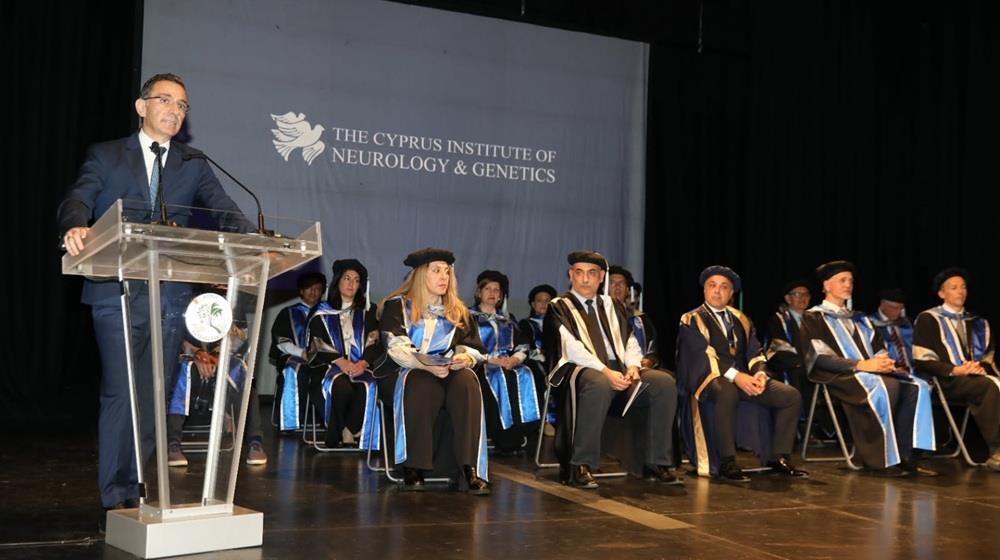
Research and innovation are strategic priorities for the Government and its ambition to establish Cyprus as a regional hub for technology and innovation, as well as to build a more resilient and competitive economy, said the Deputy Minister of Research, Innovation and Digital Policy, Nicodemos Damianou, in his address at the graduation ceremony of the Cyprus Institute of Neurology and Genetics (CING), held on Wednesday, 18 November.
He added that healthcare holds a special place in the National Artificial Intelligence Strategy 2032, with healthcare and life sciences being among the five priority sectors for the adoption of artificial intelligence (AI) and among the six national focus areas for developing research capabilities in the field of AI.
According to the Deputy Minister, 70 students received their postgraduate and doctoral degrees from the Cyprus Institute of Neurology and Genetics, joining a community that now numbers 462 graduates. This represents a particularly significant milestone for an institution where scientific knowledge is so closely linked to improving people's lives.
He also said that the State relies on the Institute's expertise in national diagnostic and preventive programmes, as well as its specialised genetic services, while its role as a regional referral centre strengthens Cyprus's position as a centre of scientific and clinical excellence.
"Last July, I had the pleasure of accompanying President Christodoulides at the inauguration of the Institute's new building, the largest development project in its history. This €31 million investment, supported by the Government and the European Investment Bank, is a clear expression of confidence in the Institute's achievements and its future. As the President emphasised at the time, continued support for the Institute is a clear policy choice.
We invest because CING strengthens our scientific capabilities and improves the healthcare provided to our citizens. Institutions of this calibre also offer talented Cypriots the opportunity to build their careers in their home country or return with the knowledge and experience they have gained abroad. Indeed, this is the ambition behind the 'Minds in Cyprus' programme," he noted.
Mr Damianou also welcomed the forthcoming Physiotherapy Centre, adding that the Institute's continued commitment to rehabilitation, as well as to the independence and quality of life of its patients, deserves particular recognition.
According to the Deputy Minister, artificial intelligence is already transforming the way researchers analyse biological data, identify patterns, study diseases and explore potential treatments, while developments in genetics, biotechnology and computational science are opening up new possibilities for understanding and treating diseases.
"I believe this is an extraordinarily exciting time to be a scientist. Most of you have probably already asked an AI system to summarise a paper, check code or suggest the next experiment.
I hope it helped. I also hope you checked its answer. Because if technology can provide us with an increasing number of answers, what will distinguish the people who use it? I believe it will be their ability to ask the right questions, recognise what matters, challenge a result that appears convincing, understand the implications of a discovery and exercise judgement when there is no obvious right answer," he noted.
"The fields you have chosen carry responsibilities towards patients and society. As technology becomes increasingly powerful, integrity, empathy and scientific judgement will become more important, not less. I am not going to pretend that I can tell you what your careers will look like twenty years from now.
Given the pace of technological change, I would be rather sceptical of anyone who claims they can. However, I would like to offer you three thoughts as you consider what comes next.
First, never become so confident in what you know that you stop questioning it. Second, do not be afraid to follow a path different from the one you originally envisaged. Third, think carefully about how you define success," he stressed.
He added that healthcare holds a special place in the National Artificial Intelligence Strategy 2032, with healthcare and life sciences featuring among the five priority sectors for AI adoption and the six national focus areas for developing research capacity in AI.
"For CING, this creates a clear opportunity. The Strategy identifies medical imaging and diagnostics, bioinformatics, personalised approaches to care and reliable health data infrastructure as priorities. It also provides for sector-specific testbeds and experimentation environments where new solutions can be developed and evaluated with appropriate safeguards," he added.