



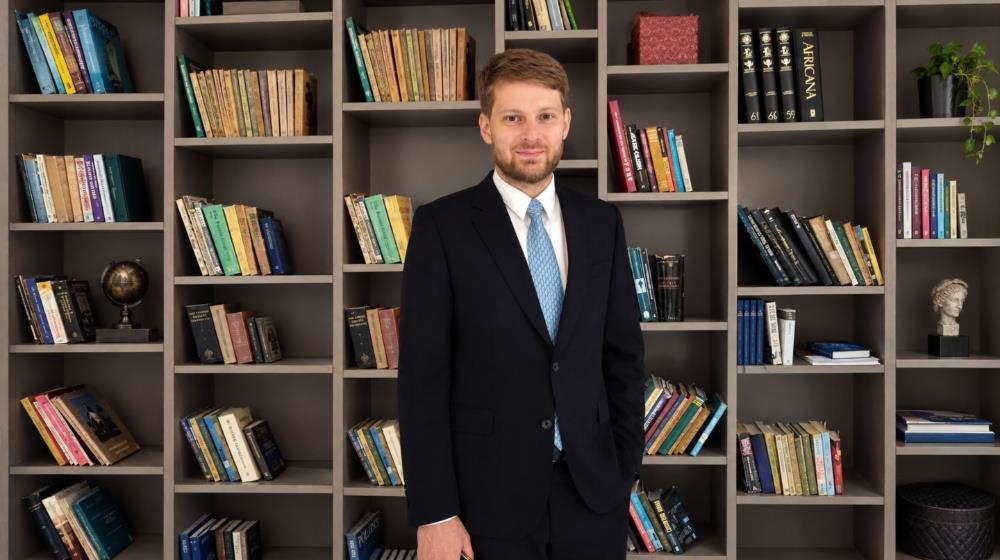
Israeli expertise in disaster prevention, early warning systems and emergency response could create opportunities for cooperation with Cyprus, particularly in areas such as wildfire detection, water security and the use of artificial intelligence, according to Dr Yaroslav Efimov, Head of Science and Technology, PLANETech, Israel Innovation Institute.
Efimov was in Cyprus as the guest speaker at a recent Cyprus-Israel Business Association event organised in cooperation with the Cyprus Chamber of Commerce & Industry, with the support of the Embassy of Israel.
Speaking to CBN just ahead of his recent presentation on ‘Innovative Israeli Technologies & Know-How for Disaster Prevention, Early Warning, and Emergency Response,’ Efimov, among other things, highlighted Israel's approach to developing innovative solutions to major environmental and disaster-related challenges, emphasising the importance of thinking beyond existing technologies and developing new approaches that offer greater efficiency and lower costs.
What do you consider to be some of the most significant advances in Israeli disaster prevention and emergency response technologies, and what distinguishes them from existing solutions?
I think that the biggest difference is that we are developing innovative solutions- something that is out-of-the-box thinking. We are not improving the same technologies that we already had, we don't just scale them up. We are trying to develop something new that will have high efficiency and lower cost. We are very strong in developing new things that can be better for the market.
So it's not a question of just building on what's already there. Is it also coming up with completely new concepts?
Yes, exactly. This is one of our strong suits, and even the technologies that I will be showcasing later today are very different, but of course they have to be scaled up. It's still at the innovation stage, but it's something new.
For example, we have different wildfire-fighting technologies that are a bit different from traditional ones on different levels. We have new technologies in detection and monitoring of wildfires, and that is very important, because the fire can be stopped with a glass of water if it's detected in time.
You've just used the example of wildfires. We have a similar climate to Israel here in Cyprus, so wildfires are always a danger. Is that one of the qualities that makes Israel well placed to study and develop this kind of technology? That it's in a geographical position where it might experience these kinds of disasters itself?
Definitely. We also had a lot of problems with wildfires. It's a big challenge. That's why we have a special authority to combat wildfires. What I'm trying to say is that technologies are being tested in the field, what we call pilots. We have a lot of institutions and educational research centers that are working on these kinds of things as well.
There is also that Israel is very advanced in defence tech. But we, as a non-governmental organisation, think is that most of these technologies can also be dual-use for other applications in civil life. And one of those, technologies that can help rescue teams, for example, to detect people under debris if there is a disaster. One of the technologies that I will also feature during the presentation is called Fire Dome. And it's easy to understand because it's like an Iron Dome, but for fires. The concept is more or less the same: to combat not missiles and rockets, but to protect facilities from wildfires.
What is also important to mention is that Israel is a very innovative country. And I think it's a great example when we can say that it's not about size. Even a small nation can be a viable innovation leader, as Israel is, because if we compare GDPs and the annual export revenues of Israel and other countries, you will see that Israel has more than 50% of export revenues from high tech. And high tech is all those kinds of advanced technologies that are being developed. The same for GDP. Israel also has the highest density of startups globally.
When I do this presentation overseas, I usually say that Israel is very different from your country because Israel is tiny, but for Cyprus, we can probably compare. It's not about size, but it's about the mindset-how you see your own development, what you want to achieve. Do you want to establish a new company and to develop a breakthrough solution that will be used worldwide and save lives and money?
Do you believe opportunities exist for cooperation between Israeli technology developers, organisations like the one you belong to, and their counterparts here in Cyprus? Do you believe there could be room for good cooperation?
Yes, we have the same climate, and we have the same limitations of different nature and different kinds, meaning that, yes, I think a lot of things can be used.
I know, for example, about the supply of fresh water supply here in Cyprus. I'm proud to say that the desalination plants that you have are by IDE, using Israeli technologies. On a smaller scale, take a look at earthquake detection.
The challenges that we face that are climate-related don't see borders, they don't distinguish between nations, and for them it doesn't matter which country it is or what people live there. These kinds of challenges are global and the solutions and the technologies that can help us to overcome these challenges are interesting and can be shared.
What would be the first practical step for an organisation or a company here in Cyprus interested in adopting one of these technologies? Are there some pilot projects or partnerships through perhaps your own organisation or others that they can become part of?
Yes, definitely. I have to say that Israel Innovation Institute and PLANETech as part of that institute, is a non-governmental non-for-profit organisation. But we are in the central part of the ecosystem, meaning that we work with startups that are developing technologies, investors that invest, companies that implement these technologies, governments that can facilitate or even implement as well, and intergovernmental organisations as well. We work with all of them. Our goal is to establish not just a connection for connection's sake, but to establish a process and provide the stakeholders with the mechanisms to collaborate.
A good example that I have is one of the projects we had last year in the Atacama Desert. It's a desert area in southern America that has Chile and other countries around it, and the challenges that they face are, again, the same. It's a lack of water, lack of energy, a very remote area, insecure communities living there, and very poor agricultural practices. We had a big project with the Inter-American Development Bank, with local governments. Right now, we have five pilot technologies that are being tested there on a scale for different purposes. It's water supply, it's agriculture, it's energy. It's advanced materials because it's a very sensitive area. This is one of the objectives of our organisation, to establish the implementation of these technologies, not just to help service providers to develop them, but also how these technologies should be implemented.
And this is what we do, and we would love to see more partners, more pilots, more testing facilities and testing opportunities for the technologies that are being developed. Meaning that if Cyprus needs something that can be tested or can be improved, we are happy to assist.
The solution in the Atacama Desert was just one of the examples. We have the Green Great Wall in Africa that we worked on with the United Nations Convention to Combat Desertification (UNCCD). One of the values of the Institute is that we have established and developed a process of innovation management from the first stages of development of the technology to its implementation.
So it's part of the entire process from the inception to implementation?
Yes, and I think that's very important because innovation doesn't work in silos, and sometimes what we see in academia also works for science. Investors want to get high returns and fast returns. And for deep tech, it doesn't work like that. You have to invest a lot, and sometimes the payoff will be in 10 years. We know that in venture capital, they usually have a lifespan of the fund for seven years, meaning that it's not even enough for one fund. That's why we work with all the stakeholders, including governments, investors, et cetera, to establish this process, to educate, to share knowledge, and to facilitate these things. Technology transfer from the lab to the proof of concept, then to the pilot, then to bring in relevant investors who are willing to invest in these kinds of things, then to bring in someone to facilitate the implementation of this technology at different levels, at the level of the municipality, at the level of government, at the level of a big organisation such as IDE. For example, we also work with IDE as well on the challenges that they have because they have special membranes that need some maintenance. So it's at different levels, but the same process.
Everybody is talking about artificial intelligence nowadays. Is it something that's already part of your processes? And do you think that it'll have even a bigger impact in the future?
AI is not artificial intelligence. It's super intelligence. You can love it, or you can hate it, but it's already here. It shifts and changes the way we work. It affects the results and the efficiencies that we see. And of course, in our sector as well. I don't remember how many examples I have in my presentation, but I think more than half of them include AI, not just because it's a buzzword, but because it's really a very helpful tool that increases the efficiency of predictions when working with big data sets, optimisation of the processes, the discovery of new drugs and chemicals- things that before usually took years now take months. And we have a lot of examples of that. Israel is very strong in this as well. We have a lot of labs, we have a lot of bright minds, and we have a lot of talent that is developing these kinds of solutions. The question is how it is implemented in the technologies. I think it boosts technology, even if it's hardware. Of course, there are some concerns about energy, for example, about the hardware, about the turbine, or about the thermal processes. It's not about computations, but if it's something that has to deal with recognition, prediction, working with big data sets, that's definitely where AI helps a lot.
In particular, in connection with the environment, however, AI has a bit of a bad reputation because of the energy generation required for data centers.
We are not activists. We are talking about technologies. We are talking about real life, and it's very different from when people hear the climate, they think about carbon removal, activism and carbon capture. No, we are talking about all the technologies that either reduce emissions of greenhouse gases or increase the efficiency of different processes. And of course, nature protection, wildfires. Were cars and all the industrial shifts better or for the worst of humanity? AI is another step. We, humanity, are being developed. We are growing in population, and this progression is not a simple one when you just combine the numbers. If we're talking about AI, it's something that makes PLANETech a very interesting organisation because we are sector agnostic and we are happy to work with different big challenges. Last year, one of our automatic focuses was data centres and AI. And we didn't just talk about the things that we've just discussed about what AI can do for climate or how AI affects climate but we said ‘We have this big sector. What are the challenges there?’ And we identified four of them. It's energy. Energy supply, energy storage, energy backup, efficiency within a data center, cooling technologies. Do you know that 40% of the energy that comes into the data center is spent on essentially nothing? It's spent on cooling. It's not spent on computation. It's spent on cooling the devices. So if you can reuse or increase the efficiency of cooling, you decrease the energy consumption. We had advanced cooling efficiency. We had advanced models for computations.
And we had some very important topics to discuss, we discussed them with the government and with the authorities. These include access to energy because it's a problem. If you want to build a data centre somewhere in Europe now, it's almost impossible. In Germany and the Netherlands, for example, the time that you have to wait to be connected to the grid takes several years. Problem number one- just not enough energy. And problem number two, grid connectivity and grid capacity are not sufficient for all the users that want to use this energy.
We also studied the electricity sector and the electricity market internationally because there are certain mechanisms already in place another interesting question is how to implement innovation in the electricity market within the grids. As a consumer, you don't want to pay more, right? You don't want to see your bill increasing. But any innovation and implementation of the technology by the distribution service operator or the company that generates energy or transmits it costs. So what is the balance here? What is really needed? That's something that's not that easy to assess. There are different models in the UK, Germany, Singapore, US, and Australia, and Israel, of course. All the models are very different. Sometimes they have incentives from the government to implement innovation. Sometimes it's about the efficiency that is set by the authority. So if you increase your efficiency, you have some tax deduction, etc.
Usually people don't understand how complex the whole process is. They think that it's easy. You just have to have amazing technology in the lab. And then it will change everything in the world. This may betrue. But between those two steps, there is a very long journey.
Lastly, what is the main takeaway that you would like the audience to have following your presentation?
That there is no problem that doesn't have a solution.