




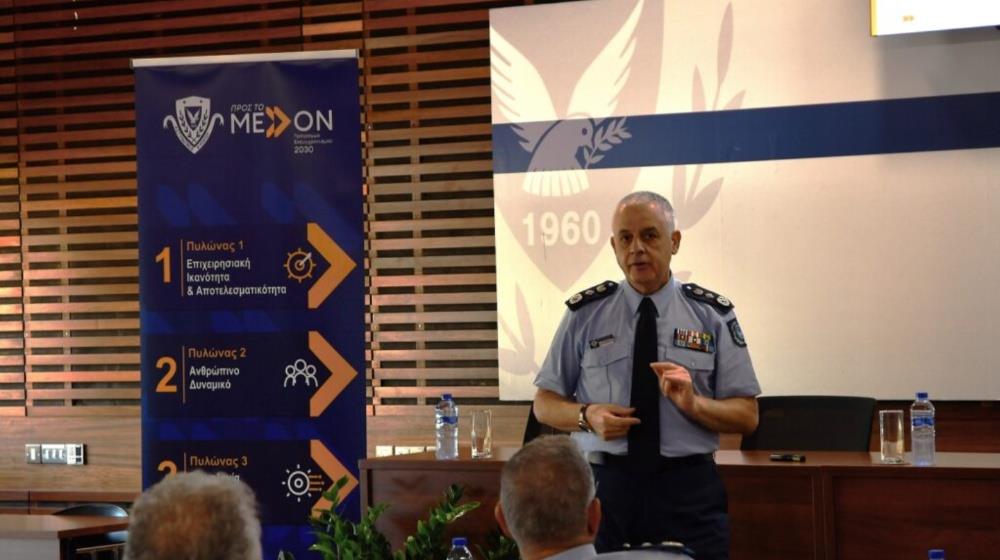
A strategic plan for Cyprus' police aims at creating a modern European police force that focuses on public safety, improved crime prevention and more effective crisis management by 2030. The plan was presented by the Chief of Police, Themistos Arnaoutis.
Speaking to media representatives on 18 November, he explained that in an environment where challenges posed by organised crime, cyber threats and European obligations are increasing, the public expects an immediate response, consistency and clear information; police officers need better tools, clear roles and support, while at the same time multiple systems and manual procedures limit the shared operational picture.
The Chief of Police acknowledged that there are some weaknesses, highlighting the significance of the lack of modern tools for effective operational cooperation and monitoring.
He noted that the aim is to create a dynamic and technologically advanced system to strengthen prevention and response, as well as cooperation with international organisations, so that the Police can earn the trust of society.
As he explained, "Police 2030" represents a comprehensive transformation of the way in which the police force works, collaborates and serves the public, with the aim of achieving a more coordinated and effective operation. He noted that the strategic direction is clear, whereas the next step involves the implementation of the changes, which, as he said, are not limited solely to technological upgrades but extend to operational procedures, organisation and human resources.
Specifically, the plan provides for the creation of a Command, Control and Communications Centre (C3), which will ensure a common operational workflow for incident management, resource allocation and coordination. At the same time, the implementation of Intelligence-Led Policing (ILP) is planned, utilising information and data for improved targeting and decision-making.
The plan also includes the development of an ICT architecture through assessment, gap analysis and enterprise architecture, with the aim of establishing the technological foundation and the necessary interconnections. Moreover, the integration of ICT is being promoted, with a new structure, defined roles and allocation of responsibilities to ensure sustainable technological operations.
Furthermore, there is a provision for the organisational strengthening of the fight against serious and organised crime through the new Directorate for Combating Organised Crime, in conjunction with intelligence and the ILP.
Arnaoutis added that this transition from the current operating model to the new one involves significant changes to the way information and operational requirements are managed. The new model provides for a unified incident management workflow, a shared overview and real-time coordination, improved prioritization and allocation of resources, as well as the use of data for operational and strategic learning.
(Source: CNA)