








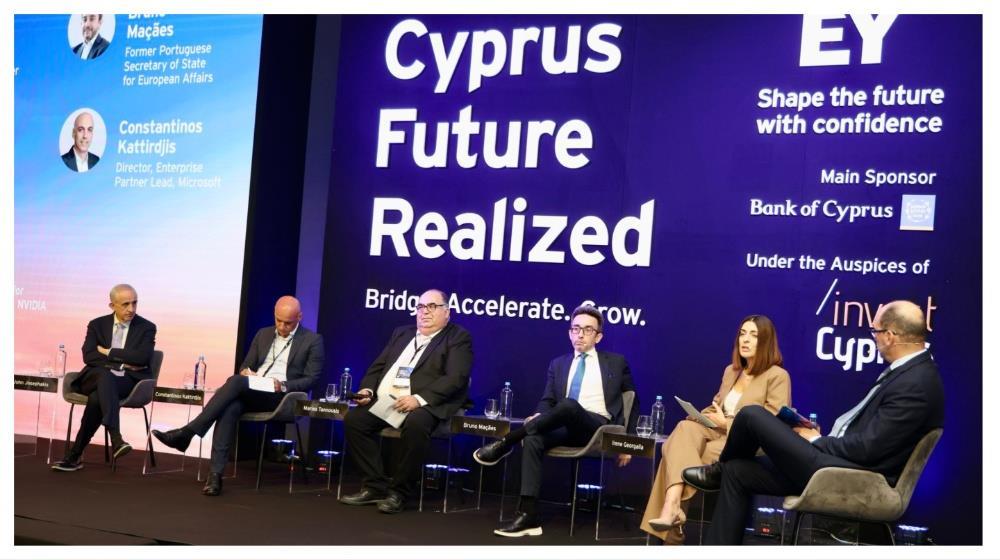
An interesting discussion about the investment attractiveness of Cyprus was held at the EY Cyprus Future Realized Forum 2026, with the participation of representatives of the state, international organisations and businesses, who analysed the conditions that shape investors' decisions today.
Within the framework of the panel 'Redefining Cyprus's FDI Attractiveness in an Era of Technological and Geopolitical Change,' the discussion focused on the impacts of technological and geopolitical developments, but also on the factors that can further strengthen Cyprus' position as an investment destination.
Irene Georgalla: The geopolitical position and international relations of Cyprus
Irene Georgalla, Director, Office of the Deputy Minister to the President, referred to the findings of the EY Attractiveness Survey, noting that investors take geopolitical risk into account in their assessments, but continue to view Cyprus positively.
She stressed that investors evaluate Cyprus with full awareness of its geographical location and continue to see its value. In this context, she noted that foreign policy is linked to the attractiveness of Cyprus as an investment destination.
Georgalla made particular reference to Cyprus' relations in the Eastern Mediterranean, using energy as an example of how geographical location can be transformed into cooperation. She said that Cyprus has created structured partnerships with countries in the region, linking its energy potential to broader issues of regional activity and European energy security.
At the same time, she referred to the expansion of Cyprus' strategic relations beyond its immediate region, with the United States and India as typical examples. On the US, she noted that the relationship has been upgraded to a strategic partnership, with areas of cooperation in security, energy, investment, technology and innovation.
Bruno Maçães: The change in the investment image of Cyprus
Bruno Maçães, Portugal's former Secretary of State for European Affairs, referred to the change in the investment landscape that has occurred over the last 10 to 15 years.
As he mentioned, one to one and a half decades ago, many countries in the periphery, including Cyprus and Portugal, were undervalued, while several countries in the core were overvalued, which was reflected in elements such as yields, public debt and foreign direct investment.
According to Maçães, there has been a correction over the last fifteen years, with markets such as Spain, Cyprus and Malta benefiting. As he explained, investors and economic actors were slow to fully integrate the benefits of the single market, but this process has begun to accelerate.
At the same time, he noted that production is starting to balance out within the single market and that investors are now more attentive to opportunities that arise outside of the obvious markets. Particularly in important sectors such as real estate and tourism, as he said, opportunities are not always in the obvious places.
According to Bruno Maçães, this correction is permanent and may not yet be complete, creating benefits for countries like Cyprus. The challenge, he noted, is for the country to harness this momentum and turn it into an opportunity for changes in the economy and adaptation to future needs.
Marios Tannousis: Clarity and predictability for investors
Marios Tannousis, CEO, Invest Cyprus, focused on the needs of foreign investors when they decide to establish a business or activity in Cyprus.
As he explained, foreign companies face essentially the same challenges as Cypriot businesses when operating in the country, but there is one important difference: international investors do not know Cyprus in the same way as those who have grown up and operate here.
In this context, he stressed the importance of guiding companies that decide, for example, from New York, Silicon Valley or Tokyo to settle in Cyprus. As he stated, these investments create highly specialised jobs, transfer know-how and skills to the local economy, contribute to development and pay taxes.
For investors, as he underlined, clarity and predictability are of particular importance. They do not need, as Tannousis said, to know the legislation themselves, but they need to know clearly what the rules are, what supporting documents are needed and what steps they need to follow.
Equally important, he added, is to have clear timelines, whether it is the creation of an investment fund or the establishment of a shipping company or an EMI. Investors, he noted, need clear time horizons and the support of the competent authorities, ministries and bodies involved in the process.
Constantinos Kattirdjis: Technology needs to permeate every sector
Constantinos Kattirdjis, Director, Enterprise Partner Lead, Microsoft, emphasised the way in which technology can permeate the economy and society, with particular reference to artificial intelligence.
As he mentioned, economic growth will not necessarily result from which country invents the next big technology model, but from which country manages to diffuse technology into everyday life and throughout society.
Regarding Cyprus, he highlighted the opportunity to integrate artificial intelligence into all key sectors of the economy, such as government, shipping and financial services.
Referring to Microsoft's contribution, he set skills as the first pillar, emphasizing that it is not enough to develop specialized executives in artificial intelligence, but rather the acquisition of AI skills on a large scale is needed so that citizens can utilise technology in their everyday lives.
As a second pillar, Kattirdjis highlighted bridging the gap between universities and industry. As he noted, the education system remains largely academic and needs a better connection between the needs of industry and what is taught in universities, especially in areas that are evolving daily, such as cybersecurity, artificial intelligence and the cloud.
In the same context, he referred to the importance of innovation labs and internships, so that students can gain experience in real-world conditions.
As a third pillar, he raised the need for greater adoption of artificial intelligence by businesses, emphasizing that the existence of the technology is not enough, but its application is needed in a way that creates real value, enhances innovation and increases productivity.
John Josephakis: The opportunity that technology creates in a small country
John Josephakis, Global Vice President, HPC, AI & Supercomputing, NVIDIA, referred to the opportunities created by Cyprus' size, noting that bureaucracy is a challenge in all countries, but in smaller economies it can have a greater impact.
At the same time, he noted that the smaller size can facilitate the implementation of changes. He referred specifically to a decision by Cyprus that, as he said, had been discussed about a year and a half earlier and concerned the acquisition of an artificial intelligence system by the Cypriot state.
As Josephakis mentioned, within a year the Cypriot government developed the "Aphrodite" system, which is already in production operation. The system is used, among other things, for workforce development and for supporting start-ups and creating the appropriate ecosystem.
He also spoke about the need to expand the sectors on which the Cypriot economy is based. As he mentioned, in a discussion he had with the President of the Republic, the issue was raised that, beyond traditional sectors such as banking and accounting services, new sectors and new industries need to be examined.
The discussion was moderated by George Tziortzis, Leader of Consulting Services, EY Cyprus.
The Forum was held with the main sponsor being the Bank of Cyprus and under the auspices of Invest Cyprus.
(Source: InBusinessNews)
