






Cyprus continues to be viewed positively as a destination for foreign direct investment, according to a survey, while investors identify significant challenges relating to energy costs, access to financing, bureaucracy, connectivity and the availability of skilled human resources.
More particularly, 83% of investors consider Cyprus an attractive destination for foreign direct investment, while 62% of survey participants plan to expand their operations on the island over the next 12 months.
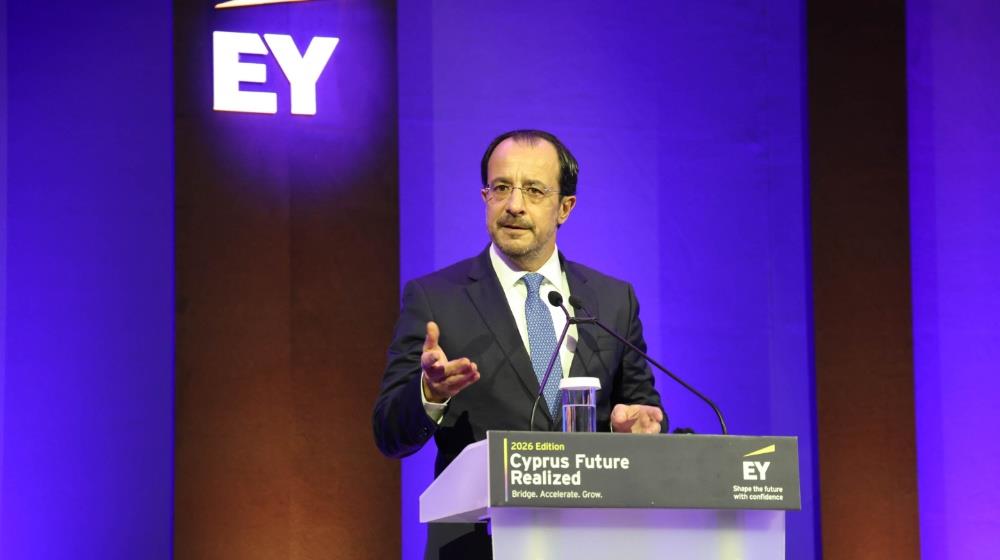
The findings were presented at the EY Cyprus forum “Cyprus Future Realized: Bridge. Accelerate. Grow”, which discussed the prospects of the Cypriot economy and the country’s position on the international investment map amid heightened geopolitical and economic uncertainty.
Presenting the results of the EY Attractiveness Survey, Andreas Anastasiou, Partner, Strategy and Transactions Services at EY Cyprus, said that 83% of investors consider Cyprus an attractive destination for foreign direct investment.
Cyprus’s tax regime tops the list of factors enhancing the country’s attractiveness, receiving a positive assessment from 90% of participants. This is followed by quality of life and political and social stability, while Cyprus’s EU membership, the quality of its professional services and its legal system are also viewed positively.
At the same time, Anastasiou said that energy costs have, for the first time, ranked so high among the factors viewed negatively, with 50% of participants identifying them as a key weakness. Access to financing and bureaucracy follow, both of which have also featured in previous surveys.
As regards risks to Cyprus’s future attractiveness, geopolitical tensions rank first, cited by 74% of respondents. These are followed by limited connectivity with the rest of the world, reputational challenges, increased regulatory burden, labour shortages and volatility in energy prices.
As Anastasiou explained, investors view Cyprus’s geographical position in two ways: on the one hand, as a factor exposing the country to regional instability and, on the other, as a source of opportunities due to its position as the closest European territory to markets in the wider region.
A total of 62% of respondents call for stronger technology and artificial intelligence infrastructure, 59% for greater government support and 56% for more skills in these areas. At the same time, 53% identify workforce availability as a key constraint.
In the banking sector, customer onboarding and KYC procedures are identified as the main pain point, followed by transaction processing speed, lending availability and the quality of customer service.
Irene Georgalla, Director of the Office of the Deputy Minister to the President, referred to the role of foreign policy in Cyprus’s investment attractiveness, noting that investors are now clearly factoring geopolitical risk into their decisions but continue to choose Cyprus.
She said the country combines its status as an EU member state with strong relationships across the Eastern Mediterranean, while energy is a characteristic example of efforts to turn geography into a platform for cooperation and regional connectivity.
She also referred to Cyprus’s expanding strategic relationships with countries beyond its immediate region, with particular emphasis on the United States and India. In the case of the US, she noted that the relationship has been elevated to a strategic partnership, encompassing cooperation in security, energy, investment, technology and innovation.
Invest Cyprus CEO, Marios Tannousis, said that once a foreign company establishes operations in Cyprus, it faces many of the same challenges as domestic businesses. The key difference, he said, is that foreign investors are unfamiliar with the Cypriot environment and therefore require greater guidance and clear information.
Clarity, predictability and faster time-to-market are, according to Tannousis, the key elements investors are looking for. He explained that investors need clear requirements, specific timelines and systematic communication with the relevant authorities throughout the licensing process.
Former Portuguese Secretary of State for European Affairs, Bruno Maçães, addressed the broader changes taking place in the international economic and geopolitical environment, describing the current world order not simply as “multipolar”, but as “metamorphic” – an order in a state of constant transformation.
He argued that the environment in which governments and businesses are called upon to make decisions is no longer stable, as rules, institutions, technologies and geopolitical balances are constantly changing.
He referred in particular to the rise of China and India, as well as changing international perceptions of the balance of power between China and the United States. In his view, trade confrontations have demonstrated that China’s rise can no longer be regarded as a process dependent on US acceptance or policy choices.
According to Maçães, the key challenge in this changing international environment is for governments and businesses to understand that they are now operating in a world that is no longer fixed but is constantly being “built and rebuilt”.
