






The next phase of European digital networks is being shaped by a complex equation that combines investment, the speed of regulatory decisions, and the need for a unified connectivity environment capable of meeting the demands of a fully digital economy. The discussion on how Europe can strengthen its competitiveness in a rapidly changing technological landscape is gaining increasing momentum.
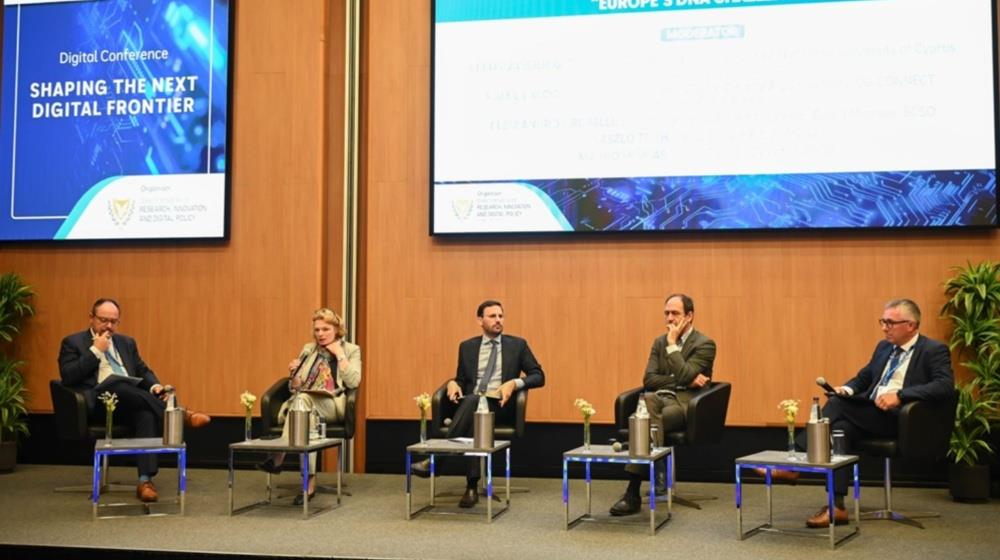
These issues were examined during the panel “Europe’s DNA Challenge,” held atthe Digital Conference “Shaping the Next Digital Frontier,” organized by the Deputy Ministry of Research, Innovation and Digital Policy in the context of the Cypriot Presidency of the Council of the European Union.
The discussion highlighted the need for a more functional and investment-friendly framework for digital networks, as well as a new approach that will accelerate the development of next-generation infrastructure. Particular emphasis was placed on transitioning from traditional regulatory models to more flexible schemes that respond to the pace of technological change and market needs.
The panel featured Kamila Kloc, Director of Directorate B (Digital Decade & Connectivity) at DG CONNECT; Alessandro Gropelli, Director General of Connect Europe and Board Member of ECSO, Laszlo Toth, Head of Europe & CIS at GSMA, and Marko Mišmaš, Chair of BEREC and Director of AKOS.
Kamila Kloc stressed that digital networks are a response to deeper structural challenges rather than a tool capable of addressing every market need. She underlined that Europe has already made substantial changes to its framework and is moving toward a more unified and immediately applicable regulatory approach. She emphasized the importance of speed in negotiations and the transition from static models to an environment that allows for the rapid implementation of policies. She also highlighted the need to accelerate key reforms, such as fiber rollout and the gradual shutdown of legacy copper networks, noting that Europe must move beyond stagnation and adopt a more ambitious investment and technological framework.
Alessandro Gropelli noted that networks are undergoing a radical transformation, becoming more flexible and virtualized, while emphasizing that the key priority is strengthening investment incentives. He stressed that European institutions and Member States should support the European Commission’s proposals on spectrum, pointing out that its effective use is a critical factor for the development of next-generation networks. He also highlighted the importance of simplifying the regulatory framework and reducing regulatory complexity, noting that investment decisions today are primarily influenced by the regulatory environment.
Laszlo Toth emphasized the need for European networks to respond to the real needs of the market and consumers, pointing out that technological evolution is fundamentally changing how telecommunications infrastructure operates. He stressed that Europe needs stronger investment incentives and a framework that enables faster infrastructure deployment, underlining that the transition to new networks requires coordination between the public and private sectors.
Marko Mišmaš highlighted the importance of policy consistency and investment certainty, noting that excessive regulation can act as a barrier to investment. He stressed the need to shift the focus from regulatory approaches to actual market demand, so that businesses can plan their investments with greater confidence at a pan-European level.
The discussion was moderated by Professor Vassos Vassiliou, Professor of Computer and Communication Networks at the University of Cyprus.