







Technology has become a key pillar of economic strength, competitiveness and strategic autonomy. In an environment of intense international competition, Europe is called upon to strengthen its own capabilities in critical areas such as semiconductors, cloud infrastructure, artificial intelligence and digital infrastructure, while ensuring the resilience and security of its economies and societies.
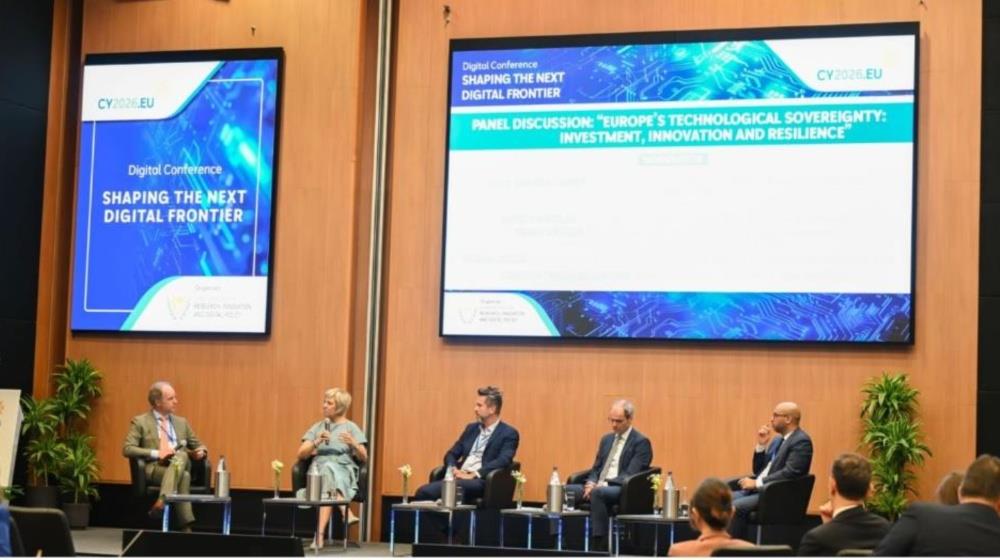
These issues were at the center of the discussion 'Europe's Technological Sovereignty: Investment, Innovation and Resilience,' which took place within the framework of the Digital Conference 'Shaping the Next Digital Frontier,' organised by the Deputy Ministry of Research, Innovation and Digital Policy in the context of the Cyprus Presidency of the Council of the European Union.
The panel included Renate Nikolay, Deputy Director-General of DG CNECT of the European Commission, Frank Krüger, Head of Directorate, Data Policy and Digital Innovations of the Federal Ministry for Digital and Transport of Germany, Thomas Boué, Vice-President & Director General, Policy, EMEA of the Business Software Alliance (BSA), and Konstantinos Hadjisavvas, Director, Resilience and Defence of DIGITALEUROPE.
Europe seeks greater autonomy in critical technologies
Renate Nikolay noted that technological sovereignty is now a strategic priority for the European Union, directly linking competitiveness, resilience and the protection of democratic institutions.
As he explained, Europe still has strong research and industrial bases, but it remains significantly dependent on third countries for critical technologies. He made particular reference to semiconductors, noting that a large proportion of the advanced chips needed for the era of artificial intelligence are produced outside Europe.
She also referred to the initiatives promoted by the European Commission to strengthen European solutions in areas such as cloud computing, artificial intelligence and digital infrastructure, emphasising that public procurement can act as an important catalyst for the development of European technology champions.
At the same time, he stressed that technological dominance does not equate to isolation. On the contrary, as he said, Europe seeks to strengthen its own capabilities, while maintaining strong partnerships with reliable international partners such as Japan, Canada, Singapore and Brazil.
Reducing dependencies and developing European solutions
For his part, Frank Krüger described the urgent need to reduce Europe's strategic dependencies on third countries, noting that the continent must accelerate the development and scaling of European technological solutions.
He referred to the initiatives that Germany is undertaking in cooperation with other European countries to define a common framework for digital sovereignty, noting that the relevant discussion concerns not only states and institutions, but also industry, academia and civil society.
As he said, Europe needs the ability to develop, control, use and adapt critical digital technologies, while remaining open to collaborations with reliable international partners.
Resilience is judged by potential, not origin
Thomas Boué approached the issue from an industry perspective, pointing out that the resilience of digital infrastructures must be assessed based on the real capabilities, security standards and operational guarantees offered by providers.
As he argued, strengthening the European technological base requires policies that promote innovation, safety and diversification of solutions, without creating new restrictions that may limit competition or access to advanced technologies.
At the same time, he stressed the importance of multi-layered resilience strategies, which include alternative infrastructure, business continuity plans and cooperation between the public and private sectors.
Investment remains the big challenge
Konstantinos Hadjisavvas focused on the issue of investment and the development of European technological champions, pointing out that a large part of the funding for advanced technologies currently comes from countries outside the European Union.
Presenting data on the financing and development of high-tech companies, he noted that a significant number of European businesses are choosing to expand outside Europe, which highlights the need to strengthen the investment ecosystem and access to growth capital.
He also stressed that strategic autonomy must be based on a balanced approach, which combines strengthening European capabilities with maintaining strong partnerships with countries that share common values and strategic goals.
The discussion was moderated by Niels Van Der Linden, Vice President, Advisory Client Partner European Institutions at Capgemini Invent.
(Source: InBusinessNews)
