








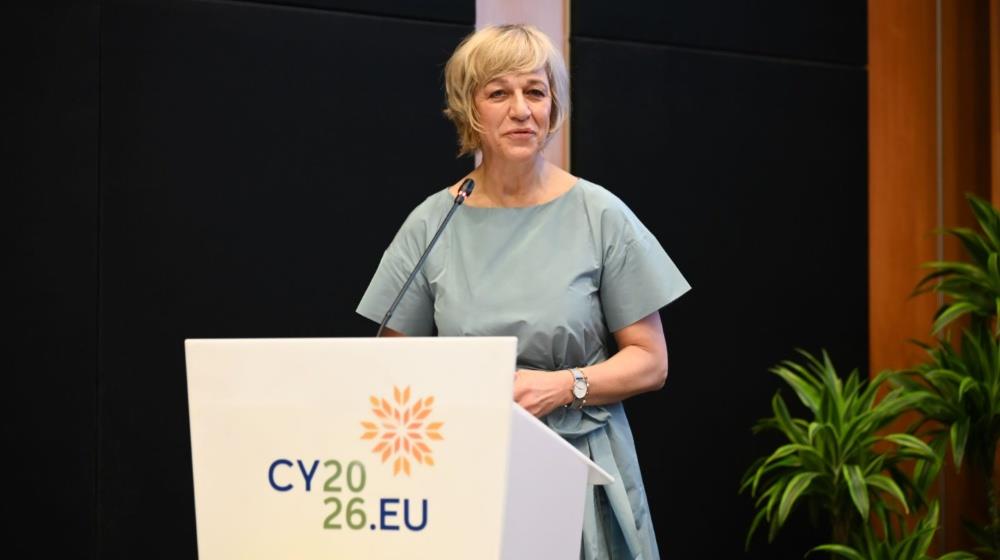
Boosting investment, accelerating the adoption of artificial intelligence by businesses and simplifying the regulatory framework are the key conditions for maintaining European competitiveness in the coming years, Renate Nikolay, Deputy Director-General of DG CNECT of the European Commission, has said.
Presenting the 'State of the Digital Decade Report 2026' at the Digital Conference 'Shaping the Next Digital Frontier' taking place in Nicosia and which was organised by the Deputy Ministry of Research, Innovation and Digital Policy in the context of the Cyprus Presidency of the Council of the European Union, Nikolay underlined that Europe has significant advantages on which to build its digital future.
As she noted, the European Union continues to have a world-class research ecosystem, strong industrial capabilities and important initiatives that are already producing results. Nikolay made special reference to the 19 European AI Factories, as well as the EuroHPC supercomputing infrastructures, which now offer access to startups for the development and training of artificial intelligence models.
She stressed, however, that the real challenge lies in transforming this technological power into productive applications that will strengthen the European economy and industry.
Nikolay also placed particular emphasis on the need to simplify the European regulatory framework. As she noted, Europe remains committed to its regulatory sovereignty and to shaping the rules of the digital economy, but at the same time it must respond to the concerns of businesses about the complexity and administrative burden created by certain regulations.
In this context, she referred to the simplification agenda initiatives, the AI Omnibus and the Digital Omnibus under development, which aim to maintain the strategic objectives of the European Union, while reducing regulatory costs for businesses and investors.
Nikolay described the issue of investment as equally critical, noting that Europe needs more private capital to bridge the innovation gap with its international competitors. She referred to the proposals included in the Draghi Report, as well as the discussion around new investment tools and financing mechanisms that could boost European technological development.
At the same time, the expert announced the revision of the Digital Decade Policy Programme, emphasizing that the new geopolitical conditions, the speed of technological developments and the growing importance of cybersecurity make it necessary to adapt existing objectives to new realities.
She also made special reference to the role of businesses, noting that the adoption of artificial intelligence is progressing, but is not yet at the levels required to achieve European goals. As he said, businesses are called upon to more dynamically integrate artificial intelligence solutions into their operations, to invest in larger-scale partnerships and to exploit the opportunities created in areas such as digital infrastructure, the cloud and connectivity.
Concluding her speech, Renate Nikolay called on Member States, regions, businesses and society to act in a coordinated manner so that Europe can turn its digital ambitions into tangible results. As she said, “we have already planted the seeds. Now it is time to see them bear fruit.”
(Source: InBusinessNews)
