







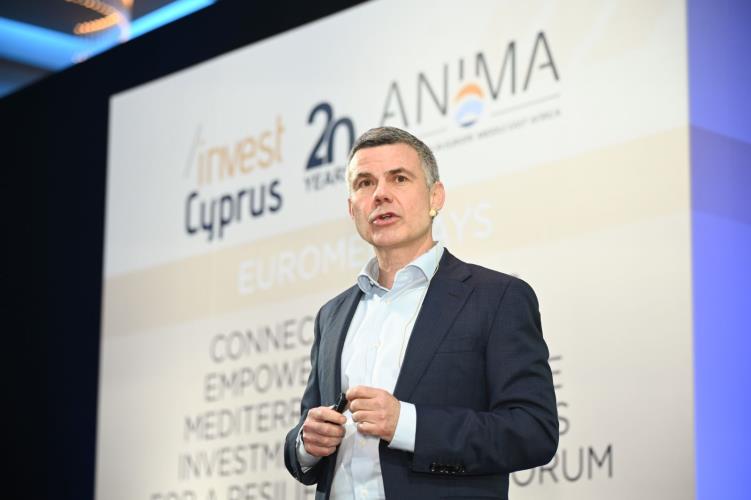
A realistic and strategic analysis of the changing global foreign direct investment environment was presented by the CEO of the FDI Center, Andreas Dressler, during his speech entitled 'Understanding FDI in a changing global economy,' within the framework of EUROMED DAYS 2026.
Dressler highlighted that foreign direct investment flows are now influenced by an environment of profound transformations, where challenges and opportunities coexist and determine the strategy of states and investment attraction organisations.
Referring to contemporary developments, he noted that the internationalisation of investment decisions has acquired a strong political character. As Dressler underlined, geopolitical tensions now directly affect where and how companies invest, but also how states shape capital attraction policies.
At the same time, he stressed that states no longer view foreign direct investment solely as a tool for job creation, but as a strategic means to achieve broader goals, such as supply chain resilience and economic security. This has led, he noted, to the adoption of new policy tools, such as industrial policies, investment incentives, tariffs, control mechanisms and regulatory screening frameworks.
In this context, Dressler referred to recent European developments and the new strategic direction of the European Union around attracting and controlling investments, underlining the importance of strengthening institutional tools at the European level.
He also pointed out that, while at a theoretical level the increased importance of foreign direct investment could enhance the role of investment promotion agencies (IPAs), in practice there is a trend towards direct involvement of governments in the management of investment flows and strategic projects.
As he noted, in several countries governments are creating parallel mechanisms or special structures to attract "strategic investments", which is redefining the role of IPAs, which in some cases are limited to a more supportive or communication role.
Referring to the international economic environment, he stressed that the global foreign direct investment market has remained largely stagnant in recent years, however, competition between countries has intensified significantly, as new players emerge dynamically and claim a share of global investment flows.
He placed particular emphasis on the prospects created by artificial intelligence, which he described as one of the most defining technological developments of the era. As he stated, artificial intelligence is not a passing trend, but a structural transformation comparable to the impact that the internet has had since the 1990s.
According to Dressler, this development will transform the way businesses operate, reducing the need for human resources but increasing the demand for specialised skills. At the same time, he highlighted artificial intelligence as a significant opportunity for countries to accelerate their technological transformation and upgrade their position in the global investment ecosystem.
Dressler also noted that artificial intelligence is creating new investment categories, with a particular emphasis on three key sectors: large technology companies, startups and innovative businesses developing AI applications, and data infrastructure, with data centers emerging as one of the fastest growing sectors worldwide.
In closing, he emphasised that the dynamics of data infrastructure and the digital economy are radically changing the investment landscape internationally, confirming the shift towards a new era where technology is the main driver of growth and investment strategy.
EUROMED DAYS – Connecting Regions, Empowering Growth: Mediterranean-Europe Investment Partnerships for a Resilient Future Forum, was organised by Invest Cyprus and the ANIMA Investment Network.
(Source: InBusinessNews)
