








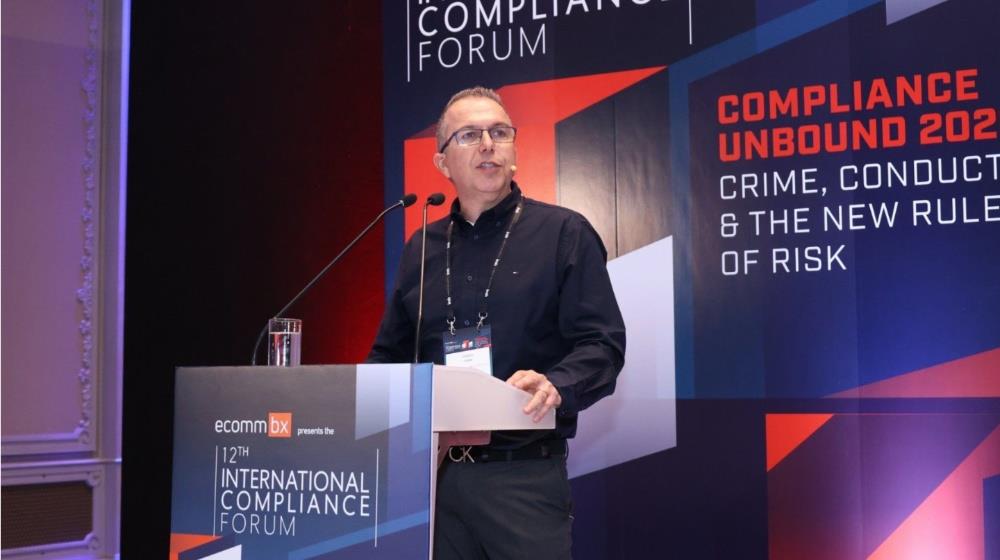
“Returning to this stage for a second consecutive year feels very different this time round. Not because the responsibility has become lighter, not because we're experienced, if anything quite the opposite. But because the world we're operating is today is fundamentally different from the one we spoke about even just a year ago. The pace of change has accelerated. The geopolitical environment has become more unstable. The global regulatory landscape has become more fragmented and more demanding,” Gregory Dellas, Group Chief Compliance & Risk Officer, ECOMMBX, Chair, ACAMS Cyprus Chapter and Chairman of the Conference said at the 12th International Compliance Forum, presented by ECOMMBX currently underway in Limassol.
He continued, “technologies evolving faster than government structures can comfortably absorb. And increasingly, institutions are being judged not only by their profitability or by their growth, but by their resilience, their integrity and ability to navigate uncertainty. We are entering an era where risk itself has become unbound. And that is why the title of this year's forum couldn't be more timely. Compliance Unbound. Because compliance today no longer exists neatly within departmental boundaries, regulatory manuals or traditional control frameworks. The boundaries between financial crime, conduct, cyber security, operational resilience, job politics, sanctions, technology, and national security are rapidly disappearing. Compliance is no longer simply about regulation. It's about trust. It's about stability. It's about governance. It's about institutional survival. And perhaps most importantly, it's about effectiveness.”
The Chairman went on to explain that, “for years, especially those of us working in the private sector, we've seen that organizations around the world have invested heavily in compliance infrastructures. More systems, more controls, more committees, more policies, more reportings, more dashboards. And yet despite all this, financial crime continued to evolve faster than many of the frameworks designed to stop it. Fraud became industrialised. Cyber and network crime exploded. Sanctions in Asian networks became more sophisticated. Criminal ecosystems became faster, smarter, and more adaptive. And emerging technologies gave bad actors scale and reach that would have been unimaginable only a few years ago.”
“At the same time,” he continued, “societies themselves became more fragile. Conflicts intensified. Economic nationalism returned. Global alliances shifted. Supply chains became politicized. And financial institutions increasingly found themselves operating at the intersection of commerce, diplomacy, security, and ethics. And the result is that compliance professionals, as in the room, are no longer simply interpreting regulations. They are navigating systemic uncertainty. And this changes everything. Because the question regulators and governments are now asking is no longer whether institutions are compliant? The real question is, are institutions effective? It's not do you have controls, but it's do those controls actually reduce harm? It's not did you complete the process or did you follow the procedure? But it's did you identify, manage the risk? And it's definitely not did you tick the box, but it shouldn't be. But it's did you protect the integrity of the system. And frankly, the shift is both necessary and overdue. Because activity should not be mistaken for effectiveness.”
As the expert went on to note, “The greatest risk facing our profession today is not necessarily that institutions are doing too little. It's that we sometimes confuse complexity with progress. We build increasingly sophisticated frameworks. We generate enormous volumes of data. We create endless layers of governance. Yet in many cases, underlying risks continue to grow faster than our ability to collectively respond.”
He pointed out that this why the discussions today at the confernece matter, “because this forum is not about compliance and isolation. It's about convergence of risks, crime, conduct, technology, culture, resilience, geopolitics, trust, all interconnected, and all influencing each other. All educating the future of our industry simultaneously,” he said.
The Chairman went on to note that nowhere is this convergence more visible than in the global fight against illicit finance, “Around the world, we are witnessing a major transformation in anti-financial crime efforts. Authorities are becoming more assertive. Supervisors or supervision is becoming more intrusive. Expectations around governance and accountability are increasing, and enforcement is no longer focused solely on technical reaches, but increasingly on things like culture, behavior, and effectiveness. The year of paper compliance is ending. Compliance, in that respect, has left the building. Institutions are not expected to demonstrate outcomes, and this is changing the role of the compliance professional entirely.”
As Dellas noted, “they are strategists, a risk advisor, a technologist, a translator between business and regulation, an interpreter of weak signals, and increasingly a protector of institutional resilience. Because resilience has become the defining theme of modern financial systems. We don't have operational resilience, regulatory resilience, cyber resilience, refutational resilience, geopolitical resilience, and this cannot exist in silence anymore.”
He gave sanctions as as example, “they evolved into one of the most powerful geopolitical instruments of our time, but sanctions compliance today is no longer nearly about screening names against lists. Institutions are not expected to understand ownership structures, trade flows, beneficial ownership capacity, supply chain exposure, geopolitical alignment, cyber threats, crypto ecosystems, and sophisticated innovation technologies operating across multiple jurisdictions simultaneously. And this creates enormous pressures, not only on the institutions themselves, but also on the regulators, because regulators too are adapting to this changing environment, this rapidly changing world.”
Dellas noted that the establishment of AMLA represents one of the most significant regulatory developments Europe has seen in decades. “AMLA has the potential to reshape supervisory convergence, strengthen intelligence sharing, improve consistency across member states, and elevate the overall effectiveness of the European anti-financial prime framework. So our expectations will rightly be very high. Success will not be measured by the number of guidelines issued or the meetings held. Success will be measured by whether Europe becomes more coordinated, more agile, more intelligence led, and ultimately more effective at reducing financial primaries,” he pointed out.
“At the same time,” the expert continued, “it's not just financial crime. Institutions across Europe are simultaneously navigating MICA, DORA, AI governance frameworks, operational resilience requirements, ESG, scrutiny, evolving social regimes, and increasing expectations around conduct and culture. The regulatory burden is immense, and this forces us to ask an uncomfortable but necessary question. Are we truly building systems that are actually safer, or are we building systems that are simply more complicated? Because complexity itself has become vulnerability, and this is what we will try to explore in our discussions today.”
“When organisations spend more time managing processes, understanding risk, effectiveness suffers,” he said, continuing, “When fear dominates decision-making in the innovation slope, when institutions become excessively defensive, collaboration deteriorates. And when regulatory fragmentation increases, criminals exploit the gaps between systems faster than we can close them.”
“That,” the Chairman added, ”is why one of the most important themes of the future must be partnership. Real partnership, not symbolic consultation, not transactional engagement, and certainly not a public-private interaction that occurs only during crisis. I mean genuine partnership, real partnership, between regulators, governments, law enforcement, and the industry. Because the private sector today sits on the front line of financial intelligence, financial institutions, payment firms, steam techs, crypto providers, technology companies, and compliance professionals often identify emerging risks before they fully materialize at national or international level. They observe changing typologies in real time, they detect behavior anomalies early, and they understand operational realities that cannot always be captured in legislation or in guidance.”
“And this means something important,” the expert went on to note, pointing out, “The private sector cannot simply be treated as a recipient of regulation anymore. It must become an active participant in shaping effective frameworks. Not because industry should detect standards, not at all, but because effective regulation requires operational reality. The strongest frameworks, emergent regulators, and industry challenge each other constructively, not when they operate in parallel universes. Because ultimately, we share the same objective. We're in for the same cause, protecting the integrity of the financial system, and integrity matters now more than ever.”
He continued, "We're living in a period where trust is under pressure. Trust in institutions, trust in governments, trust in media, trust in technology, trust in financial systems. In a world where trust is fragile. And in this world, conduct becomes critically important. That is why conduct-based is no longer a secondary conversation. Culture now sits at the center of regulatory thinking globally. Because history has repeatedly shown us that major failures rarely happen because policies did not exist, or procedures did not exist. They happen because culture failed, because incentives failed, because accountability failed, because people did not work in science, or because institutions became more focused on optics, rather than outcomes."
He added, "that is why the future of compliance cannot be built solely on rules. It must also be built on values. And that becomes even more important as artificial intelligence transforms our profession. AI is already reshaping transaction monitoring investigations, onboarding, fraud detection, sanction screening, adverse media, analysis and surveillance. But AI also introduces entirely new risks. Deep phase, synthetic identities, automated fraud, algorithmic bias, hallucinations, and pressures around explainability and accountability. The challenge ahead is not whether we use AEI. That debate is already over. The challenge is whether we can govern technology responsibly while preserving human judgment, ethics, proportionality and trust. Because despite our technology around us, compliance remains fundamentally human. Behind every alert, there's a decision. Behind every escalation, there's judgment."
Behind every framework, there's structure, he explained. "And behind every institution, there's leadership. Technology may enhance our capability, but integrity remains human. And perhaps that is the central message of today's forum. In a world where risk has become unbound, our response cannot remain limited by all boundaries. Not between compliance in business, not between public and private sectors, not between technology and governance, not between jurisdictions, and definitely not between disciplines. The future belongs to institutions and societies capable of working together intelligently, transparently, and courageously. Not perfectly, but honestly. And when I look around this room today, I genuinely believe we have the right people to drive that conversation forward. Different perspectives, different mandates, different experiences, but one common responsibility, to strengthen resilience, integrity, and trust in an increasingly uncertain world."
Concluding, the expert said, " the future of compliance will not be defined by who writes the longest policies or by who implements the most controls or by who has the biggest departments. It will be defined by who can build trust in an age of uncertainty, who can remain adaptive in an age of disruption, who can remain principled in an age of pressure, and who can turn complexity into clarity. Because ultimately compliance is no longer just about protecting institutions from regulators. Increasingly it's about protecting institutions and society itself from instability. And that responsibility belongs to all of us. There's a welcome African proverb that says, if you want to go fast, go alone. But if you want to go far, go together."
Diamond Sponsor: ECOMMBX
Platinum Sponsor: Freedom Holding Corp.
Gold Sponsors: Treppides, XM
Silver Sponsors: Complyport, KPMG, Moebius, Zygos
Supporters: ACAMS Cyprus Chapter, ACCA, ACEMPI, CCA, ICAEW, Primetel, The Marshall Islands Registry
With the support of: ACB, ACFE, Cyprus Bar Association, CIF, CFA Society, CYFA, Institute of Internal Auditors
Communication Sponsors: CBN News, GOLD, IN Business
