




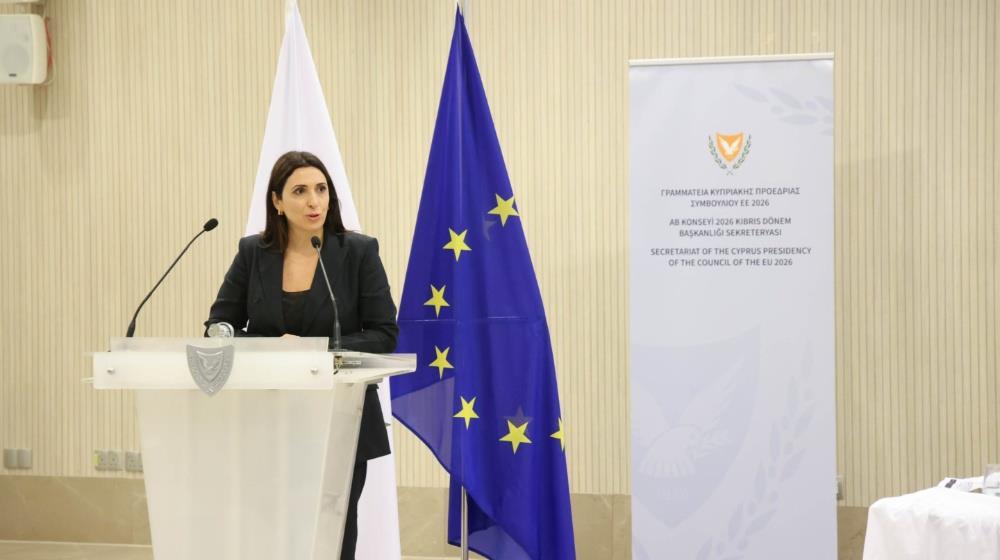
EU enlargement constitutes a strategic investment and a key foreign policy tool, Deputy Minister for European Affairs, Marilena Raouna, said on Tuesday, during an intervention at the plenary session of the European Parliament in Strasbourg, representing the Council of the EU in the context of the Cypriot Presidency, during a debate entitled “EU governance under pressure – institutional responses to global challenges”.
In her address, Raouna stated that the European Union is facing a new geopolitical reality, noting that the evolving security environment and the increasing complexity of challenges make closer cooperation necessary. She stressed that the objective is a safer, more resilient and more united Union, which remains a reliable partner and is grounded in its internal cohesion.
Referring to the war against Iran, the Deputy Minister noted that the Union demonstrated its credibility, predictability and reliability in responding to this demanding environment, as well as to its economic consequences.
Referring to Europe’s defence readiness she underlined that bold decisions have been taken to strengthen it, in particular through the adoption of the SAFE instrument. At the same time, she acknowledged that reaching consensus among the 27 member states requires time and effort, stressing that unity is the Union’s core strength.
She made particular reference to EU enlargement, describing it as a strategic investment and a key foreign policy tool. As she noted, the process is based on strict criteria concerning the rule of law, democratic institutions and the economy, while the current geopolitical context makes adherence to these criteria even more demanding.
She pointed out that the Cypriot Presidency has worked consistently, achieving concrete progress on enlargement despite the challenges, while maintaining the credibility of the established methodology and its merit-based nature.
The Deputy Minister noted that, in parallel with enlargement, the EU must advance internal reforms in order to strengthen its capacity to function effectively. She referred, among other things, to discussions on governance, policy priorities and the Union’s budget.
As regards the EU governance, Raouna emphasized that the Presidency has taken the work of the European Parliament seriously, particularly recent resolutions on the institutional consequences of enlargement and the institutional aspects of the Draghi Report.
Referring to the recently agreed “One Europe, One Market” roadmap, signed in Nicosia in April, she underlined that it represents an ambitious step towards strengthening the EU’s strategic autonomy. At the same time, she noted ongoing efforts towards a genuine energy union, seeking solutions that ensure affordable energy and deliver the energy transition.
She further stressed that in order for the European Union to become strategically autonomous, the necessary means must also be provided. As she stated, advancing work on the next Multiannual Financial Framework (MFF) is essential so that European ambitions are matched with adequate resources.
She added that, within the framework of the Cypriot Presidency, emphasis was placed on advancing the European agenda in an inclusive manner, with the aim of a more strategically autonomous Union, noting that this effort constitutes an investment in its future.
In her reply after interventions by members of the European Parliament, Raouna noted that the debate highlighted a major ongoing shift within the European Union towards even closer integration.
Finally, she noted that the changes under discussion also concern the deepening of the single market, the next Multiannual Financial Framework, military mobility, and support for innovation and entrepreneurship, stressing that unity remains the guiding principle of the European Union’s path forward.
(Source: CNA)