







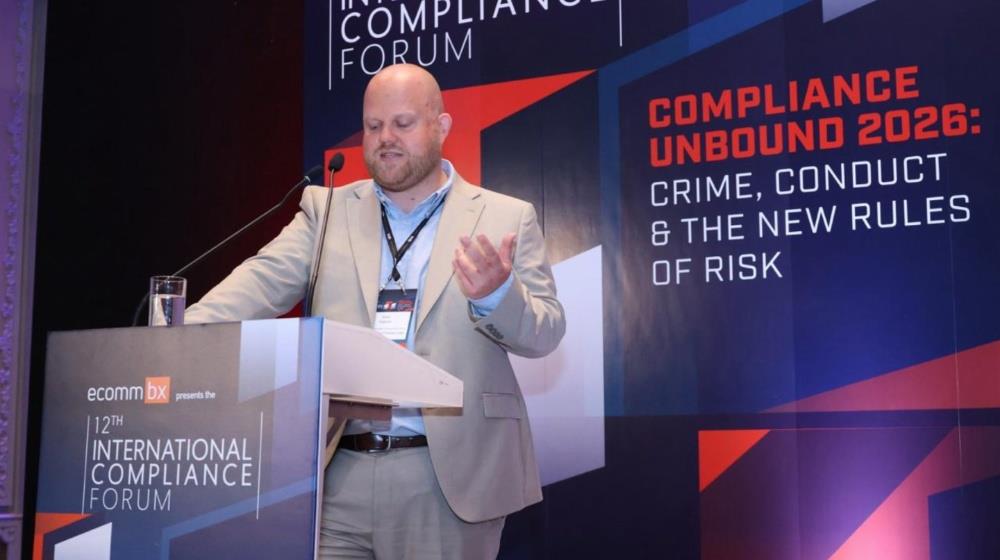
In an address entitled, ‘From Enforcement to Influence: Redefining the Fight against Illicit Finance in an Age of Systemic Risk,’ at the 12th International Compliance Forum, presented by ECOMMBX, Kane Baguley, Foreign Commonwealth and Development Office, Regional Illicit Finance Lead outlined the three phases in the evolution of an anti-illicit finance strategy.
As Baguely told the conference in Limassol, these three phases are: enforcement (catching and convicting bad actors), disruption (depriving criminals of assets), and the emerging influence model (shaping behavior before harm materializes through transparency, sanctions, supervision, and partnerships).
The expert also noted that modern challenges and contemporary threats are increasingly complex, including AI-enabled fraud, intricate ownership structures, state-oriented cryptocurrency operations, and geopolitical fragmentation.
Traditional compliance approaches focused on proceeds of crime are now insufficient, he underlined, going on to give real world examples including the following in North Korea where a $1.5 billion cryptocurrency theft demonstrated how illicit finance funds hard security objectives, including nuclear weapon development. Funds were laundered through intermediary wallets, decentralized exchanges, and mixers, he explained.
Baguley also gave the example of another event in Moldova where the 2013 billion-dollar bank fraud created systemic vulnerabilities.
As the expert explained, subsequent elections faced hundreds of millions in illicit influence through: large cash transfers distributed as "gifts," international transfers routed through Central Asia, and underground cryptocurrency networks involving Ukrainian criminals and pro-Russian actors.
As a result, a state-linked cryptocurrency emerged, linked to sanctions evasion and election interference, the expert explained.
According to Baguley, systemic solutions are required, rather than relying on enforcement alone. The expert suggests that this approach requires shaping incentives for financial institutions and enablers, managing information flows between government and private sector, coordinating sanctions, beneficial ownership reform, and asset recovery and building public trust through transparency and attribution.
On the significance of all this for Cyprus, Baguley said that the country’s role as a regional financial hub requires addressing these evolving threats.
The speaker highlighted the UK's 2023 sanctions on professional enablers, which, he noted, strengthened UK-Cyprus partnership and led to the establishment of Cyprus's national sanctions implementation unit -demonstrating how collaborative enforcement enhances effectiveness.
Baguley’s core message was that illicit finance is now a systems problem requiring coordinated influence and enforcement. Financial professionals play a critical role in shaping the operating environment to reduce opportunities for illicit actors.
Diamond Sponsor: ECOMMBX
Platinum Sponsor: Freedom Holding Corp.
Gold Sponsors: Treppides, XM
Silver Sponsors: Complyport, KPMG, Moebius, Zygos
Supporters: ACAMS Cyprus Chapter, ACCA, ACEMPI, CCA, ICAEW, Primetel, The Marshall Islands Registry
With the support of: ACB, ACFE, Cyprus Bar Association, CIF, CFA Society, CYFA, Institute of Internal Auditors
Communication Sponsors: CBN News, GOLD, IN Business
