








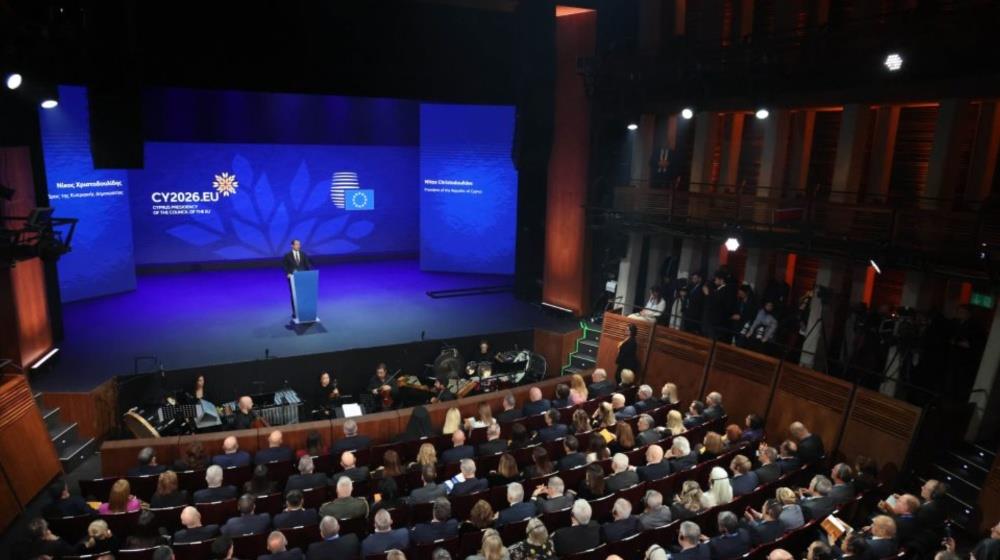
The goal of Cyprus’ Presidency of the Council of the European Union is to promote a European Union that combines strategic autonomy with strong international engagement, while defending its interests and citizens and acting as a force for peace, stability and growth, President of the Republic Nikos Christodoulides has said.
Addressing the official ceremony marking the launch of the Cypriot Presidency of the Council of the EU on the evening of 7 January, President Christodoulides stressed that Cyprus, situated at the crossroads of three continents and in a region facing multiple challenges, will continue to serve as a reliable bridge between the European Union and the wider region. He said Cyprus would promote dialogue, cooperation and mutual understanding, “always as part of the solution and never as part of the problem.”
He noted that the Cypriot Presidency will work toward this vision on behalf of the 27 EU member states and the Union’s 450 million citizens. The more united, credible and outward-looking the EU becomes, he said, the more security, stability and prospects it can offer its citizens, with the ultimate goal of “greater European integration and more Europe through an autonomous Union that is open to the world.”
The President expressed his pleasure at welcoming guests to the ceremony at “the southeasternmost edge of Europe,” referring to Nicosia as the last divided capital of the continent. “A city that embodies what is at stake when it comes to peace, security and European integration,” he said.
He also spoke of feelings of pride and responsibility, stressing that the Presidency of the Council of the EU is not merely an institutional milestone, but a collective national mission undertaken with full awareness of its significance. “Cyprus, the Republic of Cyprus, is ready and fully prepared to lead with determination,” he said.
President Christodoulides outlined Cyprus’s clear vision for the next six months: to translate the EU’s vision and strategic goals into concrete action. He said Cyprus aims to contribute positively, as an honest broker, to safeguarding institutional cohesion and promoting initiatives that will strengthen the European integration process.
“We must build together, with a strong sense of responsibility, pride and faith in the European project, the future of the EU,” he said.
Referring to the presence of the Presidents of Ukraine and Moldova at the ceremony, President Christodoulides noted the profound positive changes brought about by Cyprus’ accession to the EU, which he said significantly upgraded all aspects of daily life. He stressed the strengthening of Cyprus’ diplomatic and political influence as a key benefit of EU membership, noting that as part of a family of 27 states and nearly half a billion citizens, Cyprus has a stronger voice and an expanded diplomatic footprint.
This, he added, is particularly important for a small country under occupation like Cyprus, which continues to strive for security, reunification and peace, while progressing and developing.
He noted that as an EU member state, Cyprus has successfully overcome serious crises, including the economic crisis of the previous decade and, more recently, the pandemic. Within this context, he said, Cyprus provides unwavering political, economic and humanitarian support to Ukraine, defending its sovereignty, independence and territorial integrity.
“This policy will continue and be strengthened during our Presidency,” he said, stressing that Cyprus knows firsthand what invasion and occupation mean, as well as the realities of refugees, missing persons and violations of fundamental human rights.
President Christodoulides concluded by noting that EU member states can only survive and play a leading role in today’s international environment if they remain united in their diversity and grounded in shared principles and values. The multitude and complexity of current challenges, he said, clearly demonstrate the need for “more and stronger Europe.”
He expressed his firm belief that the current climate of geopolitical uncertainty presents an opportunity for the EU to emerge stronger, safer, more united and more strategically autonomous.
(Source: CNA)
