







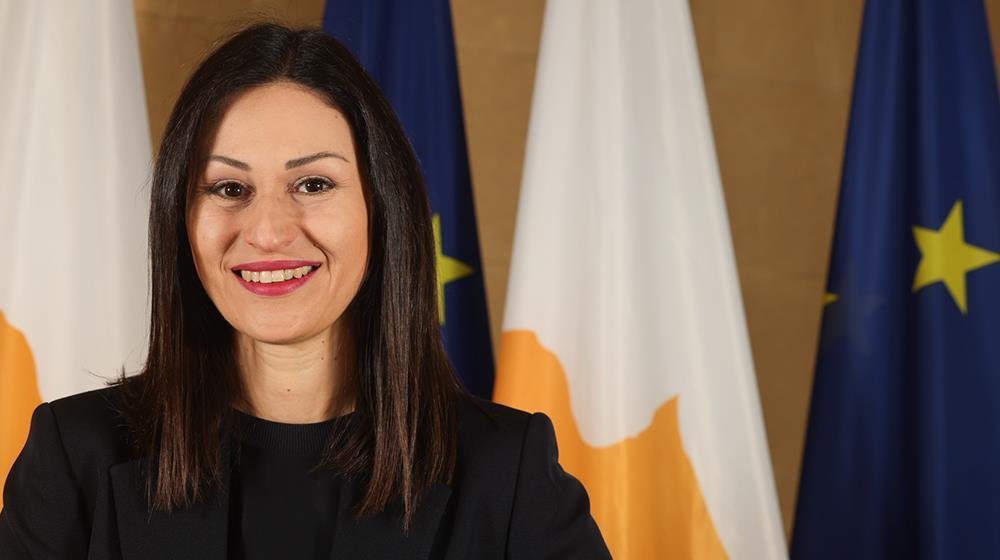
The Cypriot Presidency of the Council will work closely with all Member States and the European Commission to ensure a sustainable and competitive agricultural sector, in order to strengthen the EU’s food security, Minister of Agriculture, Rural Development and Environment Maria Panayiotou said, adding that supporting farmers is a top priority for the Presidency.
She was speaking on 7 January following the informal meeting of the 27 EU Agriculture Ministers with Commissioners for Agriculture Christophe Hansen, Trade Maroš Šefčovič and Health and Food Safety Olivér Várhelyi, held at the European Commission headquarters in Brussels.
According to the Minister, who co-chaired the meeting with the Commission, the discussion was held in order “to listen carefully to Member States and to reflect on the way forward regarding the challenges expressed by European farmers over the past months”, stressing that the concerns voiced by farmers “require swift and effective action, and the situation is far from business as usual”.
She thanked her counterparts for today’s fruitful, constructive and frank discussion, referring to it as a “timely and very necessary exchange of views”. “The issues discussed today are a top priority of our Presidency. We will advance work in all relevant Council formations in order to achieve rapid progress,” she added.
In particular, the Minister stressed that the Presidency will give priority to further supporting farmers and rural communities in the context of the next Multiannual Financial Framework. “This priority is linked both to the repeated calls by a significant number of Member States to examine whether certain provisions concerning the Common Agricultural Policy (CAP) should be transferred from the MFF Regulation to the CAP regulations, as well as to the proposal presented yesterday by the Commission aimed at securing additional resources for farmers and rural communities,” Panayiotou added.
Replying to a question from CNA on the letter sent by Commission President Ursula von der Leyen to President Nikos Christodoulides and European Parliament President Roberta Metsola, Commissioner for Agriculture Christophe Hansen said that “it economically makes sense, but as well, geopolitically, on the €45 billion that have been announced yesterday, this is additional money, secured, and guaranteed for the farmers. So this amount can be mobilised as soon as 2028, when the next MFF will start and we listened as well to farmers and rural communities, and we acted.”
He added that, together with the existing CAP envelope, this could bring total support for agriculture to close to €400 billion, exceeding the previous financial framework.
From a trade perspective, Commissioner Maroš Šefčovič underlined that fertiliser prices remain about 60% higher than in 2020, despite recent stabilisation, saying that this “is simply not sustainable”.
He announced that the Commission will propose to temporarily suspend the remaining MFN tariffs on ammonia and urea, in order to lower costs for farmers, with the measure expected to enter into force in 2026 and broadly offset the impact of CBAM. He also said that a Fertiliser Action Plan will be presented in the second quarter of the year.
Commissioner for Health and Food Safety Olivér Várhelyi stressed that agriculture is “the last sector in Europe where we are mostly self-sufficient and where European sovereignty is strong,” highlighting the need to relieve farmers from excessive administrative burdens.
He referred to the Food and Feed Omnibus proposal aimed at simplifying procedures for plant protection products, accelerating approvals for biocontrol and less hazardous substances and shortening approval times for new products, noting that these changes could save up to €1 billion per year for farmers, industry and administrations.
He also announced that steps have been launched to bring three substances – carbendazim, benomyl and thiophanate-methyl – to “technical zero” residue levels from February, while import controls will be reinforced with a 50% increase in inspections in third countries and an expansion of border control points.
On fertiliser affordability and availability, Panayiotou said that “the measures proposed, based on the requests of the farming community to reduce costs for farmers, have been positively received by the Commission”, noting that “the Fertiliser Action Plan, scheduled for the second quarter of 2026, will provide important guidance for further concrete actions. Issues related to cost reduction and boosting competitiveness, such as CBAM and trade-related measures, including safeguards, will also be examined with an emphasis on concrete action.”
Regarding the EU–Mercosur agreement and the linked safeguard instrument, the Minister recalled that a meeting at the level of the EU’s Permanent Representatives (COREPER) is still pending, stressing that the Cypriot Presidency is seeking a decision on the matter.
In conclusion, Panayiotou said that “today’s meeting gave additional impetus to our efforts to implement our vision for the future of the agricultural sector in Europe”, adding that at the upcoming AGRIFISH Council on 26 January a special Task Force will be launched “with the aim of improving the effectiveness of import controls”, an issue on which the Presidency is working closely with Commissioner Várhelyi.
“I intend to inform the Council on the progress achieved at every AGRIFISH Council during the Cypriot Presidency, in order to maintain and further strengthen the significant momentum we achieved through today’s meeting,” she added.
Concluding, the Minister stressed: “Our message today was clear. We will work tirelessly to find solutions and achieve tangible results. We reaffirmed our shared commitment to a resilient, competitive and sustainable agricultural sector – one that is able to feed our citizens, support vibrant rural communities and contribute meaningfully to Europe’s strategic autonomy.”
(Source: CNA)
