








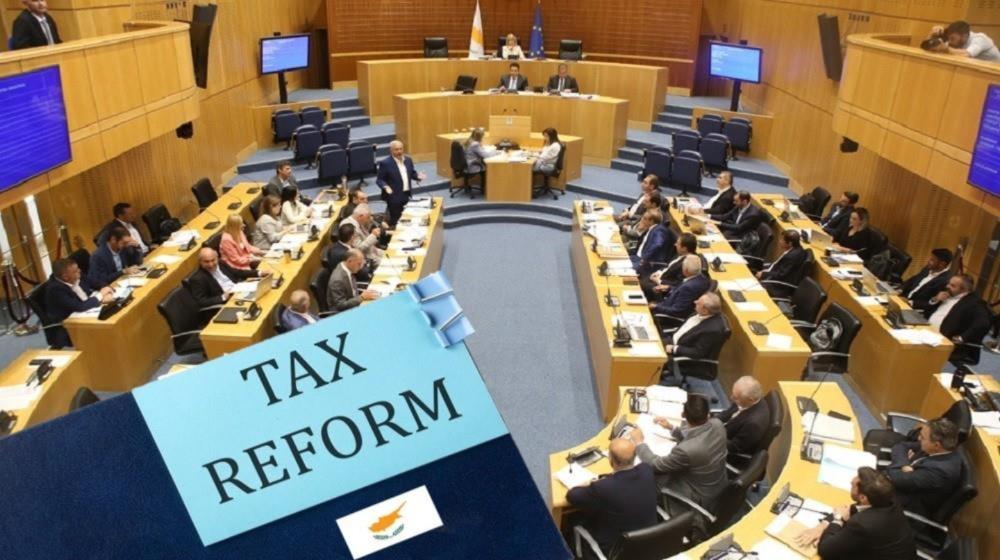
The bills on tax reform, as shaped following extensive discussion at the House Finance Committee, are being put to the vote today, 22 December, at the House Plenary, which is convening in an extraordinary session at 10 am.
Significant changes have been made to all five bills – the sixth bill concerning stamp duties will not be submitted for approval – changes deemed necessary following the serious concerns and reservations expressed by all stakeholders involved, without exception.
Most of the amendments relate to the excessive powers initially granted to the Tax Commissioner, which, under the original drafts, would have allowed him, among other things, to freeze assets, shut down businesses, and request and obtain taxpayer information from banks.
However, following the reservations and concerns raised at the Parliamentary Committee on Finance, a number of safeguards were introduced, effectively restoring the tax reform to its proper foundation, in line with what had been announced at the Presidential Palace in February.
It is noted that the parties DISY, DIKO, EDEK and DIPA played a decisive role in bringing the tax reform back on track. These parties prepared and presented a series of amendments to the Minister of Finance, all of which were adopted in full and will be included in the final texts, as well as in the amendments they will submit and which will be put to a vote alongside the bills.
Among other things, these changes concern an increase in the tax-free income threshold, the expansion of tax deductions for children and interest on performing loans, an increase in tax-free thresholds in relation to capital gains from disposals, as well as the abolition of stamp duties.
Based solely on the parliamentary strength of the four aforementioned parties, the five revised tax reform bills comfortably secure the required majority to be approved, thus paving the way for the reform’s implementation from 1 January 2026.
The changes
It is noted that, according to the report of the Parliamentary Committee on Finance, prepared ahead of the plenary session, the amendments incorporated into the revised texts to be put to a vote include, among other things, provisions ensuring the protection of personal data in the submission, collection and processing of data, in line with the observations of the Commissioner for Personal Data Protection.
They also provide for the granting of an income tax deduction for capital expenditure relating to intangible assets in cases where such assets are introduced into a company in exchange for the issuance of shares, provided that the deduction does not exceed the market value of the assets on the date of their introduction into the company.
Furthermore, following the amendments, the income tax deduction for donations of up to €50,000 to approved cultural institutions is restricted, while expenditure for the acquisition or development of capital intangible assets with an indefinite useful economic life will be spread over a period of 20 years as deductible expenses from taxable income.
In addition, employers will be granted a super-deduction in relation to expenses concerning the payment of additional cost-of-living allowance to employees under the Permanent Agreement on the Automatic Cost-of-Living Allowance (COLA), as well as deductions for capital expenditure in the agricultural sector in line with state aid rules, in accordance with the recommendations of the Office of the Commissioner for State Aid Control.
At the same time, the family income threshold is extended from €80,000 to €90,000 for eligibility for the proposed personal deductions for children, rent, interest and capital expenditure for energy upgrading, in order to increase the number of beneficiaries. The right to an income tax deduction of €1,500 in relation to interest on a performing loan is also extended to cases involving the construction of a primary residence.
The amendments also exempt deemed dividend distributions from the obligation to pay Special Defence Contribution in cases where a company pays the personal expenses of a shareholder, or where a shareholder receives a loan or financial facility from a company that is not repaid within 12 months. At the same time, the imposition of Special Defence Contribution at a rate of 3% on interest paid on bonds listed on an unregulated market is maintained.
In addition to the above, the amendments include provisions for the non-payment of capital gains tax where the total value of disposals carried out by a person on an unregulated market within the same calendar year cumulatively exceeds €50,000; the extension of the measure providing for exemption from capital gains tax on gains arising from the disposal of a primary residence used exclusively by the owner for owner-occupation purposes, where the disposal proceeds do not exceed €350,000 and the disposal takes place, among other cases, in the context of restructuring; and the inclusion of land subdivision, within the framework of property exchange, within the concept of exchange. A condition is also set that if the construction of the building or the titling of the plots under a property exchange arrangement is not completed within five years, tax will be payable upon the expiry of that period.
Other amendments
Beyond the above, the amendments incorporated into the revised texts include:
-
The revision of the provision concerning the power of the Tax Commissioner to refuse consent to the transfer of immovable property where the disposer or the purchaser does not comply with their tax obligations, so that it is implemented gradually and applies to transactions with a total value exceeding €100,000 or to primary residences valued at more than €500,000.
-
The reduction of the proposed fines and surcharges.
-
The restriction of the obligation to submit a tax return for individuals who are residents of the Republic and have no income, up to the age of 70.
-
The reduction of the periods for which taxpayers are required to retain records and accounting books, as well as the periods covered by statements taxpayers are required to submit to the Registrar of Companies, and the time limit for the imposition of tax retrospectively after the submission of a tax return.
-
The obligation of the Tax Commissioner to notify a person whom he registers in the tax register.
-
The extension of the deadline for mandatory registration of a company in the tax register to 60 days from the date of its incorporation or registration.
-
The retention of the existing arrangement concerning the imposition of additional tax due to underestimation of tax.
-
The introduction of safeguards regarding the Tax Commissioner’s right to request information from taxpayers in relation to the subject of tax for any tax year for which an assessment may be issued.
-
The extension of the deadline for the submission of the annual employer’s return and the deletion of the proposed provision requiring the submission of a monthly employer’s return.
-
The deletion of the proposed provision concerning the criminal liability of a director or officer of a company acting as an officer in another company for a criminal offence committed by that other company.
-
The rewording of the provision concerning the Tax Commissioner’s refusal to accept the retrospective removal of a director from the register of directors, so that it is subject to a maximum time limit of one year from the date the notification is delivered to the Tax Commissioner.
-
The removal of the Tax Commissioner’s power to take enforcement measures such as confiscation, asset freezing or the registration of a charge in relation to tax due, regardless of whether the administrative and judicial procedures for determining the amount of tax due have been completed.
-
The inclusion of safeguards regarding the proposed power of the Tax Commissioner to freeze shares in respect of tax debts.
-
Legislative drafting and other improvements and corrections for reasons of legal clarity and legal certainty.
Amendments by DISY, DIKO, EDEK and DIPA
At the same time, based on what DISY, DIKO, EDEK and DIPA agreed with the Minister of Finance, amendments will be submitted for approval concerning both the tax brackets and the income criteria for tax deductions for children and students.
Specifically, in relation to tax brackets, the tax-free income threshold is increased to €22,000. Income from €22,001 to €32,000 will be taxed at 20%, from €32,001 to €42,000 at 25%, from €42,001 to €72,000 at 30%, and income from €72,001 and above at 35%.
With regard to the income criteria for tax deductions for children and students, family income thresholds are increased to €100,000 for up to two children, €150,000 for three and four children, and €200,000 for five children and above, with a corresponding increase also applying to single-parent families.
As for deductions for children and students, the tax deduction (for each spouse) is set at €1,000 for the first child, €1,250 for the second child, and €1,500 for the third child and above, while for single-parent families the deduction is doubled.
Regarding deductions for interest on performing loans and rent, the tax deduction is increased from €1,500 to €2,000, with an income criterion of €100,000.
In relation to capital gains tax, the tax-free threshold for general land sales is increased from €20,000 to €30,000, for the sale of agricultural land by farmers from €30,000 to €50,000, and for the sale of a primary residence from €100,000 to €150,000.
In addition, through the amendments to be submitted by the four parties, stamp duties and the taxation of provident funds will be abolished.
It is worth noting that amendments are also expected to be submitted by the remaining parties; however, these do not appear likely to secure the necessary majority to be approved.
(Source: InBusinessNews)
