


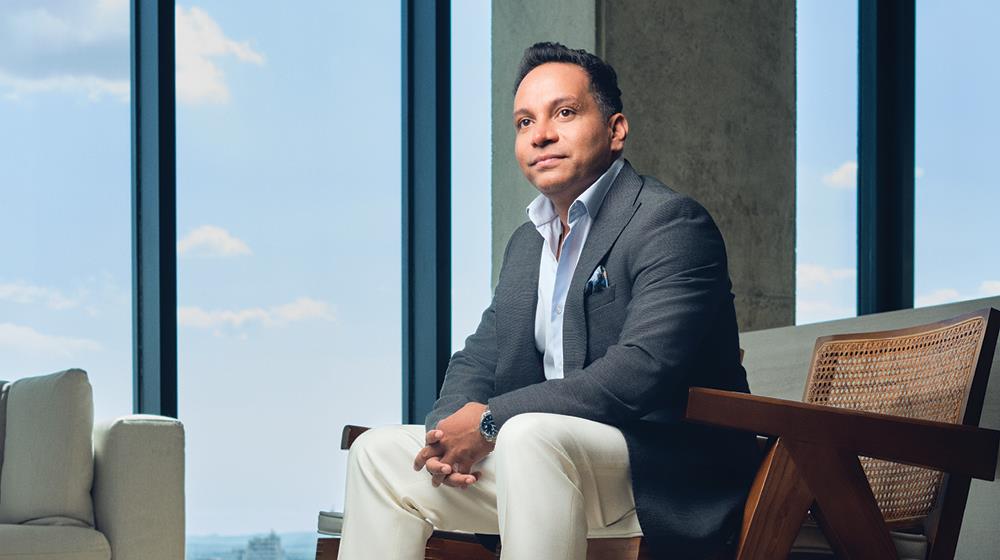
Joseph Borghese, Group Chairman & CEO of Borghese Multi-Family Office, Founder of Borghese Ventures Ltd and Founder of Hope For Children CRC Policy Center in Cyprus, tells GOLD how the last 20 years in Cyprus have shaped his professional career and how he envisions the island as a dynamic business hub in the future.
After two decades in Cyprus, how would you describe the experience of growing your businesses?
Twenty years is long enough to learn that the most durable growth is rarely the fastest. I built my adult life and my businesses on this island, and both rest on the same foundation: trust, accumulated slowly. My student years shaped me more than I realized back then. The people I met were warm, without being intrusive, and generous with their time, and somewhere between lessons, friendships and evenings out, a deep sense of belonging took hold. Those connections widened over the years to reach every part of our society. Building my life here was never a matter of circumstance.
It was a choice.
Has the local business landscape changed over time?
The business landscape has changed profoundly. The island went through difficult years, including a financial crisis that tested its institutions, and emerged more disciplined, more international and more diversified, with a generation of founders who now think globally from the outset. Those changes widened what was possible. From a base in Cyprus, I have built businesses with a presence at home and around the world. Recognition along the way, from the Cyprus Young Entrepreneur of the Year award in 2019 to the title of Académico Honorario conferred by Mexico’s Academia Nacional de Historia y Geografía in collaboration with the Universidad Nacional Autónoma de México, has reminded me how far a path rooted in Cyprus can travel.
Your company Borghese Ventures has drawn inspiration from centuries of leaders who have helped shape the modern world. What opportunities do you see in Cyprus today and where are there untapped prospects?
I have always been drawn to leaders who thought in terms of generations rather than quarters: people who built institutions and understood that influence is earned slowly. That long view has shaped how I look at Cyprus.
The first opportunity is its location. Cyprus is a member of the European Union with deep ties to the Eastern Mediterranean, the Gulf and beyond, and has a business culture that international partners find familiar. Few places of its size offer that combination.
The second is talent. Cyprus educates many students, Cypriot and international, and we could do far more to help graduates stay, start companies and put down roots. A student who finds their footing here at twenty may be building the country’s economy at forty. The third is long-term capital: businesses and families that think across generations want stability, quality of life and access to Europe, all of which Cyprus can offer.
Finally, there is a less obvious opportunity. As His Majesty’s Honorary Consul of the Kingdom of Tonga in Cyprus and Special Envoy for Foreign Direct Investment of the Government of Saint Kitts and Nevis, I see how much small states can learn from and offer one another. Cyprus understands that condition instinctively, yet it has barely begun to trade on it.
At Borghese Ventures, you work on Mergers and Acquisitions. What is your take on the recent uptick in M&A on the island and what does it say about the country’s market?
Borghese Ventures is an M&A strategic consulting and deal-making firm working with businesses across Europe, the Middle East, Africa and Southeast Asia. Our role is to bring clarity to the decisions that shape a company’s future, and to see them through to results. I see the increase in mergers and acquisitions as a sign of a market that is maturing. When buyers commit capital to Cypriot companies and founders entrust what they have built to new ownership, confidence runs in both directions. It also often reflects succession in family-owned businesses. Consolidation is not an end in itself. Lasting value comes when the strategic logic, the numbers and the people align, and in my experience it is the people who most often decide the outcome. You can model synergies on a spreadsheet but you cannot model trust. That is why our approach begins with diligence in the fullest sense: not only financial and legal review but an honest assessment of governance, culture and intentions.
I was honoured to receive the Global Excellence in Leadership Award for Enhancing Investment and Mergers & Acquisitions at the Palace of Westminster, but the truest measure of a deal, in my view, is whether both sides would choose to work together again.
Having gained an in-depth knowledge of Cyprus and witnessed the economic changes on the island, would you say that there are still challenges that need to be addressed to allow for a more thriving leadership and entrepreneurial scene?
Yes, and naming them is a sign of confidence rather than criticism. A thriving entrepreneurial scene needs more than a competitive tax regime and a pleasant climate. The first challenge is predictability. Entrepreneurs can live with rules; what they struggle with is uncertainty. Faster licensing, more digital public services and swifter resolution of commercial disputes would do more for confidence than any incentive scheme.
The second is talent. Cyprus must create a more efficient ecosystem in which young Cypriots can establish their businesses, attract experienced professionals from abroad through faster and simpler permits, and develop a working culture that gives young people responsibility early.
The third is leadership culture. Leadership, as I understand it, is the willingness to carry responsibility before the outcome is known. A healthy scene encourages people to try and allows them to fail honestly. I would like every young founder, Cypriot or newcomer, to find that same openness in the country’s institutions as readily as in its people.
You are also Chairman and CEO of the Borghese Multi-Family Office based in Ireland. How would you describe the wealth management sector in Cyprus and what could make the island more attractive for Ultra-High Net Worth Individuals (UHNWIs)?
The sector has matured considerably. There is deep expertise across legal and fiduciary services and funds, a stronger emphasis on governance and compliance than a generation ago, and a professional culture that values discretion and confidentiality. The Borghese Multi-Family Office is incorporated in Ireland, with an operational and structural presence across Europe, Asia and the Caribbean. We provide bespoke wealth solutions, deal-making, governance support, participation in investment committees and compliance for UHNW families and sovereign-adjacent entities. Our structure reflects how those families live: across borders, generations and jurisdictions. What they seek is remarkably consistent. Above all, they want stability: rules that do not change without warning and institutions that apply them fairly. They value discretion but they also want to be associated with places whose reputation is beyond question. Reputation has become the scarcest asset a jurisdiction can hold and our work in due diligence has shown me how carefully it must be protected. They also want a life, not merely a structure: schools, healthcare, safety and a welcoming community often matter more than any fiscal advantage, and here Cyprus is strong.
Cyprus should concentrate on efficient digital administration and regulation that is consistently applied. Families may come for the sunshine but they stay for the certainty.
How do you maintain being involved in business activities across so many countries and helping people across diverse business sectors, while being based in Cyprus?
By accepting that no-one does this alone. Our work spans several countries and depends on capable colleagues and shared standards, so that quality never depends on where I am. My roles for Saint Kitts and Nevis and the Kingdom of Tonga bring me into conversation with governments and investors on several continents. Our presence in Ireland keeps us anchored in the European Union, while partnerships such as our 2025 Memorandum of Understanding with the Indian Chamber of Commerce open further doors. Travel is part of the work, but so is the discipline of returning. You cannot build bridges from nowhere; you need firm ground on one side. That ground is domestic as much as professional. My wife has supported every one of my crazier ideas, including those that took me far from home, and none of this would be sustainable without her. Much of that ground was laid during my university years. The friendships I formed then were simply friendships: evenings at the bouzoukia and the ordinary pleasures of being young among people who made me feel at home. Over the years, we built our lives and careers alongside one another and my personal and professional worlds grew together without design.
I have never thought of those people as a “network.” They are my friends. That some are also part of my working life is simply what happens when you stay somewhere long enough to share each other’s lives. I should also credit Brownie, our dog, who has sat in on more calls than most of my colleagues, has never signed a confidentiality agreement and has never leaked a word! She has heard the first version of almost every decision I have made, and her only objection – a long sigh at my feet – is usually about the length of the call!
You are involved in several endeavours involving technology. How do you decide which technologies to invest time and effort in?
I approach technology in the same way as I approach any investment: with curiosity but also with patience. I am less interested in what is fashionable than in what solves a real problem. My tests are simple. Does it answer a need that already exists? Is it built by people whose integrity I would trust with my own family’s affairs? And will it still matter in ten years?
Two of my involvements illustrate the point. Pundi X 365 provides blockchain, artificial intelligence and Internet of Things solutions, together with consulting, to companies exploring next-generation technologies. Datrics, based in San Francisco, is building an enterprise-grade decision engine designed to be embedded, extended and governed rather than simply deployed, in the insurance, health and banking sectors.
In the context of giving back to the community, you founded the “Hope For Children” CRC Policy Center, which now has field offices in many countries and an office in the US. What is the importance of the rganization? Can you point to one of its most fulfilling achievements?
Hope For Children began with a conviction that children’s rights should not remain words on paper. The challenge is turning the UN Convention on the Rights of the Child into policy, services and daily protection. I founded it in 2008 because it felt like an obligation rather than an option. It has since grown into an organisation with an international reach, more than 100 full-time staff in Cyprus and many associates. Much of the credit belongs to the team who carry out the day-to-day work. What I find most meaningful is our care for children who have been sexually abused, our foster care programmes, the 24/7 child helpline (1466) and our support for unaccompanied children through the Homes for Hope shelters and many more programmes. When a child begins to trust adults again, it is a quieter achievement than any headline but it is the one that stays with me. In 2023 we received the Crystal Scales of Justice award from the Council of Europe, an honour that belongs to everyone involved and to the children of Cyprus. Yet the real measure is whether a child who comes to Hope For Children is met with warmth and with the protection that warmth alone cannot provide.
Cyprus has been your home base for many years. What does the future hold and how do you envision the island changing over the next 20 years?
I am a Cypriot and a member of the Latin community. Cyprus is not a base for me; it is home and it will remain so. Over the next two decades, I see an island that could become one of Europe’s most compelling small economies: open, well-governed and genuinely international, and a larger meeting point for Europe, the Eastern Mediterranean and partners much further afield.
None of this is automatic. It depends on strong institutions and on a willingness to take the long view rather than the quick advantage. I remain optimistic because I have watched this country recover, adapt and grow in ways that many did not expect. My commitment is simple: to keep building here and connecting Cyprus to the world. This island is where I belong and, twenty years on, I am still choosing it.
(Original photos by TASPHO)
This interview first appeared in the October edition of GOLD magazine. Click here to view it.