







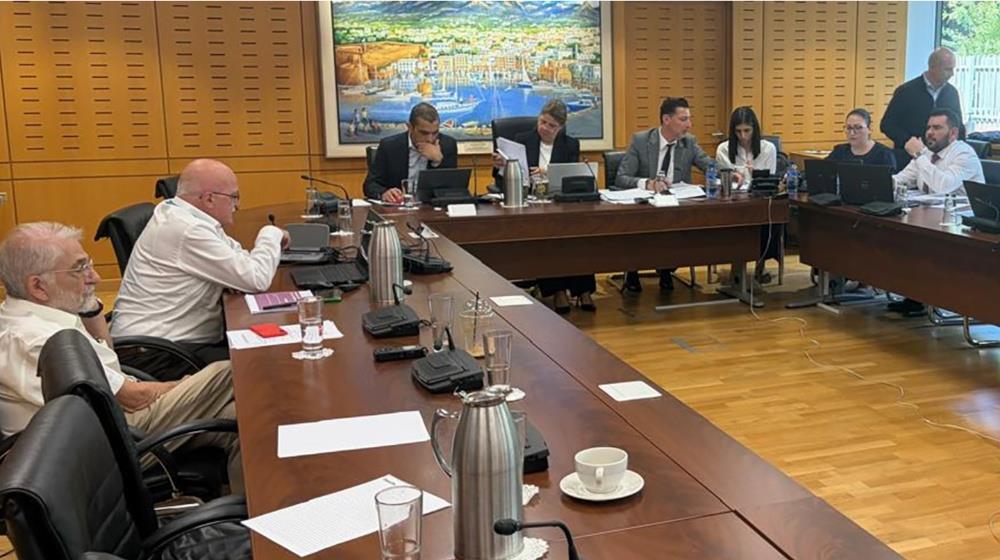
The challenges and risks facing the Cyprus economy, particularly those relating to the pension system, public expenditure and the low implementation rate of development projects, were outlined by Fiscal Council President Andreas Charalambous before the House Finance Committee during discussions on the state budget.
He was accompanied by Council member Marios Clerides.
Tax reform and tax collection
Referring to the tax reform, Charalambous said its impact is expected to be smaller than initially estimated by the University of Cyprus. The main reason, he explained, is that although public sector employees benefited from tax reductions, they also received salary increases, which expanded the tax base. As a result, the overall impact of the tax reform was smaller than originally anticipated.
The Fiscal Council also identified issues relating to tax compliance. Responding to questions from MPs, Charalambous said that although measures have been introduced, they do not yet appear to be delivering tangible results.
Such results, he explained, would be reflected in a reduction in uncollected taxes and an improvement in tax collection.
Pension system, contributions and demographic developments
Particular emphasis was placed on the sustainability of the Social Insurance Fund (SIF).
Regarding social insurance contributions, Charalambous noted that they have increased significantly in recent years. One reason, he explained, is the employment of a large number of well-paid foreign nationals, which has benefited the Fund, at least at this stage.
He added that a substantial increase in social insurance contributions is expected in 2029, reflecting an increase already provided for in legislation. He stressed that without these increases, the social insurance system would struggle to remain sustainable.
Charalambous described the introduction of a second pension pillar as particularly important. "In our view, there will be no long-term sustainability of pensions without the introduction of the second pillar. By its nature, it must be introduced gradually, which is why we need to start today," he said.
He explained that postponing its introduction would achieve nothing, as the system needs to be phased in gradually to allow businesses to absorb the change.
Turning to demographic developments, the Fiscal Council President warned of significant future pressures on the pension system. "We have enormous needs ahead of us. We have reserves, but we also face a demographic explosion, which means that ensuring pension sustainability for future generations will be extremely difficult," he said.
He explained that maintaining low public debt is important because it preserves the state's ability to provide pensions in the future, when demographic conditions will have changed.
"Today, four workers finance one pensioner. In the future, the ratio will be two to one, which means that the sustainability of pension funds as we know them will be called into question. This is why we say a second pillar is needed," he added.
Charalambous also noted that pension reform is not included in the state budget, arguing that it should be incorporated to provide MPs and other stakeholders with a comprehensive picture of public finances.
Public debt and expenditure
On public debt, Charalambous said its downward trajectory is expected to continue, describing this as a positive development. "In our view, this shows that there is room to address expenditure needs that will play a role in the future and which we have not adequately addressed so far. A strong fiscal position does not mean that we have room for wasteful spending. It means that we have room for expenditure that will benefit us in the future," he said.
Responding to questions from MPs, he also referred to the state's decision to stop borrowing the surpluses of the Social Insurance Fund.
"This alone will turn budgets that currently record surpluses into balanced budgets," he said.
Regarding net primary expenditure, Charalambous noted that targets had been significantly exceeded during the first two years.
"We have exceeded the targets by a considerable margin, and this is the only area where there is such a strict recommendation from the European Commission," he said.
On the public sector wage bill, he explained that the modest increase projected for 2027 is temporary, reflecting a reduction in retrospective contributions to the occupational pension scheme for public employees.
"In other words, the permanent base of the wage bill has not been contained," he said.
Charalambous also argued that most social expenditure is insufficiently targeted, identifying the Guaranteed Minimum Income as the only targeted measure.
"If we undertake social expenditure without limits, its impact on reducing social inequalities will be limited," he explained.
(Source: CNA)