







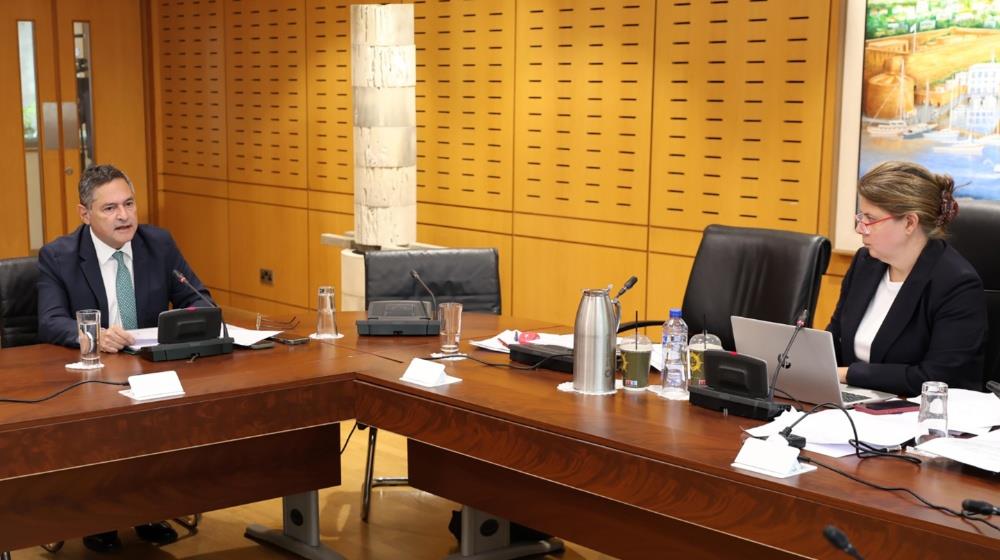
The Cyprus economy continues to perform positively, maintaining satisfactory growth rates and fiscal stability despite heightened international economic and geopolitical challenges, Central Bank of Cyprus (CBC) Governor Christodoulos Patsalides has told the House Finance Committee, during discussions on the 2027 state budget.
However, he on 12 October also noted that inflationary pressures, developments in energy prices and broader uncertainties in the international environment continue to affect the country's economic outlook.
According to the figures presented, inflation in Cyprus reached 5.2% in September 2026, compared with 3.8% in the euro area, mainly due to rising energy prices and pressures in the services sector.
The Central Bank forecasts inflation at 3.3% for 2026 as a whole. The acceleration in inflationary pressures is attributed, among other factors, to higher energy prices, increased operating costs for businesses, strong demand in tourism-related sectors, tight labour market conditions and continuing increases in rents.
According to the Governor, the war in the Middle East is a major source of renewed inflationary pressures globally, as it disrupts supply chains and drives up energy prices.
Despite international challenges, the Cyprus economy continues to outperform the euro area, recording strong growth, low unemployment and positive prospects for the coming years. GDP growth is projected at around 3% annually.
At the same time, the fiscal outlook remains positive. According to the figures presented, the general government surplus for the first eight months of 2026 reached 4.1% of GDP, while the public debt-to-GDP ratio stood at approximately 50% at the end of August.
The Central Bank stressed that maintaining sound public finances and adequate fiscal space is crucial for the economy's resilience. It also highlighted the need to contain rigid expenditure and direct public resources towards investments and reforms that strengthen productivity, competitiveness and long-term sustainability.
During the meeting, committee members raised a number of issues concerning competition in the banking sector, interest rates — particularly the spread between lending and deposit rates — foreclosures and the broader willingness of financial institutions to extend credit.
Banks' capital position stronger than ever
The Governor placed particular emphasis on the condition of the Cyprus banking sector, which is recording its strongest capital position on record.
The capital adequacy of Cypriot banks ranks among the highest in the European Union, while their liquidity exceeds both regulatory requirements and the European average.
Meanwhile, non-performing loans have fallen to levels below the European average. According to the Central Bank, this positive picture creates the conditions for sound financing of the economy, with interest rates broadly aligned with the euro area median.
Nevertheless, Patsalides warned against complacency, noting that geopolitical tensions, climate risks, high public debt in major economies and elevated valuations of artificial intelligence-related equities pose risks to financial stability.
At the same time, the development of advanced artificial intelligence systems is increasing cyber threats and operational risks.
He recalled that, as part of its macroprudential policy, the Central Bank has imposed a countercyclical capital buffer of 1.5% on domestic exposures, corresponding to capital requirements of €230 million. An additional €440 million capital buffer has been established based on the systemic importance of credit institutions.
The Central Bank is also considering activating a systemic risk buffer, with relevant decisions expected in early November.
Digital transformation and the digital euro
Discussions before the Committee also highlighted the significant changes expected in the financial sector as a result of digital transformation, with foreign digital banks expanding their activities in Cyprus and developments in payments and digital money accelerating.
According to the Governor, the electronic money and payment institutions sector currently comprises 41 licensed institutions, while interest in new licences remains strong.
During 2026, the regulatory framework, supervisory methodologies and the Central Bank's tools were upgraded, while staffing and cooperation with European supervisory authorities were strengthened.
Particular reference was made to tokenisation, namely the digital representation of financial claims and assets.
Regarding the digital euro, the legislative framework is expected to be completed by the end of 2026, while pilot testing is scheduled for 2027, with the participation of the Central Bank of Cyprus and domestic financial institutions.
Plan to modernise Central Bank governance
During the discussion, a proposal was presented to modernise the governance structure of the Central Bank of Cyprus, with the aim of adapting it to the increased responsibilities arising from its participation in the Eurosystem and European institutions.
As outlined by Patsalides, the proposed reform provides for the establishment of a collective executive governing body, drawing on European practices and particularly the model of Germany's central bank.
The proposal also incorporates provisions for a single term of office for all members of the body. The relevant draft bills have been prepared, while the European Central Bank issued its opinion on the proposed arrangements on October 9.
The bills are expected to be submitted by the Minister of Finance to the Legal Service of the Republic for legislative scrutiny.
The Central Bank links the modernisation of its governance structure to the need to strengthen its institutional preparedness and effectiveness amid increasing economic, technological and financial challenges.
(Source: CNA)