







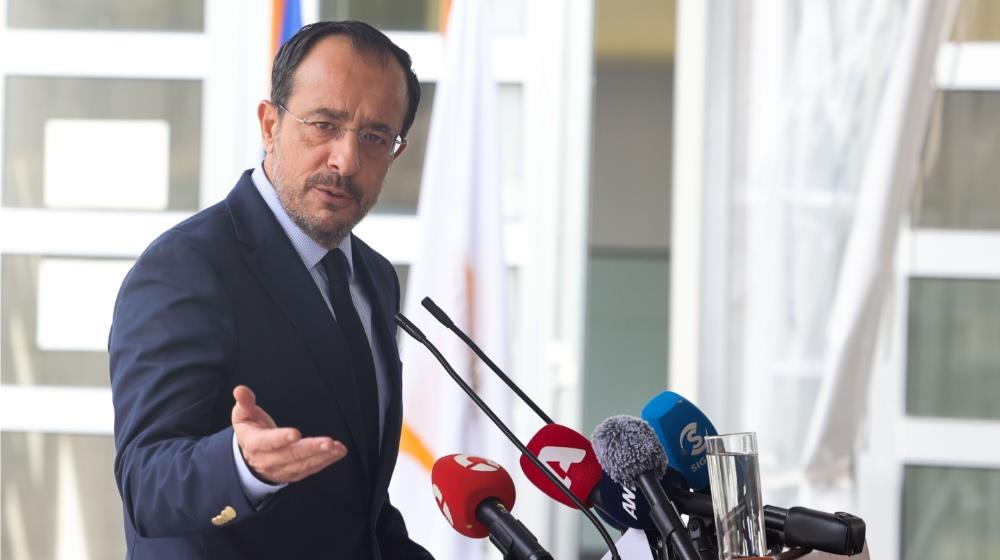
For our Government, the completion of reforms in the justice system remains a priority, because a modern and effective justice system is essential for citizens, the economy, social cohesion and the functioning of our state as a whole, President Nikos Christodoulides has said.
He was speaking on 6 October, at the Opening Ceremony of the New Judicial Year at the Supreme Constitutional Court.
According to the President of the Republic, a substantial change has taken place in the country’s judicial landscape in recent years, with the reform that came into force on 1 July 2023 and the establishment of the Supreme Constitutional Court, the Supreme Court and the Court of Appeal, marking a significant milestone in the administration of justice. He added that this process has been complemented by the further restructuring of administrative justice, with the establishment of an Administrative Court of Appeal and the new structure of the administrative courts under the Supreme Constitutional Court.
He added that technology is now an indispensable tool, with the digitisation of judicial proceedings, the utilisation of new technologies and the further development of i-Justice creating new opportunities for better case management, greater transparency and easier access to justice for citizens.
He also noted that another objective of the Government is the development and improvement of infrastructure and court facilities, as well as staffing levels, which will further contribute to high standards in the administration of justice.
“For our Government, the completion of reforms in the justice system remains a priority. Not as an end in itself; after all, reform does not in itself guarantee success. But because a modern and effective justice system is essential for citizens, the economy, social cohesion and the functioning of our state as a whole,” he emphasised.
For his part, the President of the Supreme Constitutional Court, Antonis Liatsos, said that the establishment of the Constitutional Court as a separate judicial body was deemed necessary in order, amongst other things, to facilitate the safeguarding, promotion and security of the rule of law.
“The Supreme Constitutional Court does not govern, nor does it legislate. By interpreting the Constitution – the institutional and value-based core of the State – authoritatively in accordance with constitutional requirements, it is called upon to serve the constitutional order, judging not what is politically desirable, but what is constitutionally permissible, constantly reminding the State that power has limits, and the majority that it is bound by the Constitution, and that democracy has rules which we are all obliged to accept even when they do not favour us”, he further emphasised.
He added that, in the three years since its re-establishment, the Supreme Constitutional Court has managed to exercise its jurisdiction without any significant operational problems, carrying out its work and delivering crucial judgements across a wide range of areas and within commendable timeframes, thereby confirming the reasons for its establishment.
In her address on behalf of the President of the House of Representatives, the Chair of the Parliamentary Committee on Legal Affairs, Justice and Public Order, DISY MP Fotini Tsiridou, said that the effort to reform the judicial system is currently at a particularly crucial juncture, especially following the major reform of the highest level of the judiciary.
“We are called upon every day to enact rules of law, which are, however, interpreted by the courts. Therefore, the quality of justice is ultimately inextricably linked to the quality of legislation,” she stressed in this regard.
She also expressed the readiness of the House of Representatives, within the framework of its constitutionally enshrined powers and with due regard for the principles of the separation of powers, to support every effort to modernise and improve the institutional and legislative framework governing the Cypriot judicial system.
Moreover, the President of the Council of State of Greece, Michalis Pikramenos, referred in his speech at the same event to the major changes that have taken place in the functioning of the modern state, the justice system and democracy, under the influence of globalisation, European integration and technological progress, whilst in his own address, the Judge of the Supreme Constitutional Court, Tefkros Oikonomou, referred to the importance of freedom of expression, the right of citizens to criticise judicial decisions, and the limits set to protect the administration of justice.