







The Eastern Mediterranean has natural gas. What it does not yet have is a simple, agreed and commercially viable route to Europe.
Between the offshore discoveries and international markets lie geopolitical conflict, competing national interests, costly infrastructure and an energy transition that is narrowing the window for new long-term investment in fossil fuels.
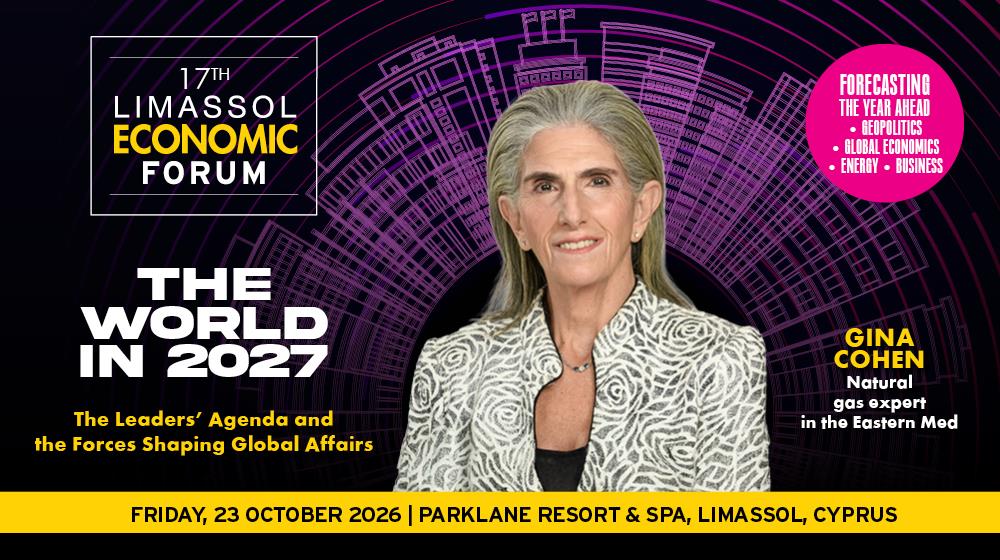
This complex equation will be examined by Gina Cohen, an internationally recognised expert on Eastern Mediterranean natural gas, in her keynote address, “The Eastern Mediterranean Gas Equation: Cooperation, Competition and Routes to Europe.”
The address will take place at the 17th Limassol Economic Forum on Friday, 23 October 2026, at Parklane, a Luxury Collection Resort & Spa in Limassol.
The Reserves Exist. Agreement Is Harder.
In the Eastern Mediterranean, natural gas is more than an energy commodity. It is an instrument of economic policy, diplomatic influence and regional power.
Cyprus, Israel and Egypt view the region’s resources as an opportunity to attract investment, generate revenue and strengthen their positions in the energy market. Yet political disputes, competing maritime claims and regional conflicts complicate every attempt to establish lasting cooperation.
Reserves alone are not enough. Development requires buyers, financing, infrastructure and agreements capable of surviving beyond the next cycle of geopolitical tension.
Egypt Holds a Crucial Key
Egypt’s role will be central to Cohen’s analysis. The country already possesses gas-processing and liquefaction infrastructure that could offer a faster and potentially more realistic route for bringing regional gas to international markets.
But this option is not automatic. Egypt’s domestic energy needs, the availability of its facilities, commercial terms and the requirement for additional pipelines will determine whether proposals can move beyond political declarations and into production.
Other possibilities include floating liquefied natural gas facilities and additional regional connections. Each route carries its own financial cost, technical demands and geopolitical risks.
Europe continues to seek secure and diversified sources of energy. Eastern Mediterranean gas could form part of that equation — but it is unlikely to provide the entire answer.
Having worked across the natural gas value chain since 1998, Gina Cohen understands that energy policy is not determined solely by the size of a discovery. It depends on economics, infrastructure, contractual arrangements and the ability of countries to cooperate.
The gas may lie beneath the sea.
Its route to Europe, however, will be decided around the negotiating table.
Conference Information
Organizers: IMH and IN Business magazine
Platinum Partners: Bank of Cyprus, bbf:, Deloitte Cyprus, Elias Neocleous & Co LLC, Finstella Ltd
In collaboration with: Cyprus LSE Alumni Association
Mobility Partner: Toyota
With the Support of: CCCI, CSE, Invest Cyprus, National Betting Authority
Media Sponsors: Alpha Cyprus, Cyprus Business News (CBN), GOLD magazine
For more information and registrations, please contact IMH:
Tel: +357 77777741│ Fax: +357 22679820
Email: events@imhbusiness.com
