









Sustainable development, as defined by the European Commission, is development that meets present needs without limiting the ability of future generations to meet their own.[1]
It encompasses society’s economic, social and environmental well‑being across the short, medium and—most importantly—the long term.[2] This principle is firmly embedded in the European Union’s long‑term vision, reflected in Article 3(3) of the Treaty on European Union (EU), which establishes sustainable development as a core objective guiding EU policy and action.
Within this broader framework, climate change has emerged as a central economic concern in recent years due to its growing influence on financial decisions, market behavior and economic stability. Supporting the transition to a climate‑resilient and sustainable economy requires a diverse set of financial instruments and innovative financial engineering solutions that can reshape how markets, firms, central banks and investors operate.
Eurosystem initiatives on climate change
The European Central Bank (ECB) has steadily expanded its climate‑policy framework since first announcing,[3] in July 2021, an action plan to integrate climate considerations into the Eurosystem’s monetary policy strategy. This plan focuses on strengthening macroeconomic modelling and statistical data to capture climate‑related effects, while embedding climate factors into the Eurosystem’s risk management, financial disclosure, collateral framework and asset‑purchase operations. Together, these steps aim to ensure that monetary policy better reflects the financial risks associated with climate change.
In January 2024[4], the ECB broadened its climate policy framework to examine three additional areas: the investment needs of the green transition, the economic consequences of rising temperatures, and the macroeconomic impact of environmental degradation and nature‑capital loss. These developments reflect the ECB’s view that climate change influences price stability through its effects on inflation, output, employment and interest rates, while also shaping financial stability and the transmission of monetary policy. At the same time, climate and carbon‑footprint indicators alter the value and risk profile of assets held on the Eurosystem’s balance sheet, increasing in this way exposure to climate‑related financial risks.
As part of its climate‑change statistical initiative, the ECB now publishes euro‑area data on sustainable debt securities, which are used in this blog article to assess key market trends and to evaluate Cyprus’s standing within the euro area. The analysis highlights both the country’s progress and the areas where further development is needed to strengthen its position in the sustainable debt market. In the ECB classification system, the following four categories of sustainable debt securities are defined:
- Green debt securities are debt securities whose proceeds are exclusively allocated to environmentally beneficial projects, such as renewable energy or pollution‑reduction initiatives.
- Sustainability‑linked debt securities refer to debt securities whose financial terms, typically the coupon, adjust depending on the issuer’s achievement of predefined sustainability performance targets.
- Social debt securities refer to debt securities dedicated to funding projects with positive social impact, such as affordable housing or access to essential services such as healthcare.
- Sustainability debt securities are debt securities that finance a combination of environmental and social objectives within a single instrument.
Holdings of sustainable debt securities by Cyprus residents
By integrating sustainable assets into their portfolios, investors can both reduce exposure to climate‑related vulnerabilities and at the same time contribute to the achievement of broader societal goals such as lowering carbon emissions and fostering environmental resilience.[5] Key climate considerations for market participants nowadays include the pricing of climate‑related risks,[6] the development of effective climate‑related risk‑management strategies, strengthening investor awareness, and understanding how climate risks influence investment choices.
Sustainable debt securities have emerged as an important asset class in recent years as demonstrated by their increasing holdings by euro-area investors. Figure 1 depicts the development of sustainable debt securities holdings by euro-area residents since 2021. There is an increasing trend in all categories reaching €2 trillion in the euro-area and €3,4 billion in Cyprus at the end of the first quarter of 2026, most notably in the green debt securities category. There is also a noticeable increase in sustainability debt securities in Cyprus, whereas in the euro area social debt securities constitute the second most important category.
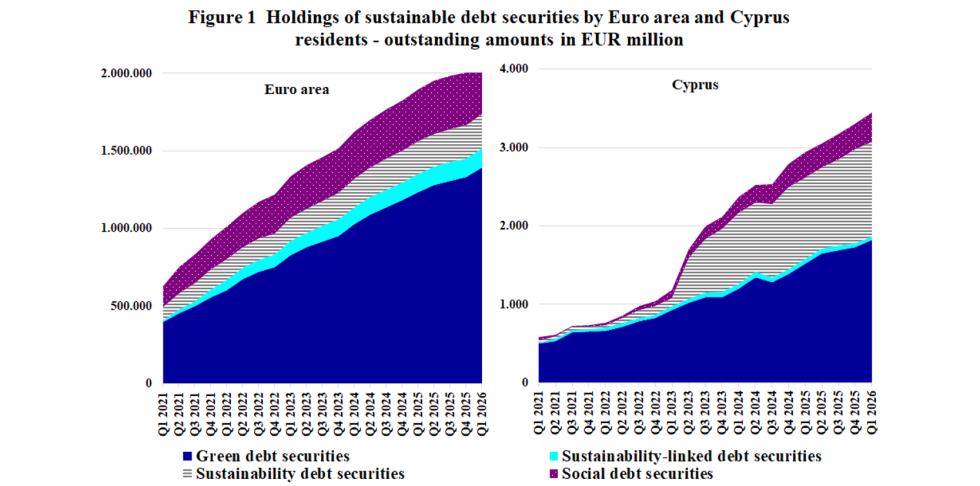
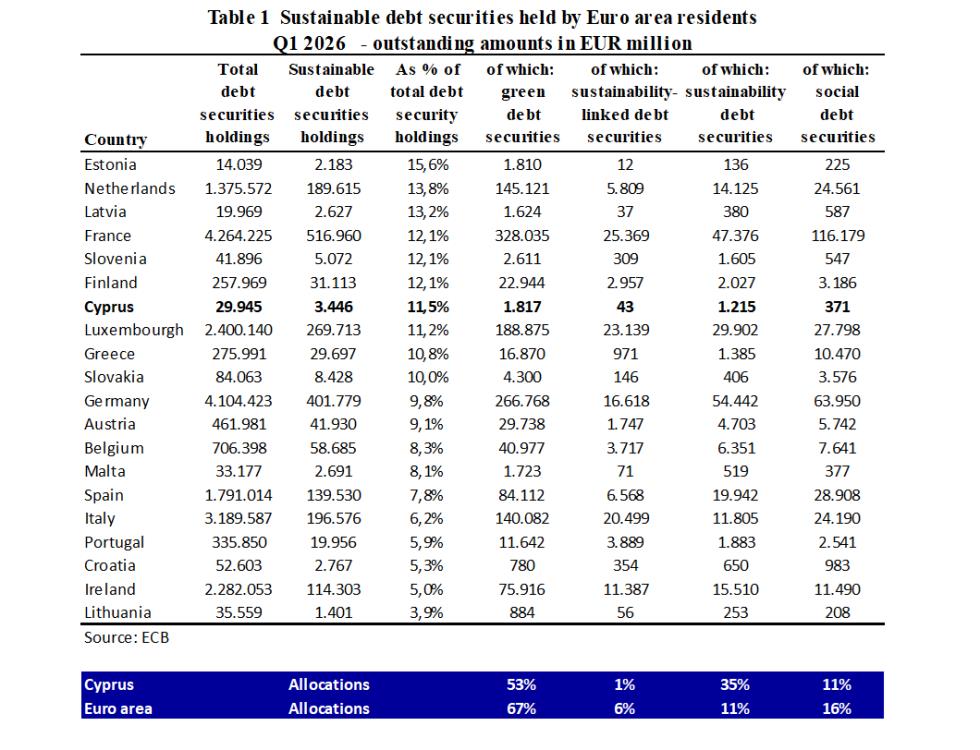
Table 1 presents detailed country‑level data for the first quarter of 2026 (Q1 2026), showing the total value of debt securities held by the residents of each country, the share of these holdings that are classified as sustainable, as well as the individual sustainable categories per country. As expected, total holdings broadly reflect the size of each economy, with Germany, France, and Italy recording the largest amounts. However, when focusing specifically on sustainable debt securities, additional countries—such as Luxembourg, Spain, and the Netherlands—also appear with notably high levels.
The shares of sustainable debt securities within total holdings range from 3,9% to 15,6%, with Cyprus standing slightly above the overall average at 11,5%. The final two rows of Table 1 demonstrate how these sustainable holdings are allocated across the different instrument categories for both Cyprus and euro‑area residents, with the latter representing average shares across countries.
Regarding Cyprus, as in the broader euro-area, the largest share corresponds to green debt securities. In contrast, there are marked differences across the remaining categories since allocations to sustainability‑linked and social debt instruments in Cyprus are lower, while the share attributed to sustainability debt instruments is comparatively higher.
Sustainable debt securities holdings should be expected to expand further in the coming years, particularly as investors’ awareness of and concerns for sustainability related issues continue to grow. Strengthening financial literacy[7] and public awareness[8] initiatives focused on sustainable investment practices can play a pivotal role in this transition by significantly strengthening investor engagement and enabling more informed participation.
Issuances of sustainable debt securities by Cyprus residents
In addition to sustainable debt securities holdings, corporations and governments are also increasingly considering sustainable debt securities issuances, which signal the issuer’s commitment towards protecting the environment and society’s well-being. Of particular interest in recent years is the price premium associated with sustainable debt securities and their usefulness as financial hedges for sustainability-related risks.[9]
For example, investors tend to react positively when a corporate green bond is announced, especially when it is a first-time issuer and carries a second party opinion (SPO) certification. After issuing such bonds, companies typically strengthen their environmental performance and attract a larger proportion of long‑term, environmentally oriented investors.[10] Green bonds are frequently certified by independent third‑party entities (SPO certification) to ensure that the proceeds are genuinely allocated to the environmental projects specified in the bond prospectus. Adhering to established green‑bond standards therefore demands significant managerial effort and resources, thereby imposing compliance costs on the issuer. Such certifications are nevertheless important for investors who are willing to accept a lower financial return, in exchange for positive environmental externalities.
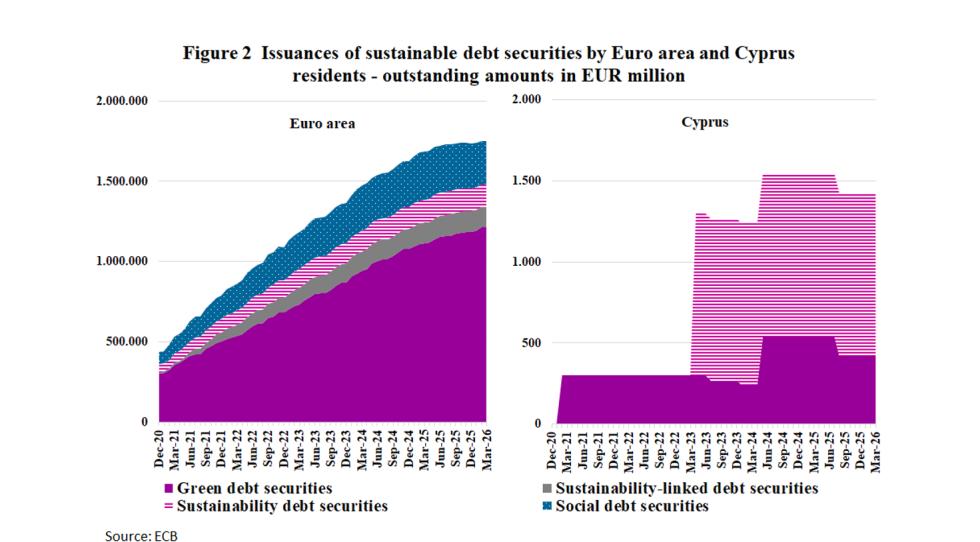
The evolution of sustainable debt securities issued by euro‑area residents since December 2020 is presented in Figure 2. As with sustainable debt holdings, issuance volumes display a steady upward trajectory across all categories, reaching €1,8 trillion in the Euro area by the end of March 2026. Over the same period, the corresponding figure for Cyprus amounted to €1,4 billion with a noticeably high share of sustainability debt securities. In contrast, issuances in the euro-area are dominated by green debt securities, representing 68% of the total, equivalent to €1,2 trillion in March 2026.
Table 2 presents detailed country‑level data for March 2026. In addition, to the value of sustainable debt securities issued per country, the table also includes the total value of debt securities issuances and the share of sustainable debt securities within them. Similarly with Table 1, the total level of issuances per country reflects the size of each economy, with France, Germany and Italy leading the group. With regards to the sustainable debt securities issuances, Germany and France are again the main issuers, while the Netherlands hold the 3rd highest value, surpassing Italy.
The share of sustainable debt securities in the total value of issuances per country, in March 2026, ranges from 0,1% to 12,5%, with Cyprus exhibiting a relatively high share of 9,5%. In line with the analysis for debt securities holdings, the last two rows of Table 2 demonstrate how these sustainable issuances are allocated across the different instruments for both Cyprus and euro‑area issuers, with the latter representing average shares across countries.
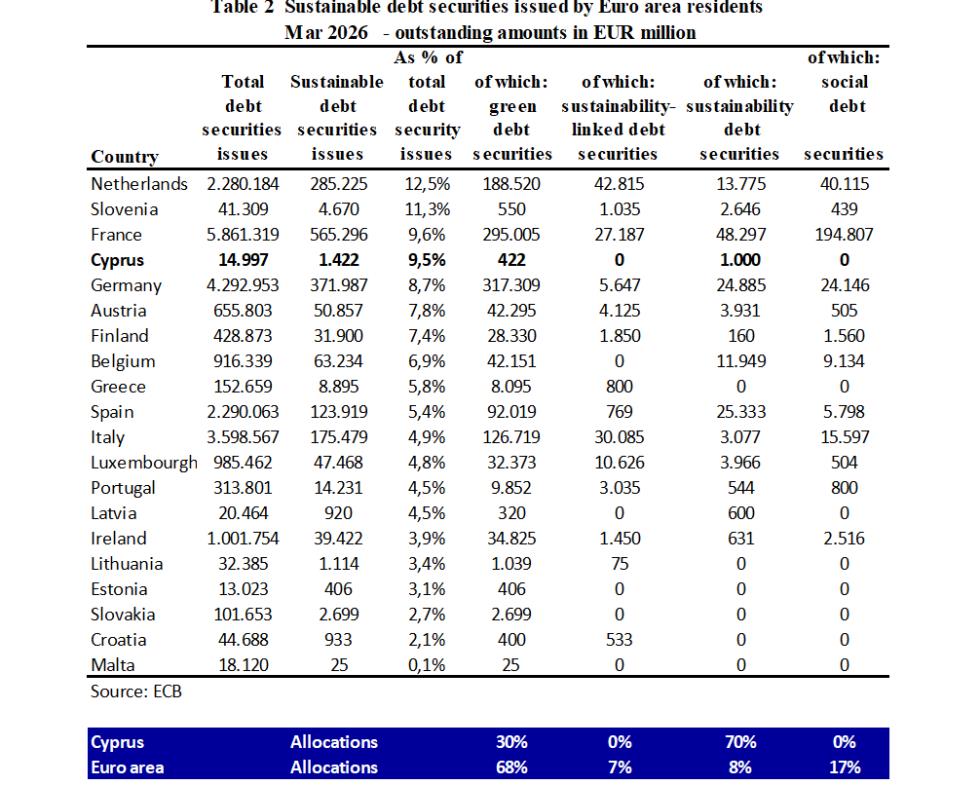
Regarding Cyprus, as previously mentioned, the largest share of issuances (70%) corresponds to sustainability debt securities, amounting to €1 billion as of March 2026. In contrast, within the broader euro-area, green bonds represent the predominant category, accounting for 68% of total debt securities issuances, while the corresponding share for Cyprus is only 30% which corresponds to an amount equal to €0,4 billion.
It is important to take note of the fact that debt issuance by Cyprus residents is concentrated in the banking and government sectors, with limited corporate issuance. Hence, the decision, for instance, of the Public Debt Management Office to issue a sustainable debt security in 2023 of €1 billion explains the elevated share of this sub-category in Cyprus. It is also noteworthy that Cyprus residents have not issued so far, any sustainability‑linked or social debt securities, indicating potential areas for future market development. These two categories have likewise remained small across the euro-area as well.
Sustainable debt used as collateral in Cyprus’s monetary policy operations
The ECB’s Governing Council decided in July 2025 to introduce a climate factor into the Eurosystem’s collateral framework as part of its climate‑change action plan and its efforts to strengthen the resilience of monetary policy operations to climate‑related risks.[11] Scheduled for implementation in the second half of 2026, this measure constitutes a substantive step toward mitigating the financial risks that climate change poses to the Eurosystem’s balance sheet.
The climate factor is designed to adjust the valuation of eligible collateral submitted by counterparties in Eurosystem refinancing operations. It applies specifically to marketable instruments issued by non‑financial corporations and their subsidiaries, which are subject to valuation reductions proportional to their exposure to climate‑related risks. These adjustments are determined using sector‑level climate stress‑test outcomes, issuer‑specific Corporate Sector Purchase Programme (CSPP) climate scores, and the residual maturity of the asset.
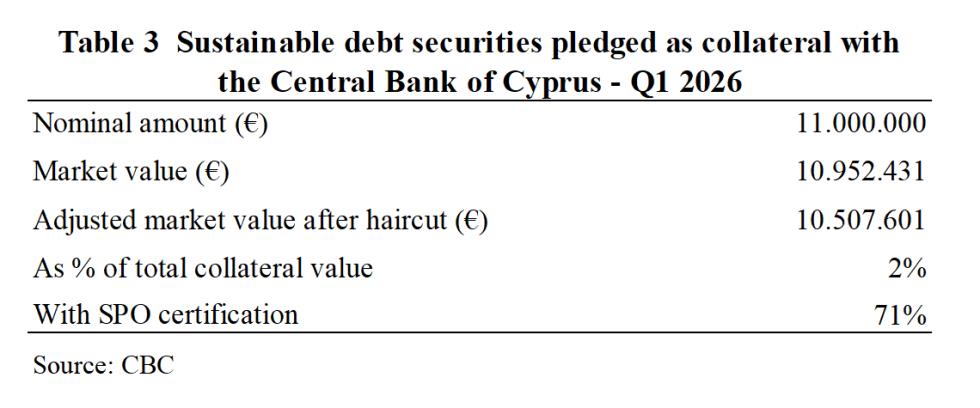
Table 3 presents key information on the sustainable debt securities pledged as collateral by monetary policy eligible credit institutions in Cyprus at the end of Q1 2026. Since June 2025, collateral operations within the Eurosystem have been centrally administered through the Eurosystem Collateral Management System (ECMS),[12] a unified platform for managing all assets mobilised as collateral in Eurosystem credit operations. This system replaced the previously decentralized national frameworks, thereby harmonizing collateral management across the Eurosystem.
At the end of the first quarter of 2026, the use of sustainable debt securities as collateral by credit institutions in Cyprus remained limited, accounting for only 2% of the total value of collateral pledged. The market value of these sustainable instruments amounted to €10.9 million (€10.5 million after the application of valuation haircuts), with 71% of the securities carrying SPO certification. This limited use is broadly consistent with developments across the Eurosystem, reflecting the relatively low demand for refinancing operations by banks in an environment of excess liquidity.[13] However, looking ahead, the introduction of the climate factor in the second half of 2026 is expected to further increase the use of sustainable debt securities as collateral.
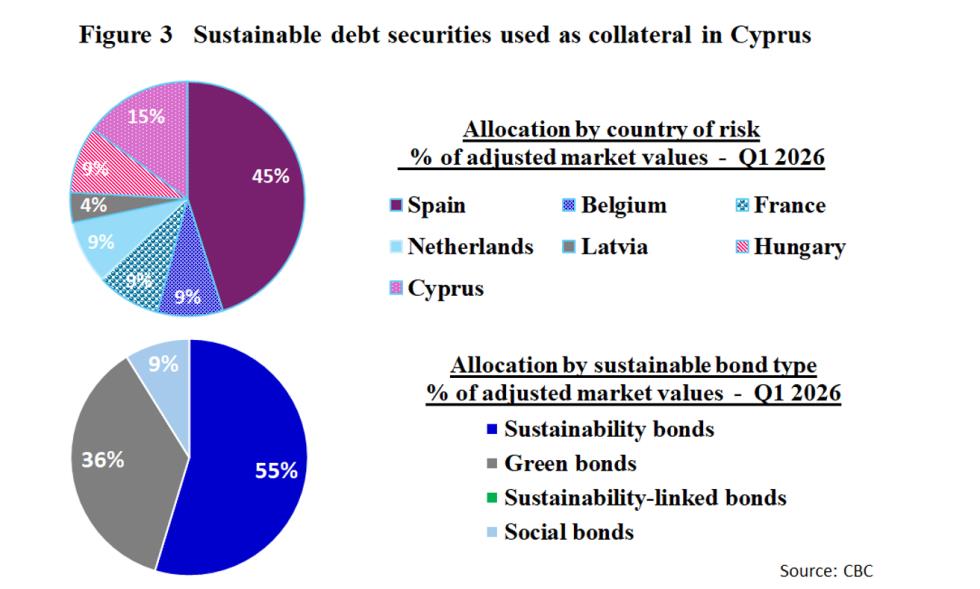
Figure 3 presents a detailed breakdown of the sustainable debt securities pledged as collateral with the Central Bank of Cyprus, disaggregated by the issuer’s country of risk and by instrument type. The largest share of these securities is associated with issuers whose country of risk is Spain, representing 45% of the adjusted collateral value. The remaining securities are distributed across six additional jurisdictions, with Cyprus, Hungary and the Netherlands featuring most prominently. Regarding instrument composition, the sustainable collateral pool consists primarily of sustainability bonds (55%) and green bonds (36%).
Sustainable debt securities have gained increasing prominence across euro‑area countries in recent years. They are becoming more widely used as investment instruments in fixed‑income portfolios, and as a modern financing tool for institutional debt‑security issuers. In Cyprus, sustainable debt securities accounted for 11,5% of total debt securities held by Cyprus residents and 9,5% of total debt securities issued by Cyprus‑resident entities in Q1 2026.
Despite this progress, several areas for improvement remain. Cyprus has yet to see issuances of sustainability‑linked or social debt securities, and the volume of investment holdings in these categories remains limited. With respect to monetary policy operations, only a small amount of sustainable debt securities has so far been pledged as collateral in the ECMS. Increasing the volume of this collateral class will enable eligible counterparties in Cyprus to benefit more from the introduction of the climate factor within the Eurosystem’s collateral framework for refinancing operations.
*By Antonis Michis, Head of Monetary Policy Operations at the Central Bank of Cyprus
The views expressed are those of the author and do not necessarily reflect those of the Central Bank of Cyprus or any other institution or organisation.
[1] A Sustainable Europe by 2030 - European Commission
[2] Inforegio - Sustainable development
[3] ECB presents action plan to include climate change considerations in its monetary policy strategy
[4] ECB steps up climate work with focus on green transition, climate and nature-related risks
[5] Laurent Calvet, Gianfranco Gianfrate and Raman Uppal (2022), The Finance of Climate Change. Journal of Corporate Finance, vol. 73, 102162.
[6] Mathias S. Kruttli, Brigitte Roth Tran and Sumudu W. Watugala (2026), Pricing Poseidon: Extreme Weather Uncertainty and Firm Return Dynamics. Journal of Finance, forthcoming.
[7] Anders Anderson and David T Robinson (2022), Financial Literacy in the Age of Green Investment. Review of Finance, vol. 26, Issue 6, pp. 1551–1584.
[8] Sandra Eickmeier and Luba Petersen (2026), The ECB’s Climate Activities and Public Trust, European Economic Review, vol. 187, 105319.
[9] Peter Feldhόtter, Kristoffer Halskov and Arthur Krebbers (2024), Pricing of Sustainability-Linked Bonds. Journal of Financial Economics vol. 162, 103944.
[10] Caroline Flammer (2021), Corporate Green Bonds, Journal of Financial Economics, vol. 142, pp. 499 – 516.
[11] ECB to adapt collateral framework to address climate-related transition risks
[13] Climate factors: how the ECB tackles climate uncertainty in its collateral framework
