






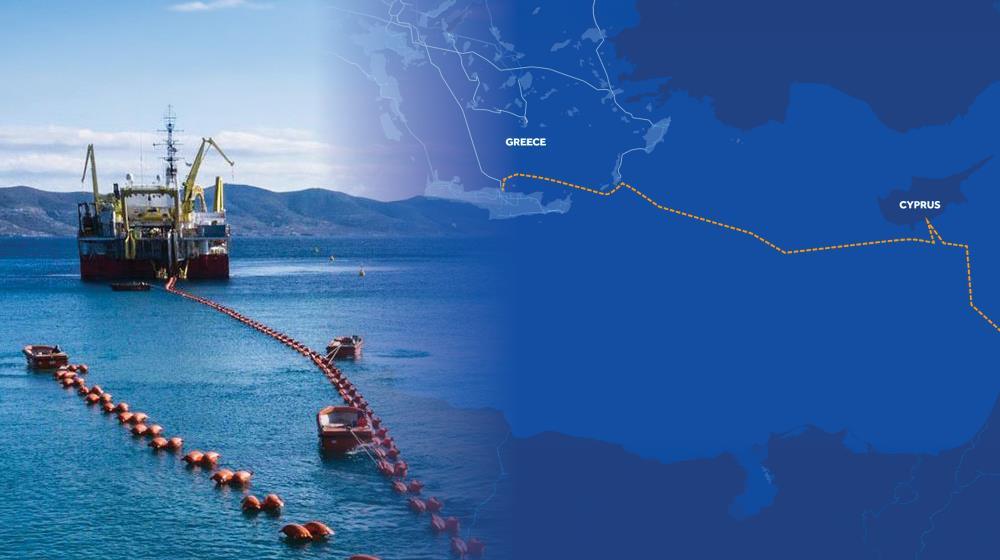
The Great Sea Interconnector (GSI) is one of the most debated and troubled energy projects of recent years, with delays, setbacks and disputes, while its cost remains a key question.
As the project enters a new critical phase, InBusinessNews is attempting its own working hypothesis, utilising available official data and, where there are gaps, specific numerical assumptions, to approximate the total cost for Cyprus. This is an estimate and not an official final cost.
Based on this exercise, the result is particularly interesting. The total cost for Cyprus is estimated at €2.56 billion, an amount that over a 35-year horizon corresponds to approximately €73 million per year.
The aim of the exercise is to give a better sense of the cost and help us understand, at least approximately, what the project may mean financially for Cyprus.
But how is this amount derived?
From €1.94 billion to €2.5 billion.
The first and most important assumption of the exercise concerns the construction cost.
Cyprus Energy Regulatory Authority (CERA) Decision 300/2024, dated September 20, 2024, refers to a total project cost of €1.9392 billion, with an expectation that it will not increase by more than 5% after the relevant technical studies.
This amount, however, cannot currently be considered a safe final estimate for the purposes of this exercise, since up to today, no revised, final total cost has been made public by CERA, while the Minister of Finance had stated that it is not known what the final cost will be, but estimates put it at €2 billion to €2.5 billion and €3 billion.
Makis Keravnos told Parliament that the €1.9 billion mainly concerns the cost of the cable, adding that there are other construction projects, insurance coverage, warehouses, and maintenance needs, which will significantly increase the final cost. As he said, all of these are being examined during the update of the viability study by the European Investment Bank (EIB).
For this reason, InBusinessNews assumes a construction cost of €2.5 billion.
European funding is being removed
Of the €2.5 billion, it cannot be considered that the entire amount constitutes a cost that will be shared between Cyprus and Greece. The European funding of €657 million enters the equation, which is deducted from the €2.5 billion.
€2,500,000,000 - €657,000,000 = €1,843,000,000
Therefore, for the purposes of this working case, the remaining construction cost to be shared between Cyprus and Greece amounts to €1.843 billion.
CERA itself has linked the cost sharing to 63% to be paid by Cyprus, and 37% to be paid by Greece, subject to the project being subsidized by €657 million, based on the Cross-Border Cost Allocation Agreement (CBCA).
Why is Cyprus assuming 63% of the cost?
The sharing is linked to the estimated economic benefits of the project for the electricity systems of the two countries. In the context of the relevant evaluation, it was judged that Cyprus derives a greater benefit and, therefore, bears a greater share of the cost.
Thus, on the amount of €1.843 billion, the mathematical operation is:
€1,843,000,000 × 63% = €1,161,090,000
In other words, with the assumptions of this exercise, approximately €1.161 billion of the construction cost is attributable to Cyprus.
And here, however, the equation does not end.
The €125 million of the construction period
There is one more amount that needs attention, as there is often confusion as to what exactly it represents.
CERA has approved for the period 2025-2029 a permitted revenue of up to €25 million per year, with a total maximum limit of €125 million for the five-year period.
This specific regulation concerns the recovery of allowed revenues during the construction period. The Republic of Cyprus has decided to cover the €25 million annually from the Consolidated Fund, therefore this specific amount does not constitute, during the period 2025-2029, a direct charge on consumers' electricity bills.
And then comes the WACC
This is the most important financial element after construction costs:
Weighted Average Cost of Capital - WACC (Weighted Average Cost of Capital)
- Simply put, it is the allowed return that the regulator recognizes to the investor for the funds he commits to the project.
- This is the profit / return on investment of the investor (GSI shareholders)
- In the case of GSI, CERA has set a basic WACC of 4.6% and an additional premium of 3.7 percentage points due to the specific risk of the project, i.e. a total of 8.3% for the specific period.
- The 8.3% premium is valid for 25 years. The 3.7% premium has a duration of 17 years from 1/1/2025. So it expires at the end of 2041
With an initial capital of €1.16109 billion attributable to Cyprus, this amount is distributed for the purposes of the exercise over 35 years .
The final equation
If we keep the above assumptions, the equation for Cyprus is:
Construction cost attributable to Cyprus:
€1,161,090,000
Plus adjusted return on capital (WACC) over a 35-year horizon:
approximately €1,399,000,000
Total GSI cost: approximately €2,560,000,000
That is, €2.56 billion.
Annual cost for Cyprus
Let's make a working hypothesis for the annual cost for Cyprus. If we divide the above number by 35 years (although this hypothesis is not exact because in different time periods we will pay different amounts) then for 35 years we will pay €73 million per year. These are the two magic numbers that we should keep in mind to see the benefit of the project based on our hypothesis.
That is, a cost of €2.56 billion or €73 million per year for 35 years.
This is the result of InBusinessNews' working case.
(Source: InBusinessNews)