








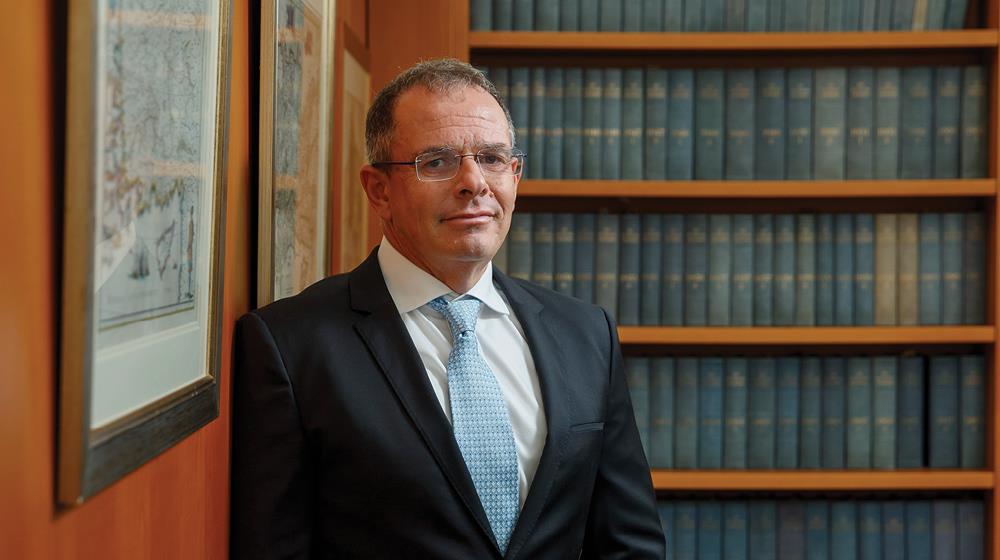
“The Cypriot legal profession needs to evolve and embrace the fact that firms must become multi-disciplined advisors. We have the unique advantage of being seasoned legal professional experts. This is the uniqueness of the legal profession, and the way to out-qualify any other advisor is to provide the best all- round advisory and ancillary services to clients, custom-tailored to their needs,” Christos Scordis, Partner at Scordis, Papaetrou & Co LLC, suggests.
In an interview with GOLD magazine, Scordis weighs in on the rising operational costs for firms, and the future of the country’s legal ecosystem.
The modernisation of Cyprus’ judicial system has faced a number of significant implementation challenges. With the Commercial and Admiralty Courts yet to become fully operational, the iJustice platform experiencing delays and case backlogs continuing to affect court efficiency, what do you believe are the principal barriers to successful reform? What recommendations would you make to ensure that various initiatives deliver their intended objectives?
The principal barrier to successful reform is the lack of genuine investment in justice infrastructure and procedures.
With the Screening of Foreign Direct Investments Law now in force, how does the new regime affect cross-border transactions?
While screening of FDI is a necessity in the current geopolitical landscape, it inevitably adds another regulatory layer impacting competitiveness with other financial centres. I would say that it is too early to give a definitive verdict on its impact on cross-border transactions.
What has the process of adopting AI been like for law firms?
The adoption of AI and, generally, the concept of AI in the legal profession is a very complex matter and the publicity surrounding it often does not correspond to the practical realities. For us, AI can be a powerful tool but, at the same time, there are major legal hurdles. One of them is the location of data, the ownership of any databases created and issues of confidentiality and integrity of answers (any AI model is only as good as its training and underlying data/information integrity). While its impact in Cyprus is currently limited, we expect that it will transform how lawyers perform their work. As a firm, we have a long-established committee dealing with the implementation of AI in the profession generally and within the firm specifically.
Inflation and rising operational costs are squeezing law firms. How are these challenges reflected in how lawyers conduct their business?
Our firm is dedicated to offering quality and cost-effective services to our clients, and it has done so throughout its long history, which collectively, dates back over 100 years. Inflationary pressures are affecting everyone; those with experience, resources and capabilities are better placed to handle them.
How do you envision the Cypriot legal profession evolving by 2030? Do opportunities exist for expansion into new lines of business?
The Cypriot legal profession needs to evolve and embrace the fact that firms must become multi-disciplined advisors. We have the unique advantage of being seasoned legal professional experts. This is the uniqueness of the legal profession and the way to out-qualify any other advisor is to provide the best all- round advisory and ancillary services to clients, custom-tailored to their needs. This is not a trend limited to Cyprus. From the moment that we are an international financial centre, it is imperative, in order for the legal profession to prosper, to be able to give all-round services and advisory to clients, under one roof, for everything pertaining to their operations in or through Cyprus.
This interview first appeared in the August editon of GOLD magazine. Click here to read it.
