







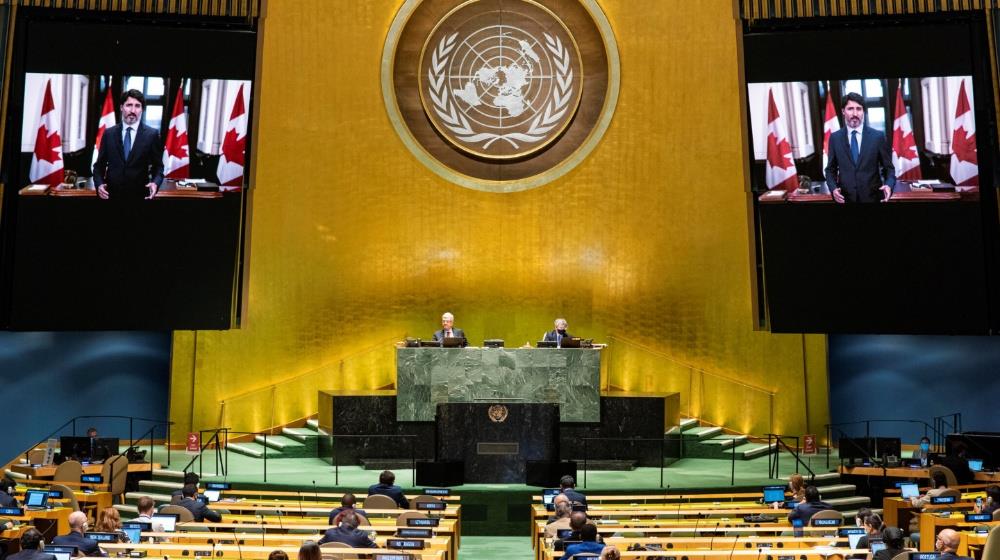
The 81st United Nations General Assembly opened in New York on Tuesday with a speech by UN Secretary-General António Guterres, who is addressing the gathering for the final time before his term ends. The session will continue through September 28.
World leaders have arrived in New York for the high-level week, preparing for President Donald Trump’s return to the podium for a second consecutive year, as discussions focus on escalating conflicts in the Middle East and Ukraine, as well as the risks posed by artificial intelligence.
Nearly 130 heads of state are meeting at a time when the post-war international order is under pressure and the UN itself is struggling to maintain its relevance, while also facing attacks from Trump, who has drastically cut US contributions and withdrawn from dozens of the organization’s bodies.
Chinese President Xi Jinping, who last addressed the General Assembly via video in 2021, will not travel to New York, preferring instead to hold private talks with Trump in Washington on Thursday -a move fueling debate over the UN’s role in tackling global crises.
Morale and financial strains are being compounded by questions over the organisation’s next leader, as it marks 80 years of existence: Guterres’ term as Secretary-General ends in late 2026, with no clear favourite to succeed him.
The UN’s 15-member Security Council is expected to hold high-level meetings on Ukraine, artificial intelligence and the Middle East, including talks with Arab leaders, diplomats said.
More than a year into Trump’s second term, “we would no longer say the UN is in freefall, but that it is stuck in a crisis with no end in sight,” said Richard Gowan, an analyst with the International Crisis Group.
“The UN may no longer be in intensive care as it was last year, but it appears to be stuck in a trauma centre for the immediate future,” Gowan added.
The US avoided losing its voting rights in the Assembly this week by paying $725 million in contributions to the regular budget, but still owes the organisation more than $1 billion, while continuing to demand cuts and reforms.
AI and risks
The Assembly convenes after several leading figures in the artificial intelligence sector called for coordinated limits on the pace of the technology’s development.
Guterres said AI would be a central topic of discussion, adding that countries leading in the field must establish “common safeguards to avoid this race to the bottom, which could one day lead to a massive global catastrophe.”
The Secretary-General has long proposed establishing a system of global governance for artificial intelligence. In 2023, the UN set up an advisory body on the technology, bringing together tech company executives, government officials and academics.
This warning has put Guterres at odds with Trump, who has described AI risks as a “hoax,” arguing there is a “sick conspiracy” against it and that China would benefit from doubts raised over its development.
Middle East and Ukraine
The Middle East will again be at the center of discussions, as the US–Israel and Iran conflict continues to fuel global inflation and destabilize the region. Recent actions by Houthi fighters threaten shipping in the strategically vital Bab el-Mandeb strait and could trigger further spikes in energy prices.
“It is very difficult to find a military solution to this problem, and the experience of conflicts in Yemen has shown how complicated successful intervention is,” Guterres said, adding that the UN’s special envoy for Yemen is making “huge efforts” to advance talks.
However, peace talks remain stalled as Iran and the US continue to exchange strikes and Trump threatens significant escalation of the war.
Iranian President Masoud Pezeshkian is expected to address the General Assembly on Wednesday.
Israeli Prime Minister Benjamin Netanyahu, who is wanted by the International Criminal Court for war crimes and crimes against humanity in Gaza -charges Israel rejects- is due to speak on Thursday.
Palestinian President Mahmoud Abbas will not attend the session in person for a second consecutive year. The US, a close ally of Israel, has again denied him a visa. On Thursday, the General Assembly approved Abbas’ participation via video link.
According to diplomats, a high-level meeting on the conflict in Sudan is likely to be held on the sidelines of the session.
Ukrainian President Volodymyr Zelensky and Russian Foreign Minister Sergei Lavrov will address the General Assembly. Zelensky is likely to seek to bolster Ukraine’s position ahead of what is expected to be another difficult winter, diplomats said.
The Security Council has been unable to act to end the conflict, as Russia, a permanent member, holds veto power.
Trump has at times expressed frustration at his failure to mediate an end to the war, a goal he prioritised at the start of his second term in January last year.
The US President spoke with his Russian counterpart Vladimir Putin earlier this month, but it remains unclear whether he intends to meet Zelensky in New York.
Guterres underlined the war’s impact on civilians, as well as on food security and energy prices.