





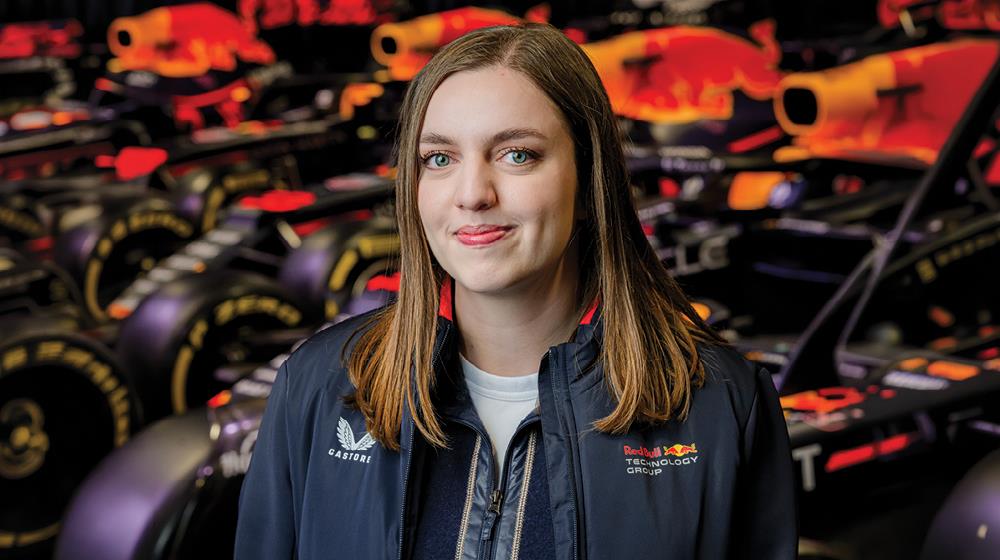
For most people, a Formula 1 car is something glimpsed fleetingly on a television screen as it flashes past at unimaginable speed. For Ioanna Pierou, her first sight of such a vehicle would spark her career.
Still in her twenties, she is currently a Transmission Design Engineer with the Aston Martin Formula One Team, having already built an impressive career with another prestigious F1 racing team.
Ioanna Pierou can still recall the moment she first saw a Formula 1 car. It was displayed inside the Mechanical Engineering building at University College London, where she was studying, and it ignited a curiosity that would soon evolve into something much greater, setting her on a path she had never imagined for herself. That curiosity deepened further during her second year at university when she took part in an engineering competition.
“It was my first exposure to the world of competitive engineering and I instantly knew that if I could turn that appetite for pushing innovation and competing into a career, it would be ideal for me,” she recalls enthusiastically. “So, I started seeking opportunities in Formula 1, which led me to work at Red Bull Powertrains on a student placement between my second and third years of university. After experiencing the fast-paced world of Formula 1 for a year, I knew that it was for me, so I was very glad to receive an unconditional offer to return to Red Bull as a full-time employee once I finished my degree. It was a no-brainer to accept and the rest is history.”
Technology, human creativity and engineering sophistication
After being immersed in the sport's relentless pace, there was no turning back for Pierou. And who could blame her? Formula 1 is perhaps the ultimate expression of technology, human creativity and engineering sophistication working in perfect harmony. It is a world where fractions of a second separate victory from defeat, where innovation never sleeps and where every decision is measured against the unforgiving stopwatch. “Mistakes can happen. Formula 1 cars crash, parts fail and ultimately we are chasing milliseconds,” she says. “A good engineer is someone who can rapidly adapt and react to unforeseen situations.”
While she is ultimately responsible for the reliability of the components she designs, Pierou is quick to highlight the strong no-blame culture that exists within her team. Every component undergoes peer review and scrutiny by senior engineers, creating a shared responsibility for performance and success.
“If I do the best job I can and I'm supported to do it, the team does well. There is a collective goal.” When challenges arise, her calm and methodical nature becomes one of her greatest strengths. “I rarely get stressed,” she says with a smile. “I'm able to keep my head clear and react as quickly as possible to make sure we're back on track.” Earlier this year she made the move from a power unit team to a chassis team, joining Aston Martin's gearbox department and embracing an entirely new challenge. As a Transmission Design Engineer, Pierou works on components that most Formula 1 fans will never see, yet they are absolutely critical to a car's performance. The observation clearly delights her. “You are absolutely right,” she says, laughing. “And it is strange that, even though no-one gets to see the parts I create, when I look at the car I still visualise them working and I realise that I am lucky to have that unique view.”
Joining key engineering programmes
Looking back on her experience at both Red Bull and Aston Martin, she notes that she had joined key engineering programmes at their earliest stages. “At Red Bull I was employee number 34 working on the brand-new Power Unit,” she recalls. “This meant that every design started with a blank sheet of paper, which was incredibly challenging because every aspect had to be defined by me. I was tasked with designing the first ever Red Bull spark plugs and, admittedly, I wasn't sure where to begin. But although that project was incredibly challenging, it taught me what matters and what doesn't when designing for tolerances smaller than a human hair.” Pierou admits that the experience taught her how to approach a brand new project and define a design process from ideation and quality control all the way through to engine fire-up. Today, some of the components she helped design form part of the technology that powers Red Bull's 2026 Formula 1 programme. The pride in her voice is unmistakable.
“Just the other day, the Red Bull engine was described as the fastest on the grid for 2026,” she says. “It makes me incredibly proud to know that the parts I designed are not only working as intended but are also at the forefront of the competition.”
Yet success in Formula 1 is never allowed to settle into comfort. Pierou readily admits that every race weekend is accompanied by a degree of nervous anticipation. “I would be lying if I said I wasn't anxiously watching and going through all my calculations over and over in my head,” she says. “With great success comes great pressure to keep going. As my mum always said, with brains and dedication it's easy to reach number one but it's much harder to stay there consistently. That's always on my mind and I'm constantly looking for the next great idea.”
Of course, predicting Formula 1's next great technological leap is notoriously difficult. Regulatory changes are continuously reshaping the sport and recent reforms have already transformed both aerodynamics and power units. Rather than a revolutionary new powertrain, Pierou believes the next major disruption may come from artificial intelligence. “The introduction of AI in the way Formula 1 cars are designed, built or analysed will play a massive role. AI is at the forefront of innovation across the world right now. It makes sense that it will play a major role in Formula 1 too, whether that's in how cars are designed, built or analysed,” she says.
A man's world
Despite her achievements, Ioanna Pierou is equally candid about another reality of the industry: motorsport remains a man’s world. As she explains, this is a feeling shared by almost every woman in engineering she has spoken to. When she looks around her team and realises she is the only woman in the room, it is impossible to ignore – and although the experience has not always been easy, it has shaped her in unexpected ways. “I would be lying if I said it never affected me but it has made me so much stronger today,” she says. “Discrimination like that made me work harder to prove myself and along the way I found confidence in my own abilities. I realised that being the only woman in the room made me stand out by default, so I learned to use that to my advantage and speak up for the opportunities I wanted. There isn't a magic solution but I am very lucky that in my current team I have spoken openly about my concerns and have been reassured that I am there because I deserve to be.” Motorsport, she believes, still has a long way to go when it comes to diversity. Rather than waiting for change, however, she has chosen to become part of it. As Co-Chair of Aston Martin's Women's Impact Network, she plays an active role in outreach programmes designed to inspire the next generation of female engineers. Through initiatives supported by Formula 1 and Motorsport UK, she visits schools and speaks to young girls about careers in engineering and motorsport.
Learning as much as possible
Young, talented and relentlessly curious, Ioanna Pierou has already achieved what many engineers spend a lifetime pursuing. Yet perhaps her most important contribution lies beyond the components she designs and the milliseconds she helps shave off a lap time. It may be the possibility that somewhere, another young girl is sitting in front of a television screen, watching a Formula 1 race and believing, for the first time, that she could belong in that world too. Knowing that she has already worked for two Formula 1 powerhouses before the age of 30, it would be easy to assume that she has accomplished most of what she set out to achieve but that is not the case. “I am a person who rarely sits still. I am always looking for the next exciting thing,” she says with a laugh. For now, her goal is simple: to learn as much as possible. But she already knows where her curiosity may take her next. “One day, I would love to work on suspension components,” she reveals, peppering the conversation with technical jargon that only deepens my appreciation of the complexity of her craft. “It's an area I don't fully understand yet, which is exactly why it interests me so much,” she explains, clearly driven not by what she has achieved but by what comes next. Ioanna Pierou is immensely grateful for the opportunities she has been given, yet permanently in motion, forever searching for the next challenge, the next idea, the next horizon. In Formula 1, after all, standing still is never an option.
This interview first appeared in the 2026 edition of The Cyprus Journal of Wealth Management. Click here to view it.