








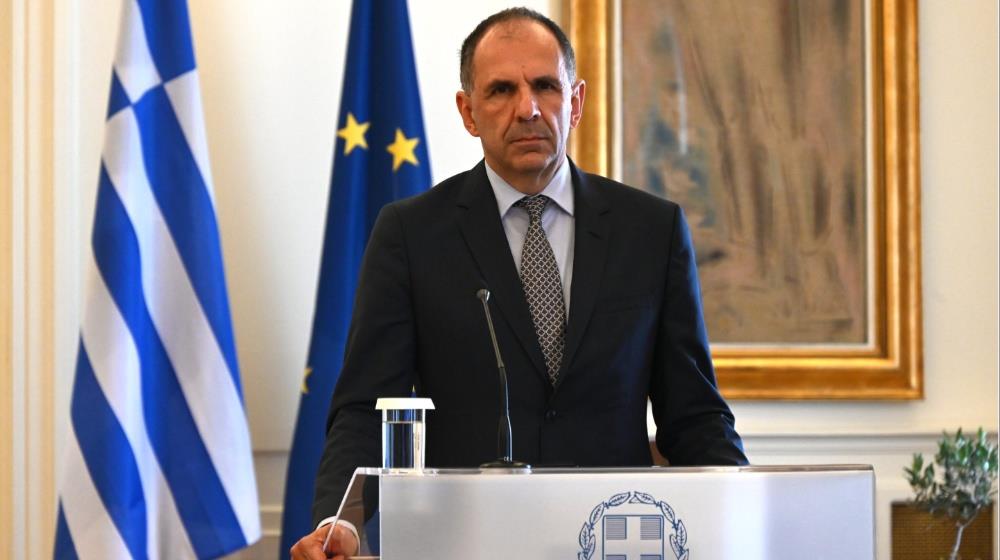
The Greece-Cyprus electricity interconnection is a project of major importance for lifting Cyprus' energy isolation, says Greek Foreign Minister Giorgos Gerapetritis in an interview with Greek newspaper 'Vima tis Kyriakis'. He also assures that Athens and Nicosia will do everything possible for its full and unhindered implementation.
The Foreign Minister also sends a clear message to Turkey that Greece seeks peace and dialogue, but from a position of strength and without any concession to its sovereign rights. At the same time, he rejects criticism of a "soft" policy towards Ankara and emphasises that "Greece has irrevocably passed the point of passive diplomatic inaction."
Gerapetritis points out that the "calm waters" in Greek-Turkish relations are not an end in themselves, but a tool for serving national goals. As he notes, the de-escalation of recent years has allowed Greece to limit crises, strengthen its economy, decisively upgrade its Armed Forces and expand its diplomatic footprint.
He refers in particular to the Rafale, the upgraded F-16s, the Belharra frigates and the expected F-35s, underlining that the country is now in a clearly stronger position in the air and at sea. At the same time, he emphasises that Greece has developed strategic relations with the US, France, Israel, Egypt, India and the Gulf countries.
Regarding the Athens Declaration, it clarifies that it remains active, as it has established a structured dialogue with Turkey and a permanent decompression channel. It underlines, however, that communication does not imply abandoning Greek positions and recalls that each side maintains its legal views intact.
He is particularly strict against recent Turkish moves in the Aegean and the Eastern Mediterranean. He characterises the Turkish marine parks as "illegal" and emphasises that they do not produce legal consequences, as they extend beyond Turkish territorial waters into undefined international waters of the Greek continental shelf.
"Any attempt to violate our sovereign rights is dealt with by every appropriate means," he emphasises, adding that, despite Athens' commitment to the peaceful resolution of disputes, "we are absolutely ready for any scenario."
Regarding the Marine Spatial Planning and the Greek marine parks in the Aegean and Ionian Seas, the Minister of Foreign Affairs notes that these are moves that practically enshrine Greek positions on the basis of International Law. At the same time, he recalls the EEZ delimitation agreements with Italy and Egypt, the expansion of territorial waters in the Ionian Sea and the exploration for hydrocarbons south of Crete.
Regarding the possibility of expanding territorial waters to 12 nautical miles, he is categorical: this is an inalienable right of Greece, which can be exercised unilaterally "at a time and in a manner chosen by the Greek State."
Regarding relations with Israel, he rejects the view that Athens is "overinvesting" in this specific strategic cooperation, emphasising that Greek foreign policy is multi-layered and maintains open channels with both Israel and the Arab world.
In closing, Gerapetritis rejects the criticism that the “calm waters” policy has led to concessions. “Yes, we want peace. But we want it from a position of strength. With self-confidence and without phobic syndromes,” he states, summarizing the government’s strategy towards Turkey.
(Sources: InBusinessNews, Vima tis Kyriakis)
