








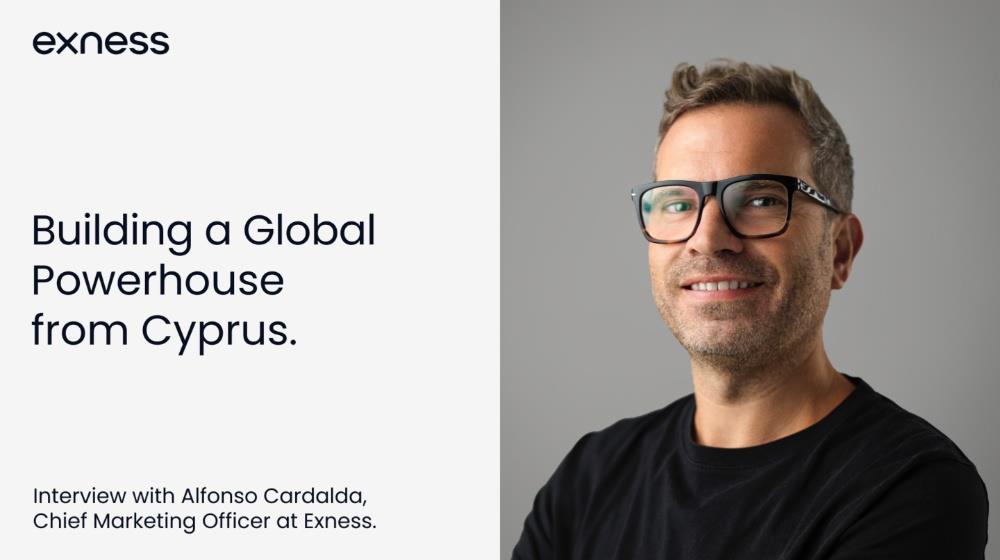
As Cyprus strengthens its position as a regional technology and business hub, the presence of global companies operating from the island is becoming increasingly significant. Yet, local audiences rarely have the opportunity to sit down with executives shaping international brands on such a scale.
Recently, we spoke with Alfonso Cardalda, Chief Marketing Officer at Exness, one of the world’s leading fintech companies, about global growth, technology, talent, and what it takes to build an international powerhouse while staying connected to the local ecosystem.
Since 2022, Alfonso has led the global marketing vision at Exness and played a central role in shaping the company’s identity through its rebrand and globally recognised campaigns. Combining strategy, creativity, and a strong focus on human connection, he continues to help position Exness at the forefront of the evolving fintech industry.
In our conversation, Alfonso shared his thoughts on trust, innovation, the future of global brands, and Cyprus’ growing role in the international technology landscape.
Many companies scale fast, but few remain trusted over time. What separates enduring global brands from the rest?
Understanding that growth and trust are two different things.
Many companies can grow fast, especially in industries driven by technology and innovation. But trust takes much longer to build, because it comes from consistency. It’s built by delivering the same level of quality, transparency, and reliability over time, especially as a company scales.
For us, trust has never been treated as a campaign or a slogan. It exists across the entire experience, from the product itself to the way we communicate, support clients, and make decisions internally. People today are much more informed and selective. They quickly recognise when a brand is driven more by visibility than by real substance.
The brands that endure are the ones that remain clear on who they are, even as markets evolve around them. Technology changes, industries move fast, consumer behaviour shifts, but values like trust, consistency, and relevance remain essential.
We’ve always believed that sustainable growth is built through relationships, not just acquisition. And that mindset shapes everything: how you build products, how you build teams, and how you build a company over the long term.
"The goal should not be growth for growth’s sake, but growth that creates real impact, stronger opportunities, and a higher quality of life for everyone living on the island"
In a world shaped by AI and automation, what will define the strongest brands over the next decade?
Technology will continue to transform how companies operate. But as AI and automation become more accessible, technology alone will stop being a differentiator. Eventually, everyone will have access to similar tools, similar data, and similar capabilities.
The real difference will come from how companies use that technology to understand people better. Data can show what users are doing, but it still doesn’t fully explain why they behave the way they do or what drives trust and confidence. That part requires judgment, empathy, and real understanding.
I believe that the strongest brands over the next decade will be the ones that manage to stay human in an increasingly automated world. They will use technology to improve experiences, simplify complexity, and communicate more clearly without losing authenticity along the way.
Automation can improve efficiency, but people still connect with transparency, consistency, and trust. Those things don’t become less important because technology evolves. If anything, they become even more important.
You often speak about combining global precision with local relevance. How does that translate in practice?
Consistency becomes much harder when you operate globally. It’s relatively easy to build a strong brand in one market. The real challenge is maintaining the same level of trust across different regions, cultures, and audiences.
At the same time, global scale alone is not enough. Every market has its own mentality. If brands become too standardised, they risk feeling distant or disconnected from people locally.
That’s why strong global companies need both structure and flexibility. You need clear standards and a strong global direction, but you also need local teams that understand their audiences and can adapt accordingly.
This is where diversity becomes a major advantage. When you bring together people from different cultures, experiences, and backgrounds, you naturally build organisations that are better equipped to think globally while still remaining relevant locally.
Ultimately, people want brands that understand them, not just brands that market to them. And that becomes even more important as industries become more competitive and automated.
With such a global footprint, what makes Cyprus strategically important for Exness today?
Cyprus is unique. Its geographical location acts as a bridge between Europe, the Middle East, and the wider region, giving the island an international mindset that is extremely valuable for global companies operating across different markets.
With that said, I believe the ecosystem is also evolving rapidly. More international companies are establishing a presence in Cyprus, global talent continues to relocate to the island, and importantly, more local professionals are choosing to stay or return because they can now access international-level opportunities from here.
That mix of local talent and international expertise creates a powerful environment for innovation and growth. It allows companies to build globally connected teams while staying closely linked to the local community and culture.
That’s also one of the reasons we continue investing in initiatives and platforms connected to the local ecosystem. Our ongoing participation in events like the Doers Summit is not only about visibility, it’s about being part of the broader conversation around technology, talent, and the future of Cyprus as an international business hub.
These platforms are an opportunity to engage directly with the community, meet future talent, and contribute to an ecosystem we believe in and continue to grow alongside.
From the beginning, my vision has been to see Cyprus evolve into the “Silicon Valley of the Mediterranean,” a technology hub capable of attracting world-class talent and innovation. That belief played a major role in Exness establishing its headquarters here, and it’s a vision many of us still strongly believe in today.
There is still a lot of work ahead, but the direction is positive. With the right long-term focus, Cyprus can continue strengthening its position as an important technology and business hub for the region.
Cyprus has evolved rapidly over the past few years. What will define whether it becomes a truly global technology hub in the decade ahead?
The foundation is already here. The growth of the technology sector over the past few years has been significant, and the overall mindset around innovation and entrepreneurship has clearly evolved. The conversation today is very different compared to a few years ago.
What I find interesting are the similarities with my home country, Spain. Beyond the obvious Mediterranean lifestyle and climate, there is a similar emphasis on relationships, openness, and human connection. People value community, communication, and quality of life, and I believe those characteristics play a much bigger role in innovation than many realise.
At the same time, both countries have traditionally been viewed through a specific lens internationally, whether tourism, lifestyle, or geography. What is interesting now is seeing Cyprus expand that identity and develop new ambitions around technology, entrepreneurship, and international business. In many ways, that transformation feels familiar to me.
But becoming a truly global technology hub requires consistency and long-term thinking. Talent will remain one of the defining factors, not only attracting international expertise, but also creating opportunities for local professionals to grow and build global careers from Cyprus.
Beyond that, ecosystems today are evaluated much more holistically. Infrastructure, housing, education, mobility, and overall quality of life all influence whether people choose to build their future somewhere long-term.
As Cyprus continues to grow, these areas will become increasingly important, not only for attracting international talent but for ensuring sustainable growth that also benefits local communities and future generations. The goal should not be growth for growth’s sake, but growth that creates real impact, stronger opportunities, and a higher quality of life for everyone living on the island.
That balance will be vital moving forward, because the strongest technology hubs are not simply places where companies operate, but places where people want to build their future.
What gives me optimism is that there is a clear ambition developing around the island. If that ambition continues to be matched with long-term investment and strategic focus, Cyprus has the potential to become an indispensable technology hub for the wider region and beyond.
Looking ahead, what will define the next generation of global companies?
I believe the next generation of global companies will be defined less by size and more by their ability to remain relevant, adaptable, and trusted in a changing world.
Technology will continue to play a major role, but over time, access to technology becomes more equal. What becomes harder to replicate is culture, clarity of purpose, and the ability to build genuine long-term relationships with people, whether that’s clients, employees, or communities.
The strongest companies will be the ones capable of combining global scale with local understanding. Organisations that can operate internationally while still remaining connected to the needs and cultures of the markets they are part of.
Ultimately, today, people are looking for more than products or services. They want transparency, consistency, trust, and a sense that the companies they engage with genuinely understand them. The organisations that manage to combine technological excellence with human connection will be the ones that continue to matter in the years ahead.
