






Labour and Social Insurance Minister Marinos Moushouttas has described pension system reform in Cyprus as the government's most important social priority for 2026.
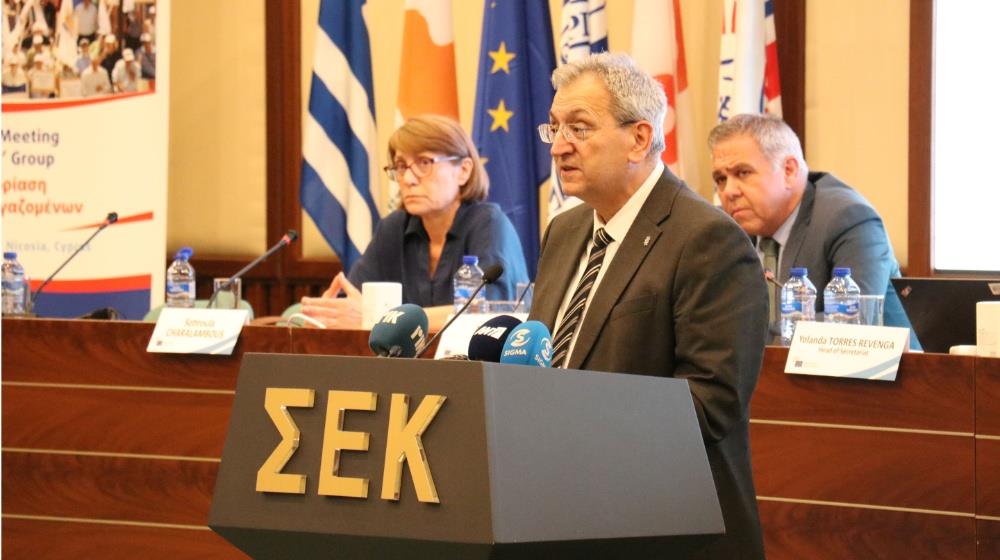
Speaking during a special meeting of the European Economic and Social Committee (EESC) Workers' Group, held on the afternoon of 2 June at trade union SEK building in Nicosia, the Minister said that the pension reform is an issue that concerns almost all of Europe and "is one of the key pillars of the European social model".
Moushouttas referred to an "almost contradictory challenge", explaining that the long-term sustainability of the social insurance system must be safeguarded "so that the system can meet its obligations towards future generations in an environment of demographic ageing and increasing life expectancy". He added that at the same time, pensions must remain adequate and decent.
The Minister also stressed that the balance between sustainability and social adequacy "is non-negotiable for us, as we will not build the sustainability of the system at the expense of those who are the most weak".
He explained that the first pillar of reform, is the Social Security Fund, that focuses on strengthening the adequacy of pensions, particularly minimum pensions, "so that no pension leaves its beneficiary below the threshold of decent living". He also said that it focuses on modernising the investment policy of the fund's reserve through a modern investment programme so that resources are utilised in an efficient and safe manner. He added that in the more medium term, the gradual strengthening of the provident funds, which is the second pillar of the reform, is also being pursued.
"Our overall objective is clear and is about a system that is fairer, more modern, and truly sustainable for future generations," the Minister said, recalling the January 2027 milestone target for the implementation of the reform.
According to the Minister, each side has red lines and there are delicate balances regarding the reform, however he described as positive the fact "that we are all moving in this direction", adding that "whatever obstacles we find with the credibility, the trust that one side has for the other, I am sure we will succeed and this will be beneficial for everyone, the workers and our pensioners, former workers."
In her opening remarks, Lucie Studnicna, President of the European Economic and Social Committee (EESC) Employees' Group, stressed the need for European competitiveness to be based on quality work, adequate wages and strong worker representation.
"Workers must be able to rely on adequate wages and a strong trade union voice in the workplace, especially in an increasingly difficult working environment," she said.
The Workers' Group President argued that the debate at European level is increasingly focused on competitiveness, but warned that the role of labour and the social economy should not be overlooked.
"Leaders have forgotten that what makes our economy strong is work and the social economy," she said.
She also referred to the social challenges facing Europe, noting that around 1 in 5 citizens are at poverty risk, while more than 1 million people are homeless in European countries.
33% of pensioners are below the poverty line
SEK General Secretary, Andreas Matsas, underlined the need to enhance social dialogue, extend collective agreements and promote a pension reform that will address the poverty of the elderly. As he said, the aim is to create conditions for quality and decent employment and to ensure equal participation of workers in economic growth.
"The European Commission itself has recently been promoting contradictory policies, which overturn previous decisions," he noted, referring to "the promotion of 28 regime legislation", noting that there is skepticism about the intentions.
He noted that there is a risk of downgrading workers' rights and weakening the social dimension of the European Union in the name of competitiveness.
At the same time, he stressed the important role that the EESC's Employees' Group plays in defending 'Social Europe', considering that the reactions of workers and several member states could have a positive impact on European policies.
Referring to the reform of the pension system, Matsas stressed that this is a crucial process that must make full use of social dialogue. He noted that about 33% of pensioners in Cyprus are below the poverty line and stressed that the main objective of the reform should be to ensure that no pensioner receives a pension below this line.
Trade union PEO's General Secretary, Sotiroula Charalambous, highlighted the impact of geopolitical developments on workers, while referring to the pension reform and the implementation of the European directive on adequate minimum wages.
As regards the pension reform, she stressed that "our goal is to fight once and for all the issue of low pensions and the poor pensioners."
At the same time, she stressed the need for a fairer tax system and for an enhanced social policy, with a particular focus on addressing the housing crisis.
Charalambous also referred to the growing social and economic inequalities, arguing that the successive crises of recent years have mainly burdened workers.
"The successive crises of the system, the financial crisis, the health crisis, the cost of living crisis, those who have paid the price are the workers and these crises have led to a deepening of economic and social inequalities," she said.
At the same time, she argued that the European social model has been weakened by policies of deregulation and privatisation. "The European social model, which in the past was the basic component for stability and dignity for the peoples of Europe, has been drastically undermined by policies of deregulation, flexibility, cuts, privatisation," she said.
She also referred to an unequal distribution of wealth in Cyprus, noting that "recently a European Union survey has shown that the top 10% of income earners in Cyprus have increased their wealth by 13% and currently hold sixty-seven per cent of the total wealth of our country."
Minimum wage and public procurement
As regards adequate minimum wages, the Labour Minister said that a bill has already been sent for legislative review and once the process is completed, it is expected to be submitted to Parliament in July, so that the discussion in the relevant parliamentary committees can begin in September.
He recalled that as of 1 January 2026 minimum wage in Cyprus amounts to 1,088 euros per month, while for the first six months of employment it is set at 979 euros.
He also said that unemployment stands at 4.3% and is significantly lower than the Eurozone average, which hovers around 6%, adding that the employment rate has already exceeded 81% above the European target for 2030. "This stability is the foundation that allows us to invest in quality of work and social justice," he noted.
Referring to public contracts, Moushouttas said that at a recent high-level meeting under the President of the Republic, trade unions called for wider implementation of collective agreements in more sectors of the economy. He said that the unions have already sent a letter with suggestions and examples to the Ministry of Labour, which will be examined immediately with a view to promoting the necessary regulations.
Dimitris Mavrommatis, Director of the Secretariat of the Cyprus Presidency of the EU Council, speaking on behalf of the Deputy Minister of State for European Affairs Marilena Raouna, highlighted the importance of the contribution of the European Economic and Social Committee (EESC) to the work of the Cyprus Presidency of the Council of the EU, noting that the Committee has made a substantial contribution to the elaboration of thirteen opinions during the Cyprus Presidency.
He said that "the European Economic and Social Committee plays a vital role in the European institutional framework by ensuring that the voices of organized social partners and civil society are heard in the EU decision-making process".
At the same time, he expressed the Cyprus Presidency's appreciation to EESC, stressing that "these opinions have provided important expertise, constructive recommendations and useful insights to our work in a wide range of policy areas".
He also referred to the key achievements of the Cyprus Presidency in the areas of defence, competitiveness, social cohesion, enlargement, housing and employment, underlining the commitment to continue the dialogue with the social partners and civil society until the end of the Presidency.
(Source: CNA)
