








NielsenIQ data shows Cypriot consumers deploy an average of 4.4 savings strategies simultaneously. They switch to private-label groceries. They hunt for promotions. They favour discount stores. Yet clothing remains one of just three categories where saved money gets actively redirected. What makes fashion spending so resistant to austerity — and what does it mean for retailers?
The numbers behind the paradox
At the 23rd Cyprus Grocery Retail Conference in April, NielsenIQ's Agnieszka Jaskiewicz presented data that should give pause to anyone assuming cost-of-living pressures would flatten consumer spending uniformly. The average Cypriot shopper now uses 4.4 distinct savings strategies — choosing lower-cost products, buying on promotion, preferring private labels, sometimes selecting the cheapest option regardless of brand. In supermarkets, this is reshaping the competitive landscape entirely.
But when Jaskiewicz examined where the saved money goes, a pattern emerged that defied the austerity narrative. Three categories consistently absorb the surplus: entertainment outside the home, travel and holidays, and the purchase of clothing. Not electronics. Not home improvement. Clothing.
The CySTAT figures tell the same story from the supply side. In May 2026, clothing and footwear retail turnover volume surged 19.4% year-on-year — nearly three times the overall market growth of 7.5%. For the full year of 2025, the category led all retail segments with a 14.5% volume increase. This is not a blip. It is a structural preference.
Why fashion survives the squeeze
The standard explanation — that clothing is a necessity — does not hold up. People need food more urgently, and they are actively downgrading their food spending. The real drivers are more interesting.
First, visibility. A private-label tin of tomatoes sits in a cupboard. A pair of trainers walks into a room. In a culture where social gatherings, church visits, and weekend coffees are woven into daily life, what you wear carries a social signal that what you eat does not. Research from the University of Cambridge's Department of Psychology has demonstrated that clothing choices affect not just how others perceive us, but how we perceive ourselves — a phenomenon termed "enclothed cognition."
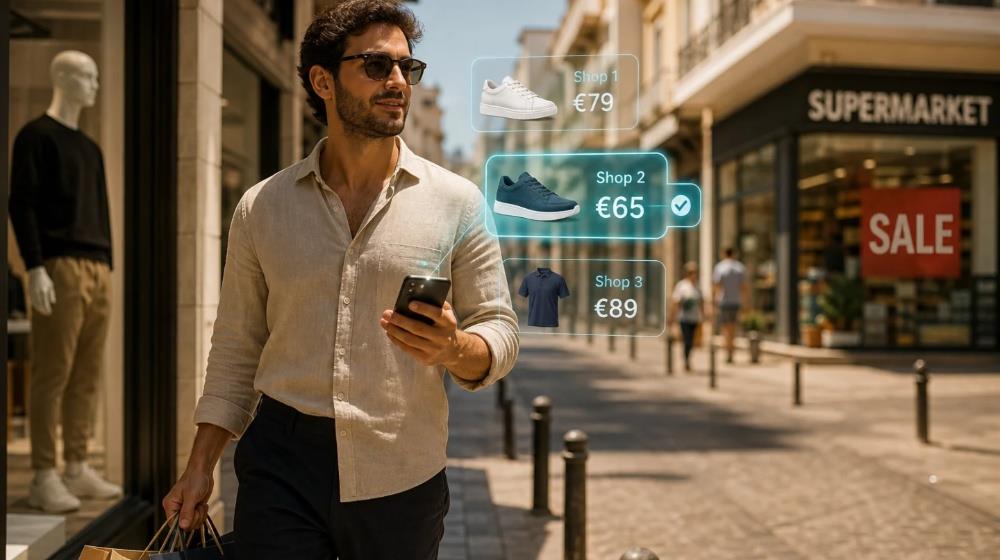
Second, the price architecture of fashion allows for compromise without sacrifice. Consumers do not need to choose between a €500 designer jacket and a €15 fast-fashion t-shirt. The middle ground — quality brands at competitive prices — is where most spending actually lands. The challenge, until recently, was finding it efficiently. Platforms like Stylino are beginning to change this by aggregating European fashion retailers in one place, allowing consumers to compare prices across stores rather than settling for the first result in a search engine.
The Skroutz effect — and its limits
Skroutz's 2025 Cyprus review offers a revealing data point: trainers were the platform's most-purchased category, ahead of mobile phones, perfumes, and supplements. Orders grew 83% year-on-year, reaching roughly half a million. The average order value hit €78.
This confirms that Cypriot consumers are perfectly willing to use comparison tools for fashion — when they exist. The problem is coverage. Skroutz's fashion catalogue is built primarily around Greek marketplace sellers and does not map the broader European retail landscape. A consumer searching for a specific Asics running shoe or a women's dress from a European boutique still faces the old problem: open ten tabs, compare manually, hope for the best.
The EU duty catalyst
The July 2026 introduction of a €3 per-item customs duty on parcels from non-EU countries valued below €150 has added a financial nudge to what was already a behavioural shift. According to the European Commission, the reform targets ultra-low-cost platforms that previously benefited from the de minimis exemption. For a basket of three items from a Chinese marketplace, the additional €9 in duties — plus VAT — can push the total cost increase to 20-30%.
This does not eliminate cross-border shopping. But it tilts the economics. European retailers offering free shipping within the EU, 14-day return rights under EU consumer law, and competitive pricing on mid-range brands suddenly look like the rational choice. The consumer just needs a way to find them — and compare them — without the manual effort that made it impractical before.
What this means for the market
The savings paradox is not a contradiction. It is a reallocation. Cypriot consumers are not spending recklessly on fashion — they are spending deliberately. They downgrade where social cost is low (groceries, household goods) and protect spending where social and psychological returns are high (clothing, entertainment, travel).
For retailers, the implication is clear: competing on price alone is insufficient. The consumer who switches to private-label butter without hesitation will still comparison-shop for a pair of men's shoes across multiple stores before committing. Value perception — the sense that you found the right product at the best available price — matters more than the absolute price tag.
The infrastructure to support this kind of informed fashion spending is only now being assembled in Cyprus. Price comparison arrived in electronics a decade ago. It reached groceries through the government-backed e-kalathi platform. Fashion, with its messy data, inconsistent SKUs, and brand-level complexity, was always the last category standing. That is no longer the case — and the 19.4% growth figure suggests the market was waiting for exactly this kind of shift.
