








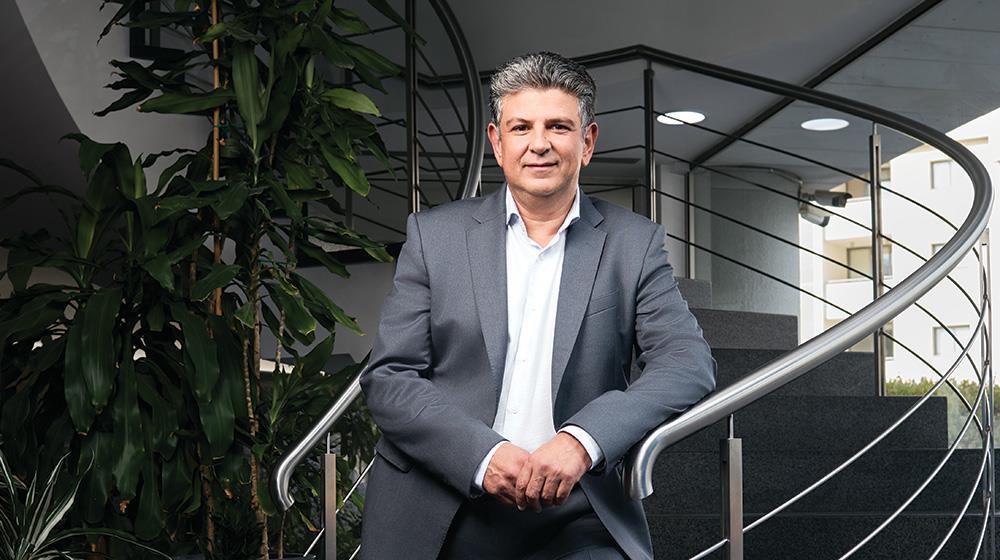
The Cypriot economy has proven that it has the conditions to absorb external shocks, a fact particularly important for a small and open economy like ours, Christos V. Vasiliou, tthe Managing Director of KPMG in Cyprus, says.
In an interview with InBusinessNews, Vasiliou notes that the second half of 2026 is expected to remain equally demanding, but, at the same time it, creates significant prospects for those businesses and economies that adapt quickly to the new conditions.
Among other things, he explains that "businesses now operate in an environment where managing geopolitical risk is just as important a factor as managing their financials" and points out that "if I had to choose just one intervention, it would be the acceleration of structural reforms that enhance competitiveness and facilitate business activity."
How do you assess the course of the Cypriot economy and your sector during the first half of 2026? What developments stood out positively or negatively and to what extent were the predictions you made at the beginning of the year confirmed or overturned?
The first half of 2026 confirmed that the Cypriot economy continues to demonstrate remarkable resilience, despite operating in a particularly complex and volatile international environment. The main pillars of the economy, such as professional services, shipping, investment and the technology sector, continued to support the country's growth path, while the labour market maintained a positive picture. However, the international situation significantly impacted the business climate, and more specifically tourism, as uncertainty remained at particularly high levels.
Geopolitical tensions in the Middle East, fluctuations in energy prices, continued pressure on production costs, and the effects of restrictive monetary policy in recent years have created a challenging business environment. Although inflation has moved lower than in previous years, it continues to affect the purchasing power of households and the operation of businesses, while the cost of borrowing remains a significant deterrent to new investments.
In general, the forecasts made at the beginning of the year were confirmed. We had estimated that 2026 would be characterised by moderate growth, but also by increased uncertainty due to international developments. What perhaps exceeded initial estimates was the intensity of geopolitical upheavals and the speed with which they were transferred to international markets, affecting energy, trade, transport and investment decisions. Nevertheless, the Cypriot economy has proven that it has the conditions to absorb external shocks, a fact particularly important for a small and open economy like ours.
What are your expectations and priorities for the second half of 2026? Where do you see growth opportunities, and also what challenges do you believe will determine the course of the market by the end of the year?
The second half of 2026 is expected to remain equally challenging, but at the same time it creates significant prospects for those businesses and economies that adapt quickly to the new conditions. The main priority should be to strengthen competitiveness, increase productivity and create an even more attractive investment environment.
Cyprus has significant comparative advantages that can be further exploited. Its strategic geographical location, membership in the European Union, developed professional services ecosystem, dynamic investment fund sector, shipping and the continuous development of the technology sector create significant opportunities for attracting foreign investment and developing new business activities. At the same time, the need for many international companies to diversify their supply chains and investment bases creates new opportunities for countries that offer stability and reliability.
On the other hand, challenges remain significant. Geopolitical uncertainty is unlikely to disappear by the end of the year, while developments in energy markets continue to affect inflation and business operating costs. In addition, the high financing burden continues to affect investment decisions, especially for small and medium-sized enterprises. In this environment, adaptability, the use of technology, innovation and proper risk management will be key factors for success.
To what extent have geopolitical developments, and in particular the crisis in the Middle East, affected the economy in general and your industry in particular? Have they created more risks, upheavals or even new opportunities?
Geopolitical developments are perhaps the most important external factor shaping the global economic outlook today. The Middle East crisis has demonstrated once again that the international economy is highly interconnected and that a regional conflict can have direct effects on energy markets, transport, international trade, supply chains and investment decisions.
The greatest pressures are recorded mainly through the increase in uncertainty and volatility in international markets. Businesses now operate in an environment where managing geopolitical risk is as important a factor as managing their financial figures. Rising energy costs, transport delays, fluctuations in raw material prices and investor caution affect the entire economic activity.
At the same time, however, periods of reshuffling also create new opportunities. Cyprus can further strengthen its role as a regional business, shipping and financial centre. In an environment where many businesses are looking for secure and stable bases for their activities, our country can attract new capital, companies and investments, leveraging its geographical location, institutional stability and its status as a member state of the European Union.
The challenge is to turn geopolitical uncertainty into a strategic advantage, by investing in stability, quality of services, technology and the international credibility of the Cypriot economy.
The professional services sector remains on a steady path despite the fact that there has been a slight relative slowdown in foreign direct investment recently. As a Firm, we are on an upward trajectory despite the challenges, helping our clients to address these challenges.
At the same time, we capitalise on the opportunities presented in the market by making significant use of technology and the high level of training of our executives. Also at the same time, we draw significant experience from the international network of KPMG International in sectors that are at an early stage in our country, with the aim of further developing them for the benefit of our clients.
If you could point to one intervention from the state or market that would strengthen the resilience of the economy in the second half of the year, what would it be?
If I had to choose just one intervention, it would be to accelerate structural reforms that enhance competitiveness and facilitate business activity. In a period where international developments cannot be controlled, improving the domestic business environment is the most important factor in strengthening the resilience of the economy.
Further digitalization of public services, simplification of licensing procedures and reduction of bureaucracy can substantially enhance the attractiveness of Cyprus as an investment destination. At the same time, facilitating access to financing for small and medium-sized enterprises is of particular importance, as well as strengthening investments in innovation, new technologies and human resource development.
Today's international reality shows that the economies that adapt fastest to change are the ones that ultimately emerge stronger from each crisis. Cyprus has all the necessary characteristics to capitalise on the new conditions, as long as it continues to invest in institutional stability, extroversion and the creation of a modern and competitive business ecosystem.
(Source: InBusinessNews)
