








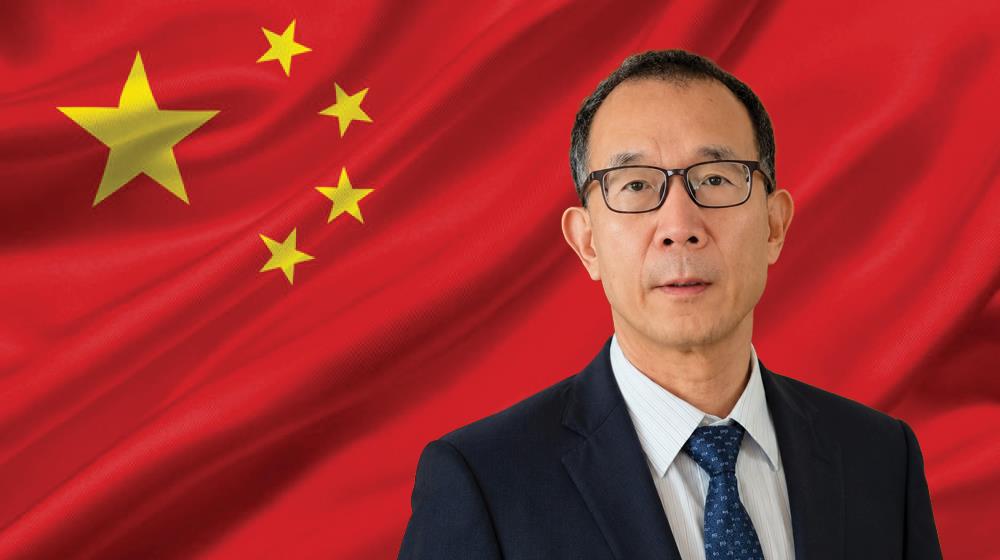
“The Chinese market is large, but competition is also very intense. Regional differences, consumer preferences, channel structures and compliance requirements all need careful study. Entering the Chinese market cannot rely on just one exhibition or one promotional event. It requires long-term planning, stable partners and clear positioning,” suggests Liu Kai, Economic and Commercial Counsellor of the Embassy of the People’s Republic of China in Cyprus.
In an interview with CBN, Liu Kai discusses both the economic ties and the growing people-to-people connections between Cyprus and China. He outlines key opportunities for Cyprus-based businesses seeking market entry to China, as well as areas where bilateral cooperation could deepen in the years ahead.
Cyprus and China have long collaborated in established industries like shipping, tourism, and renewables. How has trade volume between China and Cyprus evolved over the past five years? What key sectors show the strongest growth ahead of the 55th anniversary of bilateral relations?
Over the past 55 years since the establishment of diplomatic relations between China and Cyprus, economic and trade cooperation between our two countries has maintained a steady, practical and mutually beneficial momentum. In particular, over the past five years, against the backdrop of a complex and evolving international situation and deep adjustments in global supply chains, China-Cyprus trade has not stagnated. On the contrary, it has demonstrated strong resilience and growth potential. According to China Customs statistics, bilateral trade between China and Cyprus reached USD 1.44 billion in 2025, a historic high. China has become Cyprus' fourth largest trading partner and third largest source of imports. This is not an easy achievement for two countries that differ significantly in size and are geographically far apart. It shows that our economic structures are highly complementary and that China-Cyprus cooperation enjoys a solid market foundation.
Structurally, China-Cyprus trade relations are no longer confined to traditional trade in goods. They are gradually expanding towards a more balanced pattern covering trade in goods, trade in services, investment cooperation and industrial coordination. Cyprus is a small and open economy with distinctive strengths in shipping, tourism, finance, professional services, education and health. China has a complete industrial system, a super-sized market and continuously upgrading manufacturing capabilities. In recent years, China has also vigorously developed its services sector, with the tertiary industry accounting for 57.7 percent of GDP in 2025.
Looking ahead, three areas show particularly strong growth potential. The first is shipping and the maritime economy. Cyprus is an important global shipping management centre, while China is the world's largest trade in goods and a major shipbuilding country. The two sides have natural space for cooperation in shipbuilding, ship management, port logistics, green shipping and maritime services. The second is green transition and clean energy. Cyprus is rich in solar resources and is accelerating the adjustment of its energy structure. China has developed strong industrial capabilities in photovoltaics, energy storage, electric vehicles and green infrastructure. The two sides can further expand cooperation in project investment, equipment supply, standards alignment and green finance. The third is the digital economy and innovation cooperation. In recent years, Chinese enterprises have participated in the construction of Cyprus' telecommunications infrastructure and made positive contributions to the improvement of local digital development. As Cyprus advances digital government, smart cities and its innovation ecosystem, China and Cyprus still have considerable potential in digital infrastructure, artificial intelligence applications, cross-border e-commerce and exchanges of scientific and technological talent.
More importantly, this year marks not only the 55th anniversary of diplomatic relations between China and Cyprus, but also the fifth anniversary of the establishment of the China-Cyprus strategic partnership. The two sides can take this opportunity to translate the political mutual trust, people-to-people friendship and economic and trade foundation accumulated over the years into more visible, tangible and sustainable cooperation outcomes. China stands ready to work with Cyprus to make good use of mechanisms such as the China-Cyprus Joint Economic and Trade Committee, further expand the scale of trade, optimise the trade structure, deepen shipping cooperation, and explore cooperation potential in emerging areas such as clean energy, the digital economy and trade in services.
As China continues to advance high-level opening-up, how is it working to further improve the business environment? How will various trade and investment platforms contribute to promoting cooperation? In which areas do China-EU and China-Cyprus have the greatest potential for deeper collaboration in the future?
China's promotion of high-level opening-up is not a temporary policy, but a long-term strategic choice. In recent years, in the face of headwinds against economic globalisation, China has always adhered to development with its door open, and has regarded the improvement of the business environment as an important part of institutional opening-up. China has continued to ease foreign investment access. The negative list for foreign investment access has been reduced from 93 items in 2017 to 29 items in 2024, and China will continue to expand opening-up in the services sector in an orderly manner. China protects, in accordance with law, the equal participation of foreign-invested enterprises in government procurement, bidding and tendering, and standards formulation, and works to ensure that foreign-invested enterprises enjoy a stable, transparent and predictable development environment in the Chinese market. There is no such thing as the best business environment; there is always room for improvement. China welcomes enterprises from all countries, including Cyprus, to share the opportunities of China's super-sized market.
China has also turned its opening-up policies into practical cooperation channels that enterprises can see and use through a series of national-level trade and investment platforms. The China International Import Expo is the world's first national-level exhibition dedicated to imports. Since its launch in 2018, it has become an important window for enterprises from various countries to enter the Chinese market. Cyprus has participated in the CIIE consecutively, and distinctive Cypriot products such as juices, wine and halloumi have attracted the attention of Chinese consumers. Platforms such as the Canton Fair, the China International Fair for Investment and Trade, the China International Fair for Trade in Services, the China International Consumer Products Expo and the China International Supply Chain Expo provide institutionalised channels for enterprises from various countries to connect with the Chinese market from different angles, including trade in goods, investment promotion, trade in services, consumption upgrading and supply chain cooperation. We hope to see more Cypriot enterprises, brands and service institutions appear on these platforms, not only to enter the Chinese market, but also to connect with broader global resources through Chinese platforms.
The essence of China-EU economic and trade cooperation lies in complementary strengths and mutual benefit. Europe has deep accumulation in rules, research and development, branding, green governance and high-end services, while China has advantages in industrial systems, market scale, engineering capacity, green manufacturing and digital applications. The two sides share broad common interests in addressing climate change, advancing low-carbon transition and maintaining the stability of global supply chains. China-Cyprus cooperation is more characterised by being small but refined, specialised and practical. Shipping and the maritime economy, clean energy and energy storage, the digital economy and smart cities, education and professional services, agri-food products and the health industry can all become priorities for the next stage of cooperation.
At the same time, I would like to emphasise that although the current international economic environment is complex and volatile, with rising protectionism and geopolitical risks, the fundamentals of China's long-term economic growth remain unchanged. China remains an important stabiliser and engine of global growth. During the 14th Five-Year Plan period, from 2021 to 2025, China's GDP successively crossed the thresholds of RMB 110 trillion, RMB 120 trillion, RMB 130 trillion and RMB 140 trillion, with an average annual growth rate of 5.4 percent, significantly higher than the global average. China has maintained the world's largest manufacturing sector for 16 consecutive years, and has achieved a series of breakthroughs in the digital economy, artificial intelligence, new energy and high-end manufacturing. Annual production of new energy vehicles exceeded 16 million units, the added value of core digital economy industries rose to over 10.5 percent of GDP, and the green and low-carbon transition continued to advance. Looking ahead to the 15th Five-Year Plan period, from 2026 to 2030, China will continue to pursue high-quality development, scientific and technological innovation, green transition and high-level opening-up. It will accelerate the building of a modern industrial system and further leverage the advantages of its super-sized market. We believe that the Chinese economy will not only continue to achieve long-term and stable development, but will also bring more market opportunities, innovation opportunities and cooperation opportunities to global partners, including Cyprus and Europe.
China's goods trade surplus has attracted wide attention in recent years. How can this phenomenon be interpreted from the perspective of global division of labour and value chain distribution? In the context of rising global uncertainties, what impact have these factors had on global trade patterns?
It is understandable that China's goods trade surplus has attracted attention. However, in discussing this issue, one should not look only at the figures, but also at the global industrial division of labour, value chain distribution and multinational corporate production networks behind those figures. Today's international trade is no longer a simple model in which one country produces and another consumes. A large number of products go through research and development, design, key components, assembly and manufacturing, logistics and distribution, branding and sales across multiple countries and regions. In many products, China undertakes large-scale manufacturing, assembly and supply chain supporting functions, while core technologies, key components, brand profits and investment returns are often distributed across different economies. Trade statistics record the entire product as China's export, but the actual value added and profits are distributed globally. Therefore, China's surplus largely reflects the structure of global value chains, rather than a situation in which one single country obtains all the benefits.
The global layout of multinational companies is also an important perspective for understanding China's trade surplus. China is an important node in the global manufacturing network, and foreign-invested enterprises have long been deeply involved in China's export system. In 2025, around 27 percent of China's exports were contributed by foreign-invested enterprises, and their share was even higher in processing trade exports. Many multinational companies manufacture in China and export to the global market. The relevant trade value is recorded in China's export data, but profits, intellectual property revenues and capital returns usually flow back to the home countries or other investment-source locations according to corporate ownership and headquarters structures. This has created a pattern in which the accounting surplus is recorded in China, while the value returns are distributed globally.
It should also be noted that China is not a one-way surplus economy. China has long imported large quantities of energy, agricultural products, integrated circuits, high-end equipment and key raw materials, and has also long recorded deficits in services trade and investment income. In 2025, China's goods imports reached RMB 18.5 trillion, while the deficit in services trade offset a considerable part of the goods trade surplus. In other words, if goods, services and investment income are considered together, China's external economic relations are complex, two-way and structural. They cannot be simply summarised by the goods trade surplus alone.
Against the backdrop of rising global uncertainty, the significance of China's manufacturing system to the global trade landscape has become even more prominent. Geopolitical conflicts, energy price fluctuations, inflationary pressures, shipping disruptions and rising protectionism are all increasing global supply chain costs. Under such circumstances, China's stable, efficient and complete industrial system provides the global market with a large volume of reliable and reasonably priced industrial products, consumer goods and green products. This helps ease inflationary pressures in some economies and maintain the resilience of global supply chains. Particularly in areas such as new energy equipment, consumer electronics, machinery and equipment, and daily consumer goods, Chinese enterprises have reduced costs through scaled production and technological progress, enabling more countries and consumers to obtain high-quality products at lower prices.
Of course, structural issues should be addressed through openness and cooperation, not protectionism. A trade surplus itself does not determine the direction of the global economy. What matters is whether all parties can respect comparative advantages and market rules, and address imbalances by expanding market access, improving the investment environment, deepening industrial cooperation and safeguarding the multilateral trading system. China will continue to expand imports and advance high-level opening-up. It also stands ready to strengthen cooperation with European partners, including Cyprus, in trade, services, investment and industrial chains, and jointly promote a more balanced, stable and sustainable global trading system.
How is the embassy fostering people-to-people exchanges, such as business forums or student programmes, to mark the anniversary and deepen economic ties?
Friendly exchanges between the peoples of our two countries are an important part of the China-Cyprus strategic partnership, and also the social foundation for the long-term and stable development of bilateral economic and trade cooperation. The Chinese Embassy in Cyprus has always actively promoted exchanges in education, youth, culture, as well as between local authorities and the business community, with the aim of ensuring that China-Cyprus cooperation is reflected not only in trade figures and investment projects, but also in the deeper understanding, trust and links between people.
In education and youth exchanges, the Embassy has continuously supported cooperation between universities of the two countries. Joint training programmes, summer and winter camps and short-term exchange programmes between institutions such as University of Cyprus, Cyprus University of Technology, European University Cyprus and Chinese universities have continued to expand in recent years. The two Confucius Institutes at the University of Cyprus and the Cyprus University of Technology have also attracted more and more Cypriot people, especially the youth to learn Chinese and understand Chinese culture. This year, the Embassy will also focus on promoting the Young Envoys Scholarship programme, creating more opportunities for Cypriot students to visit China for short-term study, exchanges and visits.
In human resources cooperation and exchanges on local governance, cooperation between the two sides is also deepening. In 2025, the Embassy worked with relevant Chinese departments to organise, for the first time, a bilateral training programme for Cyprus, namely the China-Cyprus Seminar on Modern Urban Construction and Management. A total of 27 senior local government officials from five districts and 20 municipalities of Cyprus visited China, including several mayors and local government leaders. This was also the first bilateral human resources cooperation project between China and Cyprus. The seminar focused on modern urban construction, green transition, smart cities and local governance. Participants undertook thematic study and field visits in Beijing and Guangzhou, and had in-depth exchanges with Chinese local governments, enterprises and research institutions. Mr Andreas Vyras, President of the Union of Cyprus Municipalities and Mayor of Larnaca, spoke highly of the outcomes of the programme, noting that China's experience in urban governance, infrastructure development and green development offers important reference value. Such exchanges not only help deepen mutual understanding, but also build more consensus and a stronger talent base for future cooperation in local development, industry and green transition. In addition, China has long relied on human resources cooperation mechanisms under the frameworks of Belt and Road cooperation and South-South cooperation to provide multilateral training programmes for many emerging economies and developing countries, including Cyprus. These programmes cover fields such as the digital economy, green development, port logistics, e-commerce, public administration and climate change. In recent years, a number of Cypriot government officials, professionals and youth representatives have visited China to participate in relevant training and exchange programmes. These institutionalised training mechanisms have not only enhanced professional exchanges between the two sides, but also helped cultivate more talent resources with a better understanding of each other's development concepts and market environment.
In cultural and people-to-people exchanges, both China and Cyprus are countries with long histories and profound cultural heritage. The affinity between our civilisations and cultures is a distinctive strength of bilateral relations. This year, the Embassy plans to continue working with the Cypriot side to organise activities such as a Chinese Film Week and a China-Cyprus literature seminar, so as to further enhance mutual understanding through film, literature, art and academic exchanges. In recent years, activities such as the China-Cyprus Youth Forum and the China-Cyprus-Europe Media Forum have also been warmly received, creating more channels of communication for different sectors of society in both countries.
In business exchanges, the Embassy has in recent years continued to promote more institutionalised and regular channels of communication between chambers of commerce, local governments and enterprises of the two countries. Last year, around the visit to Cyprus by a high-level Chinese delegation, the Embassy coordinated with institutions such as the Cyprus Chamber of Commerce and Industry to organise a major business matchmaking event. More than 50 Chinese enterprise representatives from sectors including energy, trade, healthcare, education and services held in-depth exchanges with the Cypriot business community, producing positive responses. Earlier this year, the Embassy witnessed the Hong Kong Economic and Trade Office in Brussels of the Hong Kong Special Administrative Region of China making a dedicated visit to Cyprus to hold a business and trade promotion seminar. Together with institutions such as the Limassol Chamber of Commerce and Industry, the event explored Hong Kong's role as an international financial, shipping and professional services centre, and as a bridge connecting the Chinese Mainland with the European market. We are pleased to see that business links between China and Cyprus, and between China and Europe, are becoming more active, more diversified and more practical.
Going forward, the Embassy will continue to support deeper exchanges and cooperation between chambers of commerce, universities, local governments and enterprises of the two countries. We will encourage more Cypriot enterprises to participate in important Chinese economic and trade platforms such as the CIIE, the Canton Fair, CIFIT and CIFTIS, and we also welcome more Chinese enterprises to visit Cyprus for business exploration, investment and cooperation. We hope that through business forums, enterprise matchmaking, youth exchanges and professional training, more cooperation can be transformed from one-off activities into long-term, stable and sustainable cooperation networks, injecting more vitality into the future development of China-Cyprus relations.
What advice would you give Cypriot companies seeking to enter the Chinese market and vice versa? Which Chinese companies currently have a significant presence on the island? Are there any companies which are currently considering Cyprus as a base?
For Cypriot enterprises seeking to enter the Chinese market, I have three suggestions. First, they should have confidence in the Chinese market. China is the world's second largest economy and the second largest import market, with a population of more than 1.4 billion and a continuously expanding middle-income group. Chinese consumers are increasingly receptive to high-quality products and services with distinctive features and cultural value. Cyprus has its own characteristics in areas such as agri-food products, wine, halloumi, health services, tourism, education and professional services. Second, they should choose the right platforms. The CIIE is an important window for Cypriot enterprises to showcase distinctive products and connect with Chinese buyers and consumers. Platforms such as CIFIT and CIFTIS are also suitable for Cypriot service providers and investment institutions to look for partners. Third, they should conduct long-term market research. The Chinese market is large, but competition is also very intense. Regional differences, consumer preferences, channel structures and compliance requirements all need careful study. Entering the Chinese market cannot rely on just one exhibition or one promotional event. It requires long-term planning, stable partners and clear positioning.
At present, Chinese enterprises in Cyprus are mainly involved in energy, telecommunications, digital gaming, construction and real estate, trade and consumer goods, and are located in major cities such as Nicosia, Limassol and Paphos. Many Chinese enterprises also enter the Cypriot market through agents, distributors or direct sales. Chinese goods, ranging from daily consumer products to electric vehicles, telecommunications equipment and green energy products, are increasingly entering Cypriot households and business settings. As to whether companies are considering Cyprus as a base, we note that as Cyprus' geographical advantages, EU membership, professional services system and business environment attract more attention, more and more Chinese enterprises are indeed including Cyprus in their assessment of European and regional layouts. For specific projects that are still at the stage of commercial evaluation, it would not be appropriate for us to speak publicly on behalf of enterprises. However, China supports enterprises of both countries in carrying out more investment cooperation on the basis of law, compliance and market principles.
Which aspect of future Cyprus-China economic and trade ties excites you most?
If I had to choose the one aspect that I find most promising, I would say that China-Cyprus cooperation is moving from a traditional trade relationship towards a more comprehensive, modern and future-oriented partnership.
In the past, when people spoke about China-Cyprus economic and trade relations, they often thought first of goods trade, shipping, tourism and traditional investment. These remain important, and they remain the foundation. But what is truly promising for the future is that the two sides can integrate their respective strengths more deeply. Cyprus has a unique geographical location, mature services, a long shipping tradition, connectivity with the EU market and the characteristics of an open economy. China has a complete industrial system, a super-sized market, green manufacturing capabilities, digital technology application capacity and long-term development planning. The two sides are complementary, not competitors. The value of China-Cyprus cooperation lies precisely in combining China's industrial and market strengths with Cyprus' location, services and professional expertise.
At the same time, China has also noted that some current EU legislative moves under the banner of "economic security" are creating new uncertainties for future China-EU and China-Cyprus cooperation. For example, the EU's draft amendment to the Cybersecurity Act and the Industrial Accelerator Act have both raised serious concerns on the Chinese side. These legislative proposals set clearly exclusionary restrictions in areas such as network equipment, new energy, batteries, photovoltaics and critical raw materials, and attempt to politicise and over-securitise normal market competition through concepts such as "high-risk suppliers" and "EU-origin" requirements. China believes that such practices are not only suspected of violating basic WTO principles such as most-favoured-nation treatment and national treatment, but will also weaken the openness of the European market and its fair competition environment, increase compliance and investment costs for enterprises, and affect the stability of global industrial and supply chains.
In fact, the economic impact of these policies has already attracted wide attention from the Chinese business community. According to research commissioned by the China Chamber of Commerce to the EU and conducted by KPMG, if the EU were to exclude specific Chinese suppliers on a large scale in the field of telecommunications and digital infrastructure, the cost of network equipment replacement and system adjustment alone could bring an additional burden of more than EUR 360 billion to EU Member States. For Cyprus in particular, as a small, open economy with no domestic telecommunications equipment manufacturers and with a high degree of reliance on international supply chains for digitalisation, the potential economic loss is estimated at around EUR 300 million, close to 1 percent of GDP. This would not only mean a significant increase in the costs of network construction and operation in Cyprus, but could also slow down the upgrading of 5G, smart cities, digital government and other areas, with costs ultimately passed on to enterprises and consumers.
More importantly, Europe is currently advancing its green and digital transitions, while China has complete industrial chains and scale advantages in areas such as new energy equipment, energy storage, electric vehicles and digital infrastructure. If institutional barriers are artificially created, they may restrict the entry of some enterprises in the short term, but in the long term they will push up Europe's own green transition costs, reduce industrial efficiency, and weaken the ability of European enterprises and consumers to access high-quality and cost-effective products and technologies. In my view, the underlying character of Cyprus' economic and social development is its high dependence on open markets, international investment and the digital economy. Therefore, it is particularly important to maintain an open, diversified, neutral and non-discriminatory market environment. China has always believed that cooperation and dialogue are the right way to address China-EU economic and trade issues. China is ready to continue strengthening communication with the EU, including Cyprus, properly manage differences on the basis of mutual respect for market rules and international rules, and jointly maintain the stability and smooth functioning of global industrial and supply chains.
Finally, I would like to say that China-Cyprus relations have a very important feature: although the two countries differ in size, system and culture, both have been able, over thousands of years of long history, to treat each other with mutual respect, equality and practical cooperation. This is in itself a valuable experience and model in international relations. Standing at the new starting point of the 55th anniversary of diplomatic relations, what I most hope to see is not only continued growth in trade figures, but also the formation of more sustainable, replicable and accumulative cooperation outcomes between China and Cyprus, so that the peoples of both countries can truly benefit from this friendship.
