








Airlines are facing a severe financial dilemma as the sharp increase in fuel prices due to developments in the Middle East significantly burdens their operating costs. As with other energy products, jet fuel, the fuel used in aircraft and one of the largest expenses in the industry, has recorded a strong increase, creating suffocating pressures on air transport.
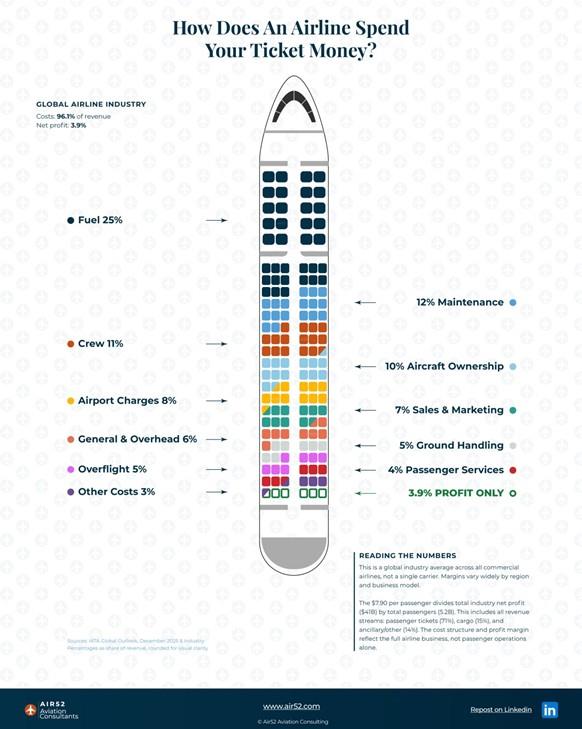
The importance of fuel costs is understood if we examine the distribution of individual costs in relation to the revenues of an airline. Fuel corresponds to approximately 25% of the value of the ticket, constituting the largest single category of costs for the operation of a route and for airlines in general. This is followed by costs such as aircraft maintenance (12%), crew costs (11%), the cost of owning or leasing aircraft (10%), airport fees (8%) and other expenses amounting to approximately 30%. At the same time, profit margins remain extremely limited. On average, only about 4% of the value of a ticket ends up as net profit. It is worth noting that the cost of fuel, following recent geopolitical developments, has more than doubled, reaching approximately $209 per barrel, from the $88 it previously cost.
The above analysis demonstrates that even small increases in fuel costs can wipe out profitability, making airlines particularly vulnerable to international geopolitical and energy developments.
Faced with this reality, airlines are faced with a difficult choice between two strategies: either passing on some of the increased costs to passengers through higher fares and fuel surcharges, or absorbing the increases, directly hitting their bottom lines. Both options carry serious risks, especially at a time when consumer demand remains fragile and highly price-sensitive.
Airlines around the world have already implemented fuel surcharges, route cuts or capacity reductions, affecting flight frequency and overall connectivity, limiting passenger choices.
The outcome of geopolitical developments remains a key factor in the evolution of the global travel market, with the de-escalation of tensions being a key prerequisite for the stabilisation of markets. Only through such a development will the air transport sector be able to gradually return to a more normal pace.
This article first appeared, in Greek, in Hermes Airports' online newsletter, Flight Mode. Click here to view it.
