






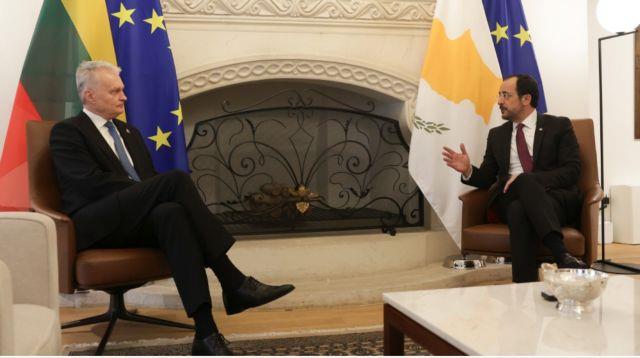
Common will to strengthen bilateral relations between Cyprus and Lithuania, as well as to further strengthen cooperation within the EU, has been expressed by President of the Republic, Nikos Christodoulides, and the President of Lithuania, Gitanas Nausėda, who is paying a visit to Cyprus.
Welcoming Nausėda, President Christodoulides noted that this was the first visit of a Lithuanian President to Cyprus since 2001, while referring to his own visit to Lithuania 10 months ago. “This is, I think, a clear indication of our political will to advance our bilateral relations, our coordination within the European Union,” he said.
He also noted that the two countries were geographically distant but have a lot in common, “that can be the base for enhanced cooperation”.
Nausėda said they had many issues to discuss, “vital bilateral questions and topics”, as well as issues on the “tense geopolitical situations”, noting the war in Ukraine, and “the war against Iran”.
“I think we should be flexible, we should be creative, we should be committed to find a solution which would lead to peace and a peaceful resolution of the conflicts,” he said, noting that this could be achieved through cooperation.
He added that his country, which will assume the EU Presidency in the first half of 2027, will learn from Cyprus’ EU Presidency, “will take all the best examples, and we will try to implement those priorities which are important for my country, although many of them are the priorities for Europe, of course.”
Following their meeting, expanded talks were held with the participation of the delegations of the two countries.
President Christodoulides referred to the “clear political will” of both to enhance cooperation, and bilateral relations, but also coordination within the European Union.
He also said that both countries joined the EU in 2004 and that for Cyprus, “it was the most important development” since its independence in 1960. He also said that geography “is the most decisive factor in our history”.
Nausėda praised Cyprus’ successful path in the EU and the Eurozone, noting that his country's economy was also “doing well” and that now Lithuania’s growth “is quite similar to your growth, maybe slightly lower, about 3-3.5% of the GDP”.
Referring to the two countries’ geopolitical location, he said that “we have complicated neighbours”.
He also expressed the position that “it's very important to keep a high level of coordination with our American friends. We cannot go separate ways,” he added, noting that, if this happens, “we achieve less”.
The Lithuanian President also said it was necessary to find solutions regarding the Strait of Hormuz because, he noted, it creates a lot of tension in the energy market.
(Source: CNA)